
Before buying generator fuel, find out whether your property has an allowed storage location and quantity. Ask the local fire authority, then check the property rules and the exact generator and container instructions. Gasoline and other fuels can create fire, flashback, poisoning, vapor, spill, and child-access hazards before the generator ever starts.
There is no universal household fuel quantity or shelf-life rule. Limits vary by fuel, container, property type, local fire code, lease, insurer, climate, and manufacturer. Start with those constraints, then calculate whether a generator remains practical.
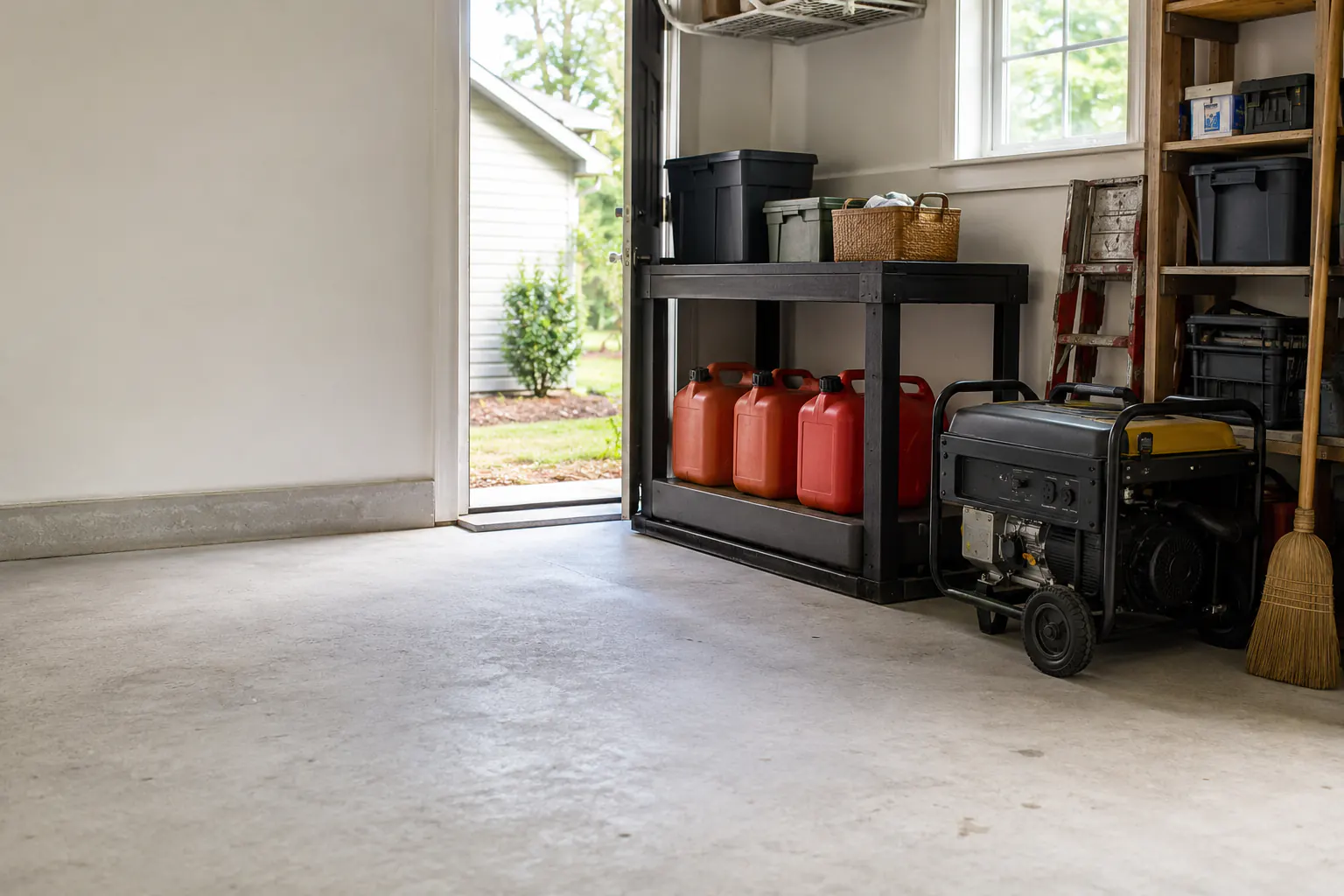
Confirm that fuel storage is allowed at the property
Contact the local fire authority or fire-prevention office and review current code. Ask specifically about:
- fuel type and maximum quantity at a residence;
- attached versus detached garage or accessory-building rules;
- multifamily, condominium, balcony, basement, and common-area restrictions;
- approved container standards and individual capacity;
- separation from ignition, heat, openings, and living areas;
- ventilation, spill containment, cabinet, and signage requirements;
- propane-cylinder or other pressurized-container rules;
- disposal of old fuel and contaminated absorbent material.
Also check the lease, homeowners association, insurer, and generator manual. The most restrictive applicable requirement controls. If the property has no compliant storage and operating locations, a fuel-burning generator is not an appropriate household backup even if the electrical capacity is attractive.
In an apartment, shared openings, fuel-storage restrictions and exit routes may rule out a generator. Do not assume that a balcony, garage, hallway or storage closet provides a permitted fuel plan. If the property cannot meet the requirements, use the apartment battery guide to consider another approach.
Use only the correct approved container
The CPSC defines portable fuel containers as consumer products intended for specified flammable liquid fuels and notes federal flame-mitigation and child-resistance requirements. Purchase a container intended and labeled for the exact fuel from a reputable source. Check recalls and warnings.
Do not use water jugs, beverage bottles, glass containers, food containers, plastic bags, buckets, or an unlabeled substitute. Never mix fuel types or transfer old labels to a different container.
Keep the original cap, spout, flame-mitigation device, child-resistant closure, venting design, and labels intact. Do not drill, modify, defeat, or repair a container in a way the manufacturer does not authorize. Replace a damaged, swollen, leaking, badly corroded, missing-part, or recalled container through the approved path.
Label the purchase or fill date without covering safety information. Keep an inventory that identifies fuel type, quantity, container, location, and planned rotation date. Prevent access by children while preserving adult emergency access.
Choose the storage location by hazard, not convenience
CPSC advises storing portable fuel containers in cool, well-ventilated areas and never inside a house or basement or near ignition sources. Follow the local fire authority for the exact permitted location.
Keep fuel away from:
- living and sleeping areas;
- pilot lights, flames, heaters, stoves, furnaces, water heaters, and smoking;
- electrical equipment, tools, chargers, switches, and other potential ignition sources;
- direct sun and excessive heat;
- exits, stairs, corridors, and accessible routes;
- children, pets, vehicles, and impact;
- drains, wells, waterways, and places where a leak can spread;
- fertilizer, oxidizers, pool chemicals, and incompatible materials.
“Well ventilated” does not mean leaving a cap open. Keep every container closed as designed. Do not intentionally vent vapors into a building. A gasoline odor, visible leak, damaged container, or unexplained vapor requires people to move away and qualified local guidance; do not operate switches or create a spark in a suspected vapor area.
Do not use this guide to select an improvised cabinet or retrofit a room. Fire-rated storage, electrical classification, ventilation, separation, and quantity are code questions for the authority having jurisdiction.
Fill and transport without creating a second storage site
Follow the service station, container, vehicle, and local rules. CPSC and USFA advise placing a portable gasoline container on the ground outdoors for filling. This reduces static risk compared with filling it in a vehicle or truck bed.
Use the correct fuel nozzle and leave the expansion space directed by the container manufacturer. Close the cap and spout fully, wipe only as instructed, and inspect for leakage before transport. Never smoke or use a flame nearby.
Transport only the amount and in the manner allowed by law and the vehicle and container instructions. Secure containers upright against movement and remove them promptly to the compliant storage location. Never treat a passenger compartment or vehicle trunk as permanent fuel storage. Do not leave fuel in a hot vehicle.
For propane, diesel, or another fuel, use its own approved container, supplier guidance, transport rules, and fire-code requirements. Gasoline instructions are not interchangeable with cylinder or diesel instructions.
Calculate fuel from measured use, not tank-time marketing
Use the backup-power load worksheet to define the generator’s load schedule. Start with the manufacturer’s consumption data for the relevant load and fuel. Record ordinary use only where the exact operating instructions and all location, connection, weather and fuel requirements are met; this estimate is not a reason to create a test or operate during unsafe conditions.
planned fuel = fuel per operating hour at the relevant load × planned operating hours
Add only the reserve permitted by the storage rules. Generator consumption changes with load, engine, maintenance, temperature, fuel, and operating mode. An advertised “hours per tank” figure may assume a particular fraction of rated load and does not prove household consumption.
Schedule high-demand loads rather than running everything continuously when the equipment and safety plan permit it. A battery station can sometimes handle quiet intervals, but charging it from a generator retains all generator hazards.
If the fuel required for the expected outage exceeds what the property can safely and legally store, reduce loads, identify a lawful resupply plan, add another power source, or define relocation. Do not solve a storage limit by hiding fuel in multiple unsafe locations.
Rotate according to product-specific evidence
Fuel age, formulation, temperature, moisture, container, engine, and manufacturer recommendations affect storage life. Use the generator manual, fuel supplier, and any additive manufacturer for a dated rotation plan. Do not assume one stabilizer or one calendar interval applies to every fuel and engine.
Maintain a simple log:
| Field | Record |
|---|---|
| Fuel | exact type and grade required by the generator |
| Container | identifier and capacity |
| Filled | date and source |
| Additive | exact product and dose only if approved |
| Stored | compliant location |
| Inspect | container condition and leakage check |
| Rotate by | manufacturer- and supplier-based date |
| Used or disposed | date and approved destination |
Rotate fuel through lawful normal use only when the receiving equipment permits it. Never pour fuel on the ground, into a drain, sewer, waterway, trash, or fire. Contact the local household hazardous-waste program for unusable fuel, mixed fuel, spill material, or an uncertain product.
Refuel the generator only after shutdown and cooling
Follow the generator manual. CPSC instructs users to shut the generator down and let it cool before refueling. Fuel spilled on a hot engine can ignite.
Before refueling:
- reduce and disconnect loads as the manual directs;
- shut the generator down;
- allow the manufacturer-required cooling period;
- keep people, smoking, flames, and ignition sources away;
- use lighting that does not introduce a flame;
- inspect the fuel container and generator for damage or leaks;
- refuel outdoors in the permitted operating area according to both manuals;
- close and return the container to its compliant storage location before restart.
Do not refuel a running or hot generator. Do not move a generator into a building for refueling, weather, or theft protection. Do not use improvised funnels, siphons, or transfer pumps not approved for the fuel and task.
Keep carbon monoxide controls independent of fuel controls
Safe fuel storage does not make generator exhaust safe. Operate a portable generator outdoors at least 20 feet from the home under current CPSC guidance, with exhaust directed away from the home, other buildings, windows, doors, vents, and air intakes.
Use working CO alarms on each level and outside sleeping areas according to current guidance and product instructions. If an alarm sounds or CO exposure is suspected, get everyone outside immediately and call 911. Do not reenter to shut down the generator.
Read Generator Carbon Monoxide Safety and the generator versus power station comparison. CO shutoff technology is an added layer, not permission for unsafe placement.
Audit the plan before forecast season
Check:
- current local storage rules and property permission;
- exact generator fuel requirement;
- every container’s label, cap, spout, condition, and recall status;
- storage ventilation, temperature, access control, and ignition separation;
- inventory and rotation dates;
- safe operating location and weather instructions;
- CO and smoke alarms;
- measured consumption and legal quantity;
- cool-down and refueling procedure;
- spill, fire, and hazardous-waste contacts;
- a battery, load-reduction, or relocation fallback.
A forecast does not change the storage limit. Check the existing inventory and lawful resupply plan before adding fuel. If the plan requires more than the property can maintain within the rules, reduce loads or arrange another power source or destination.
Return to Backup Power for Home for the full energy plan and Safe Tool Storage for household access-control principles that do not override fuel code.
Sources reviewed
- U.S. Consumer Product Safety Commission: Fuel Container, Gasoline and Other Liquid Fuel Safety
- U.S. Consumer Product Safety Commission: Portable Fuel Container Business Guidance
- U.S. Fire Administration: Home Hazardous Materials
- U.S. Consumer Product Safety Commission: 2026 generator and CO safety warning
Sources reviewed July 14, 2026. Check the current local fire rules, property requirements, container instructions, and generator manual before storing or using fuel.