
Before adding a portable panel, confirm that the exact panel and station are compatible and that you have a safe, permitted deployment location. Then compare measured recharge with the energy your plan uses. Nameplate watts cannot promise the watt-hours returned during an outage.
Clouds, smoke, shade, sun angle, heat, snow, dirt, wiring, controller conversion, station input limits, and daylight all change harvest. Portable solar works best as one recharge path inside a reduced-load plan, not as the only assumption protecting food, medical equipment, or a home from unsafe temperature.
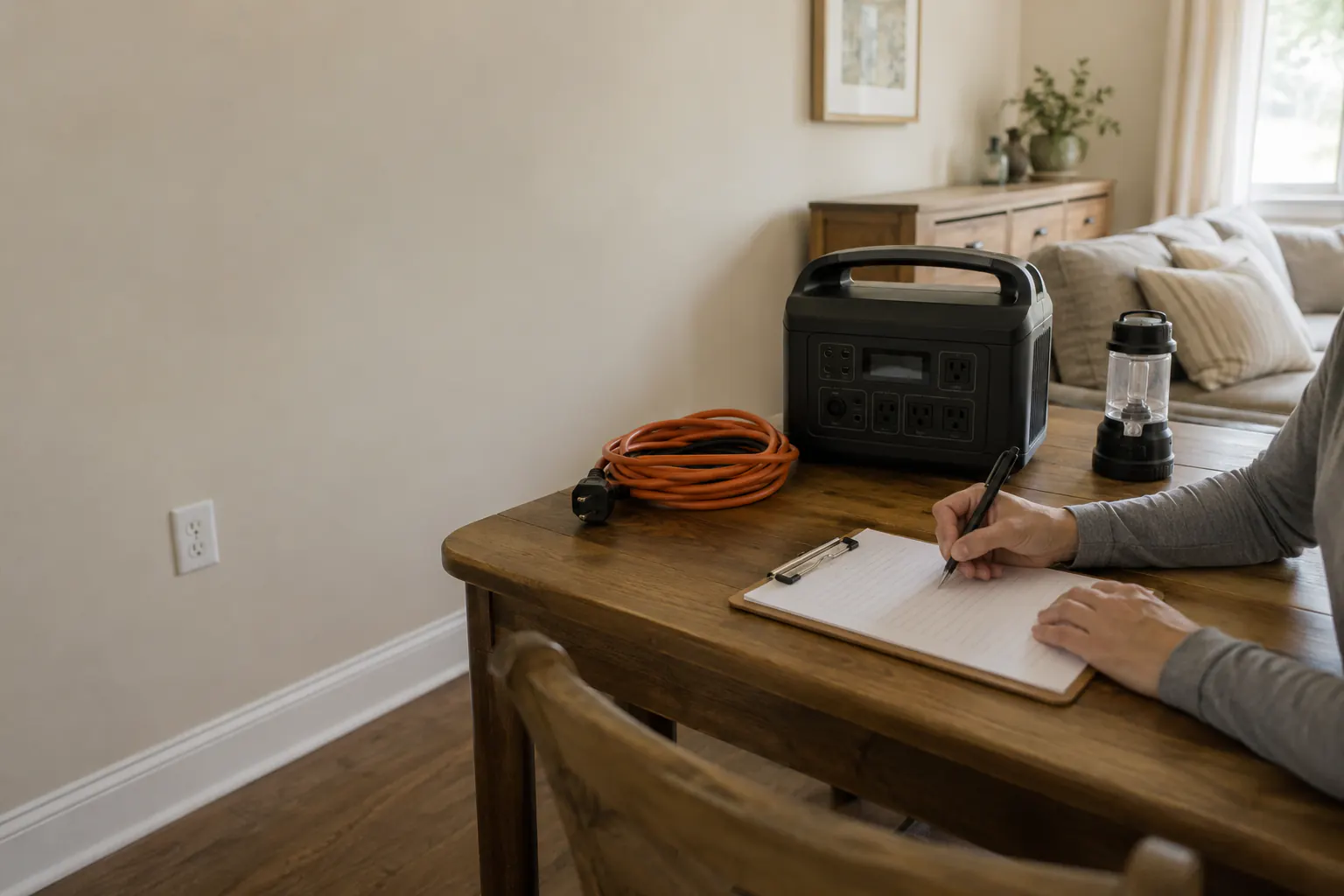
Start with daily energy demand
Use the backup-power load worksheet to total the watt-hours consumed each day. Keep critical, essential, and deferrable loads separate.
Suppose communication, lighting, and a measured appliance plan consume 700 Wh per day. A solar setup that returns 300 Wh on a clear test day slows depletion but does not make the system energy-neutral. The daily balance is:
energy balance = watt-hours harvested − watt-hours consumed
If the result is negative, calculate when the battery reaches its protected reserve. Reduce loads, add a verified recharge source, or set an earlier relocation trigger.
Do not use panel watts as battery watt-hours. A 200 W panel producing 110 W at one moment has not yet delivered 110 Wh. If that output remained constant for two hours, it would deliver about 220 Wh before additional system losses. Real output changes throughout the period.
Verify electrical compatibility before deployment
Read both the panel and power-station manuals. Record:
- panel open-circuit voltage and operating voltage;
- panel short-circuit and operating current;
- station solar-input voltage and current ranges;
- maximum solar-input watts;
- connector type and polarity;
- whether series or parallel arrangements are permitted;
- approved cable length, gauge, adapters, and controller;
- operating, charging, storage, and wet-weather limits.
A matching connector does not prove safe voltage, current, polarity, or controller compatibility. Do not splice cables, reverse polarity, combine mismatched panels, bypass a controller, or exceed the station’s input range. Use only combinations explicitly approved by the equipment manufacturers.
More panel nameplate wattage may help under weak sun only if the station permits the array configuration and never sees voltage or current outside its limits. Treat “overpaneling” as a manufacturer-specific electrical design question, not a generic trick.
Choose a safe location before estimating output
Portable panels need a stable, permitted area with useful sun and no new hazard. Do not place them:
- on a roof, fire escape, roadway, or emergency access route;
- where wind can lift or overturn them;
- across a sidewalk, stair, doorway, or accessible path;
- in floodwater, standing water, or a drainage path;
- where a cable can be pinched by a door or window;
- beneath damaged trees, lines, roofs, or storm debris;
- on a balcony railing or building facade without explicit approval;
- where theft recovery would require confrontation.
Do not climb, clear snow from a roof, trim branches, or deploy panels during lightning, high wind, active wildfire, flood, or another unsafe condition. A cloudy safe day is better than a hazardous attempt to improve output.
For an apartment, ask management about the panel, cable route, balcony, facade, fire separation, and egress. Many units have no safe permitted solar location. The apartment power-station guide includes non-solar recharge alternatives.
Understand why field output changes
The Department of Energy distinguishes module efficiency under test conditions from actual energy yield. DOE identifies shade, dirt, operating temperature, and system design as sources of loss. NREL’s PVWatts uses long-term weather and system assumptions for grid-connected PV estimates, but a portable panel at one temporary location can differ substantially.
Sun angle and orientation
Output is generally stronger when sunlight strikes the panel more directly. The useful orientation changes with latitude, season, and time of day. Follow the portable panel’s support and positioning instructions; do not improvise a mount that can collapse or become airborne.
Partial shade
A narrow shadow across part of a folding panel can reduce output more than its area suggests, depending on cell and bypass-diode layout. Move only when the new location remains safe and permitted.
Temperature
Bright sun can heat modules, while electrical output and charging limits change with temperature. A battery station may also reduce or stop charging outside its allowed range. Keep the station in its manufacturer-permitted environment rather than baking it beside the panel.
Clouds, smoke, and season
Cloud cover and smoke can sharply reduce irradiance. Short winter days reduce the charging window even when cold panels operate efficiently. Wildfire smoke can coincide with evacuation orders and unsafe outdoor air; do not send someone outside merely to preserve a battery.
Conversion and cables
Controller, cable, connector, and battery-charging losses separate panel output from energy stored. Long or undersized cables can add loss and heat. Use approved equipment and inspect connectors for damage, moisture, looseness, discoloration, or unusual warmth.
Build a conservative harvest range
Avoid multiplying panel watts by all daylight hours. Instead, create three field scenarios from measurements or a conservative planning model:
| Scenario | Conditions to record | Planning use |
|---|---|---|
| Strong | clear sky, good orientation, little shade, safe temperature | upper comparison, not guaranteed daily output |
| Typical | seasonally realistic cloud and periodic shade | routine budget |
| Poor | heavy cloud, smoke, short day, unavoidable shade | depletion and relocation trigger |
For each test, record start and end time, location, weather, shade, panel orientation, panel and station temperatures if available, starting and ending battery energy or percentage, station input watts over time, and watt-hours added.
Battery percentage alone can be nonlinear or rounded. A station that reports solar watt-hours received provides better evidence, while an external meter must be compatible and used within instructions. Repeat tests because one clear day cannot represent a storm week.
Use the lowest credible harvest for critical planning. Keep a reserve that is not spent in the forecast. The runtime calculator estimates consumption; compare its daily Wh with measured solar Wh.
Protect reserves before flexible loads
When solar is available, charge the battery within its allowed range and run flexible loads only if critical reserve remains protected. Directly powering an appliance from a changing solar source may cause interruptions unless the complete system is designed for it.
Prioritize:
- prescribed or safety-critical power under its approved plan;
- communication and lighting reserve;
- temperature-monitored refrigeration;
- essential information and accessibility equipment;
- deferrable devices only after the next reserve target is secured.
Do not use an optimistic afternoon forecast to spend the morning reserve. Weather and emergency conditions can change faster than recharge.
Compare portable panel products honestly
A credible comparison should document:
- measured watt-hours under the same location and time windows;
- output under partial shade and cloud;
- compatibility with named stations without unsafe adapters;
- folded and deployed size, weight, handles, and storage;
- support stability and wind limitations;
- cable length, connector strain relief, and weather rating;
- surface temperature and station charging behavior;
- warranty, repairability, and replacement cables;
- exact test date, instruments, weather, and acquisition source.
Do not choose a panel from nameplate watts or a single clear-sky peak alone. Comparable measured energy, exact compatibility, and safe deployment matter more than an unsupported ranking.
Keep a non-solar fallback
Identify grid recharge after restoration, a safe community charging location, vehicle charging within both manuals, or generator charging under the full CO and fuel plan. Regional outages can also close those options, so define the load-reduction and departure sequence.
Never depend on portable solar alone for a prescribed device. Confirm medical backup and relocation with the care team and manufacturer. For smoke, heat, or evacuation conditions, follow official instructions even when that means leaving panels behind.
Return to Backup Power for Home for the full system and the generator versus battery comparison for an alternate recharge path.
Sources reviewed
- U.S. Department of Energy: Photovoltaic System Design and Energy Yield
- U.S. Department of Energy: Optimizing Solar Photovoltaic Performance for Longevity
- National Renewable Energy Laboratory: PVWatts Calculator
- U.S. Department of Energy: Solar Photovoltaic System Design Basics
Sources reviewed July 14, 2026. Treat real output as a site-and-weather-dependent result, and follow the current manuals for the exact panel, station, cables, and connectors.