
Keep care, alarms, essential communication, and other protected loads on their established plans. Reduce only the nonessential loads you are authorized and able to switch off. A battery has limited stored energy; a generator also depends on safe operation, fuel, and rated output. Neither is a reason to interrupt an essential function.
This guide is the outage-time application of everyday efficiency. It assumes you have a backup source and want it to last as long as possible. If you are still deciding what to buy or how big it should be, start with the backup power planning hub and the load worksheet. Here, the power is already out and the clock is running.
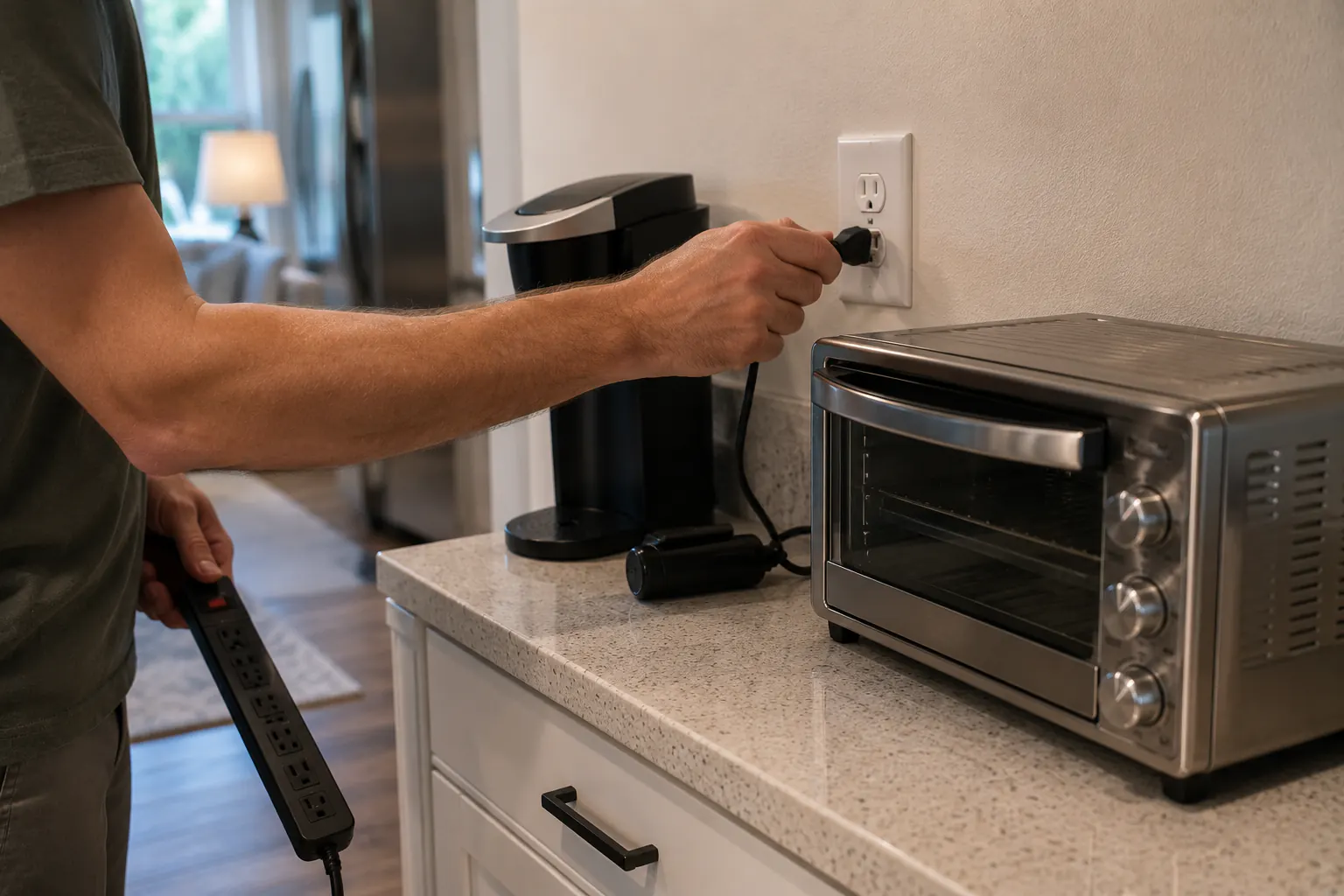
The one rule: reduce before you replace
The backup power hub opens with it and it is worth repeating: reduce the load before increasing the power source. A 100-watt load saved for 10 hours is a full kilowatt-hour you did not have to store. Shedding load is instant, free, and reversible — the opposite of buying more capacity.
Sort your loads under pressure
Before an outage, and again the moment one starts, sort every device into three tiers. This mirrors the load categories in the load worksheet but here the goal is triage, not sizing.
Critical — never shed
- Prescribed medical equipment (set by your care plan, not by this guide)
- Well or sump pumps where loss threatens health or the building
- One communication device kept charged for emergencies
- Carbon monoxide and smoke alarms
Essential — follow the applicable operating plan
- Refrigerator and freezer, within appliance instructions and a temperature-based food-safety plan
- Limited task lighting
- Phone and radio charging
- Heating or cooling required by the actual household temperature and care plan
Deferrable — shed immediately
- Entertainment beyond one small device, most electronics
- Electric cooking, kettles, toasters, and other high-wattage heat
- Laundry, dishwashers, and convenience appliances
- Anything already on your everyday standby-power cut list
High-wattage heat is the budget killer
The fastest way to drain a backup system is to make heat with electricity. A 1,500-watt space heater or kettle can consume 1.5 kWh in a single hour of continuous running — often more than a small power station holds in total. Electric resistance heat, hair dryers, toasters, and stovetops are the biggest single line items you can cut.
Layers and bedding can help comfort but cannot replace needed heating or establish a safe indoor temperature. Cooking is not space heating. Use the actual heating, cooling, care, and relocation plan; do not seal a room against required ventilation. The weatherization priorities guide covers building measures, not a safety guarantee during an outage.
Protect food by temperature, not a power schedule
A refrigerator’s own thermostat cycling is not permission to disconnect its supply on a generic timer:
- Keep the door closed as much as possible. A full fridge holds cold longer.
- Keep a compatible supply available as the appliance and food-safety plan require. There is no universal run-and-coast interval that makes food safe.
- Judge food by temperature, not by whether the fridge “was on.” Follow the power outage food safety guide and FoodSafety.gov thresholds. (Source: FoodSafety.gov, Food Safety During a Power Outage.)
The power a refrigerator during an outage guide covers this cycling in detail, including how to size the load honestly.
Measure so you shed the right things
Guessing which devices are expensive wastes effort. Before an outage season, use a plug-in watt meter to record the running and standby watts of the devices you might keep on backup. DOE guidance notes that nameplate ratings can overstate normal use, so measured values give you a realistic load list. (Source: U.S. Department of Energy, Estimating Appliance and Home Electronic Energy Use.) A short worksheet of measured watts is worth more in an outage than any spec sheet.
Load-shedding sequence when the power drops
- Protect the essential functions first. Never turn everything off as a blanket starting step; use the actual care, alarm, building, and communication plans.
- Switch off only identified nonessential loads within their instructions. A standby-looking device can still provide required care, alerts, monitoring, or communication.
- Confirm critical loads are supported and, for medical equipment, that you are following the manufacturer and care-plan instructions.
- Separate optional tasks only where permitted. Do not interrupt required refrigeration, care, alarms, or safe path lighting to fit a generic schedule.
- Avoid electric heat entirely unless a professionally designed plan requires it.
- Recheck the budget. Estimate remaining watt-hours against expected outage length and the next recharge opportunity.
Match the plan to your power source
- A small power station needs a compatible protected-load plan, not a generic refrigerator on/off cycle. Preserve required care and temperature functions; optional loads can wait. Verify startup, output, energy, and operating limits separately.
- A generator gives more headroom but keeps every fuel, noise, and carbon-monoxide constraint — read generator carbon monoxide safety before running one, and never connect it to household wiring without a qualified electrician and listed transfer equipment.
- Solar recharge varies with weather and may be insufficient even after reducing optional use. See portable solar panels for outages.
Prepare the plan before you need it
Load-shedding works best when it is rehearsed, not improvised in the dark. Do three things before outage season:
- Write a one-page priority list. List your critical, essential, and deferrable loads with their measured watts, and post it where the backup gear is stored. Deciding what to cut is far harder by flashlight during a storm.
- Pre-stage the tools. Keep working flashlights or lanterns, charged battery banks, the backup unit itself charged or fueled within safe limits, and a manual can opener and non-electric cooking option ready.
- Run a dry run. Once, on a calm evening, switch to backup and live on it for an hour. You will discover which loads you forgot, whether your battery lasts as expected, and whether everyone can find what they need. A rehearsal turns a stressful event into a routine one.
Adjust the plan to the season
The loads worth protecting shift with the weather, and so does the danger of getting it wrong.
- Summer outage. Follow the actual cooling and care plan. A fan is not proof that a room is safe in extreme heat. Preserve required cooling or use the planned accessible relocation route before conditions become unsafe.
- Winter outage. Follow the actual heating, care, ventilation, and relocation plan. Layers do not make an unsafe room safe. Never operate a generator, outdoor-only heater, grill, or stove indoors; installed heating has its own qualified operating requirements.
- Storm or hurricane outage. These can last for days, so plan for the longest realistic gap between recharges and lean hardest on load reduction from the first hour.
Keep a non-electric fallback
Load-shedding buys time; it does not create energy. Always keep a fallback that needs no electricity at all: warm clothing and bedding, a safe manual cooking method, stored water, and a plan to relocate to a warming or cooling center if the outage outlasts your reserves. Efficiency stretches your backup; it does not replace an evacuation option.
Return to the home energy efficiency hub to build these habits before an outage, so shedding load under pressure is routine rather than improvised.
Sources reviewed
- U.S. Department of Energy, Energy Saver: Estimating Appliance and Home Electronic Energy Use; standby-power guidance
- FoodSafety.gov: Food Safety During a Power Outage
- U.S. Energy Information Administration: Use of energy in homes
Sources reviewed July 14, 2026.