
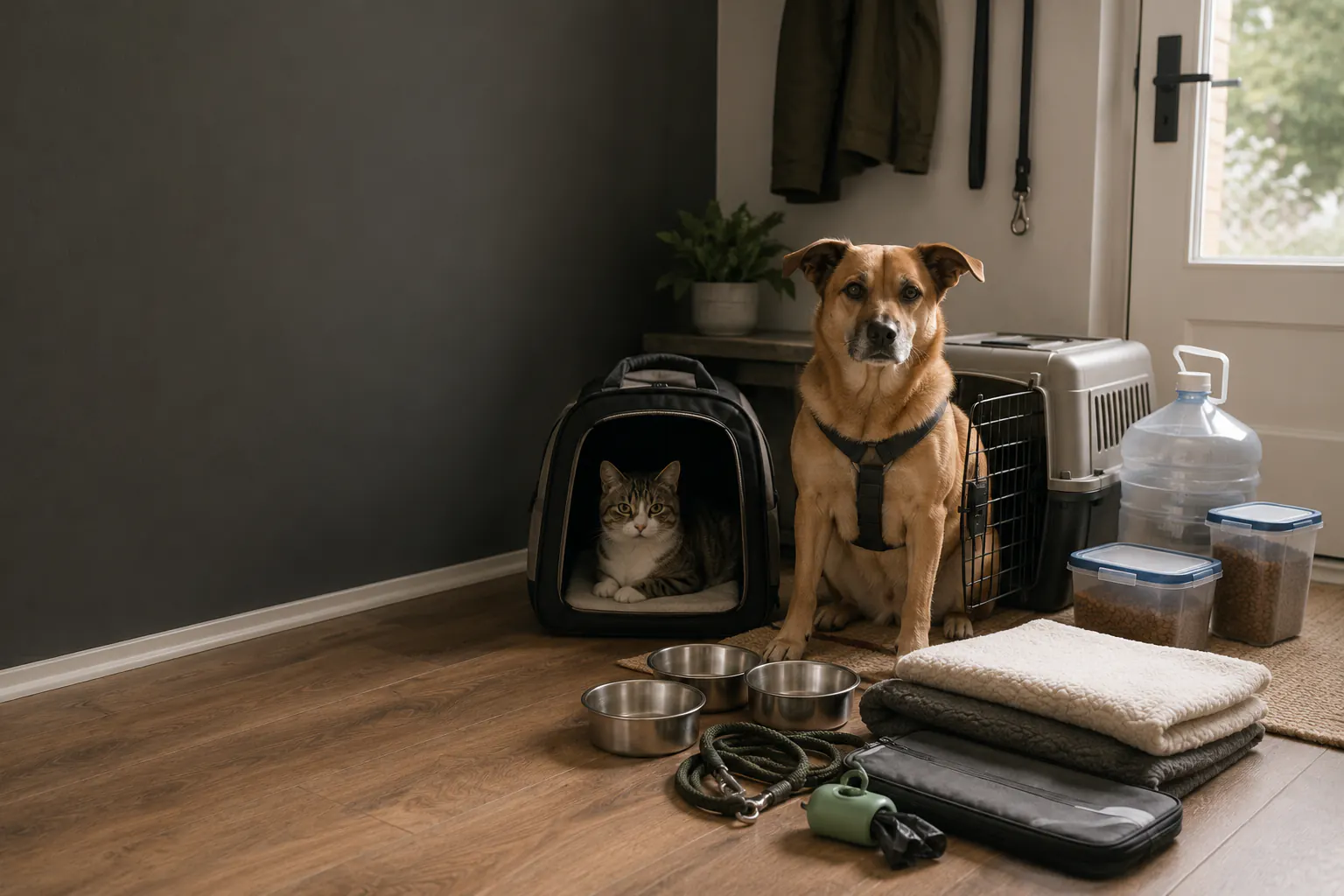
Start with one animal: who would help it leave, which carrier or handling equipment is ready, and where it could stay? Check those three things before building a longer list. A familiar carrier, a willing helper, and an agreed destination give the rest of the plan somewhere to go.
This hub focuses on household dogs and cats, with explicit routes for service animals and animals needing specialized care. Livestock, horses, birds, reptiles, aquariums, and other animals may require different equipment, transport, environment, permits, handlers, and veterinary plans. A generic checklist cannot establish those needs.
Start with the event authority
Follow current evacuation, shelter, fire, weather, chemical, flood, building, law-enforcement, and public-health instructions. Do not delay leaving to assemble optional supplies, retrieve an animal from a dangerous area, or negotiate a destination from the driveway.
Use the all-hazards evacuation hub for household departure and routes. This guide connects the animal’s identification, transport, supplies, care, and destination to that plan. Private notes and preparation lists must not delay necessary assistance or an evacuation instruction.
Give every animal one accountable plan
Create a row for each animal rather than one line labeled “pets.” Record:
| Planning field | What to check |
|---|---|
| Identity | Current tag, microchip registration, description, photographs, ownership record |
| Veterinary care | Regular and emergency veterinarian, care summary, prescriptions, current instructions |
| Containment | Appropriate carrier, crate, leash or harness, and who can use it safely |
| Daily needs | Food, water, sanitation, routine, handling, mobility and environment |
| Movement | Agreed handlers, vehicle or arranged transport, and a sequence that keeps people and exits safe |
| Destination | Currently confirmed options and a backup consistent with official routes and the animal’s needs |
| Separation | Trusted contact, paper record, microchip company, animal-control and shelter contacts |
Do not publish microchip numbers, medical details, home-access instructions, or absence information. Keep paper copies inside the travel kit and protected digital copies with the household record plan. Start with the information available; an unfinished folder is not a reason to postpone help.
Keep the carrier usable
A carrier stored behind holiday boxes is not an evacuation system. Keep the correct carrier or crate accessible, intact, labeled, and sized under veterinary or manufacturer guidance. The animal should encounter it during ordinary life, not only when frightened or ill.
During ordinary preparation, walk through the plan with the agreed handler: where the animal rests, where its familiar equipment is kept, and how to reach the arranged transport while keeping people and exits safe. Do not block or lock required exits to contain an animal. Practice only within its care plan on a comfortable day, without forced handling or interrupting required equipment or medication storage. Stop for distress or unsafe handling. Do not chase, corner, sedate, muzzle, or improvise restraint from an article; ask the veterinarian or qualified behavior professional for the animal-specific plan.
Separate the portable kit from the home reserve
The travel kit supports movement and the first destination. Extra supplies at home support a longer disruption. The dog and cat emergency-kit checklist separates what travels from what stays in storage.
Preserve food, confirmed-safe water, veterinary-directed medication, records, bowls, sanitation, familiar bedding, and containment. Check the actual travel supplies with the agreed handler. Do not overload a household member, block an exit, or put medication where heat, freezing, moisture, children, or other animals can reach it. Storage instructions still apply when a medicine cannot be kept beside the kit.
Verify destinations before every hazard season
CDC’s Be Prepared: Pet Safety in Emergencies recommends planning destinations and transport ahead of an emergency. A public shelter, co-located animal shelter, boarding facility, veterinary hospital, hotel, friend, or relative may have different species, number, crate, vaccination, deposit, arrival-time, and supervision rules. Capacity and policies can change during an incident.
Confirm a destination and a backup outside the affected area, consistent with official routes and the animal’s care needs. Call the actual operator and record the date, contact method, conditions, and backup. Reconfirm when feasible without delaying necessary movement. “Pet friendly” is not enough. The shelter and hotel planning guide provides questions for that conversation.
The U.S. Department of Justice’s ADA Service Animals guidance explains that covered public-facing facilities and emergency shelters generally allow the service-animal team despite a no-pets rule. Other assistance-animal, housing, and transport contexts can involve different laws and facts. Do not route a handler to a pet destination merely because the household also owns pets, or treat a pet-acceptance call as permission for service-animal access. Seek the appropriate official guidance for a disputed situation without requesting unnecessary medical details.
Build a buddy system that has permission
Choose a person who has agreed to check, contain, and move the animal if the household is away. Give only the access, records, equipment, and instructions needed for that role. Confirm whether the person can safely handle the animal and whether the building will admit them.
The buddy needs a stop rule. They do not enter a fire, smoke, flood, chemical release, violent scene, structurally unsafe building, closed zone, or another condition prohibited by authorities. Contact animal control, emergency management, building staff, or responders through the local plan instead.
Add the buddy to the Family Communication Plan with a primary and fallback contact path. A name without current permission and access is not coverage.
Plan for water, sanitation, and indoor conditions
Use the animal’s normal consumption and veterinary guidance to plan water rather than applying a human rule. Keep the animal supply distinct and use only confirmed-safe water. The Emergency Water Storage guide explains household containers, storage, and water advisories.
Plan litter, waste bags, bedding, cleaning, hand hygiene, and a separated food area. In shared shelter, follow the operator’s containment and sanitation rules. Do not mix cleaners, use unfamiliar chemicals around an animal, or store animal waste next to food and water.
Heat, cold, smoke, and loss of powered equipment can end a safe shelter-at-home plan. A fan, blanket, battery, or filter does not establish veterinary safety. Set relocation questions with the veterinarian before the season and use the distinct heat, winter, and wildfire-smoke pet plan.
Keep veterinary care separate from first-aid supplies
Ask the veterinarian what belongs in the animal’s kit and what requires immediate contact or transport. Do not give human medication, share prescriptions between animals, change a dose, induce vomiting, improvise treatment, or rely on an affiliate product list.
The First Aid Kit Planning guide separates general household supplies from veterinary care. This hub does not provide treatment steps.
Plan for separation and return
After a disaster, fences, doors, landmarks, smells, wildlife, traffic, debris, and animal behavior may change. Keep animals contained until the environment is assessed. Use the current photograph, microchip registration, tag, paper record, local shelter, animal control, and veterinary contacts if an animal is missing.
Do not enter a closed area or send strangers into a hazard to search. Protect people first, report through the responsible local channels, and share only the minimum identification needed.
On return, check for spilled chemicals, downed lines, contaminated water, damaged fencing, sharp debris, ash, mold, pests, and escape routes before releasing an animal. Contact the veterinarian for illness, injury, unusual behavior, exposure, or care questions.
Choose the guide for your next task
Start with the task that is still unresolved:
- Emergency Kit Checklist for Dogs and Cats separates travel supplies from the home reserve.
- How to Evacuate With Pets Safely assigns handlers, containment, loading, transport, and separation contingencies.
- Pet-Friendly Shelter and Hotel Planning verifies two destinations without treating an old directory label as admission.
- Pet Medications, Records, Identification, and Contacts creates the protected continuity and handoff record.
- Keeping Pets Safe During Extreme Heat and Power Outages connects veterinary limits to cooling and early relocation.
- Cold-Weather and Winter Outage Planning for Pets connects safe heat, liquid water, powered care, transport, and winter triggers.
- Wildfire Smoke and Pets remains the smoke-specific indoor-air and evacuation extension.
- Make a Pet Backup-Handler Plan Before an Emergency confirms consent, ordinary-care notes, and pickup authority for a trusted handler.
- Pet Insurance, Records, and Emergency Expense Contacts keeps the household’s pet-insurance and emergency-expense contacts findable.
Each page routes species-specific decisions back to veterinary care.
The goal is not a larger pet bag. It is an animal that can leave with the household, arrive at a destination that has actually agreed to receive it, continue its established care, and remain identifiable if plans fail.
Sources reviewed
- Ready.gov: Pets and Animals
- Centers for Disease Control and Prevention: pet emergency preparedness and disaster-kit planning
- U.S. Department of Justice: ADA service-animal guidance
Sources reviewed July 15, 2026. Veterinary, evacuation, shelter, public-health, disability-access, building, transportation, animal-control, and agricultural authorities control actual decisions.
CDC’s kit and emergency-planning pages and DOJ’s ADA service-animal overview were checked October 3, 2026 for the planning and access points above. Animal-specific care and disputed legal questions still need the appropriate professional or authority.
Ruffwear’s current Quencher sizing and care information and the exact Amazon Medium/Spring Mountains variant were checked October 12, 2026. The maker’s 5.5-inch opening and 1 L capacity are specifications, not measurements made here. No dog, cleaning, chemical, leak, transport or care result was tested, and no full veterinary review was repeated for this addition.
Kurgo’s Red selection leads to its K01136 product route; Ruffwear’s current Blue Pool Trail Runner record identifies 20771-410. Their selected listings, ordinary folding/stow features and manufacturer care instructions were reviewed October 12, 2026. Neither product establishes an animal’s needs, safe water, contamination control or veterinary suitability; no serving, cleaning, leak or fit tests were performed.