
On a quiet day, choose who will handle each pet and check that they can reach its carrier and move it to the planned transport. Start with one animal, then repeat for the others. CDC’s pet emergency guidance recommends practicing with the family and arranging transport before an emergency.
If an evacuation is already underway, follow the current official instructions and your household departure plan. Protect people first. Do not delay departure to finish this checklist, gather optional supplies, or make a destination call.
This guide focuses on household dogs and cats. Service animals have distinct access protections, while horses, livestock, birds, reptiles, aquariums, and other animals can require specialized transport, environment, permits, and handlers. Build those plans with the veterinarian, agricultural authority, animal-control agency, transport provider, and destination responsible for the animal.
For supplies, shelter and care, use the pet emergency planning guide. Fit these pet arrangements into your household evacuation plan, including assistance for people and current official departure instructions.
Leave when the responsible authority says to leave
Follow the current order, route, closure, shelter, and responder instruction. Leaving early when officials advise it can preserve more destination and transport options. Do not wait for visible flames, rising water, failed indoor temperature, or an animal to become distressed before using an established trigger.
Never enter a fire, flood, smoke-filled building, chemical release, violent scene, structurally unsafe property, closed zone, or other dangerous area to retrieve an animal. Tell responders or animal control what animal may remain, its likely location, and any relevant handling risk through the local process. Do not put a person at risk trying to retrieve a pet.
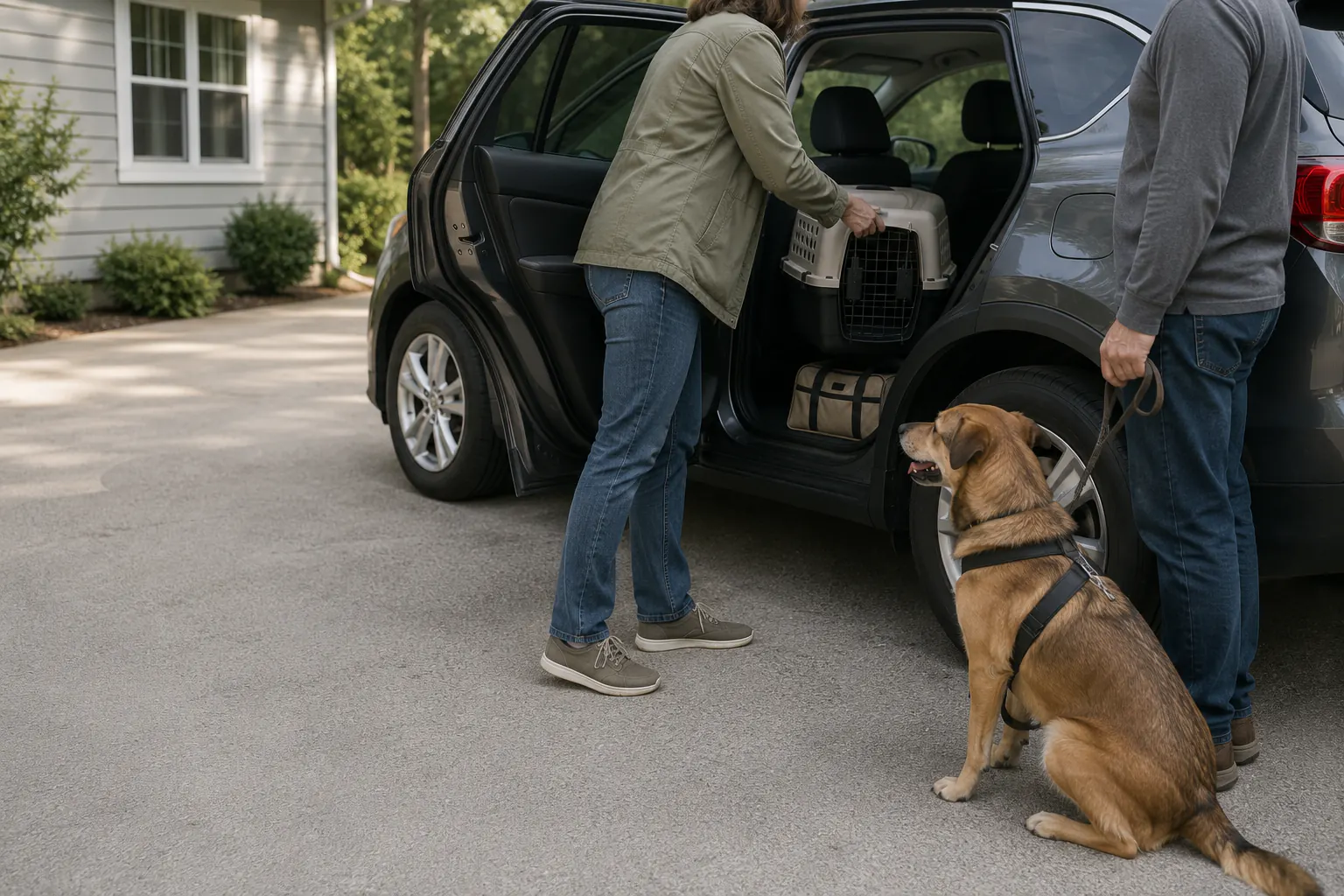
Keep the pet’s bag and carrier reachable near the planned exit without obstructing doors, stairs, or circulation. Optional supplies do not justify delaying departure.
Assign one handler and one backup per animal
Start with the handler and carrier. Fill in the remaining answers privately as you confirm them; this is a planning record, not paperwork to complete before leaving.
| Question | First choice | Backup |
|---|---|---|
| Who finds and contains the animal? | Capable handler who knows the animal | Trusted helper who has agreed to the role |
| Which equipment will they use? | Labeled carrier, leash, or harness | Inspected spare in a known location |
| Who carries the pet’s bag? | Household member able to carry it | Supplies divided into manageable bags |
| Where does the animal ride? | Secured position in the planned vehicle | Alternate transport whose operator has confirmed acceptance |
| Where can the animal stay? | Destination that confirmed acceptance | Second confirmed destination |
| Who helps if you are separated? | Owner or handler | Trusted out-of-area contact |
Do not give a child sole responsibility for an animal during evacuation. Do not assign someone who cannot safely lift, guide, or contain that animal. The handler must understand the animal’s established method without improvising restraint.
Make containment ordinary before the emergency
Keep the carrier assembled, accessible, correctly sized under professional or manufacturer guidance, and labeled with current contacts. Check the door, latch, handle, seams, fasteners, ventilation, and base. Let the animal encounter the carrier during calm routines according to veterinary or qualified behavior guidance.
During an ordinary, calm practice, keep the animal from slipping outside while preserving usable exits for people. Locate it, use its normal handling cue, secure the carrier, pick up the pet emergency kit, and reach the exit. Stop if the exercise causes unsafe handling or significant distress. This is not a reason to close an emergency exit or stay inside a dangerous building.
Do not chase, corner, drag, sedate, muzzle, or use improvised restraints based on an online checklist. Ask the veterinarian or qualified behavior professional for the animal-specific method well before the season.
Write the loading order
Put pet tasks inside the household evacuation plan, not ahead of it. There is no universal loading order for a household with children, mobility needs, different animals, or an inaccessible vehicle.
On a calm day, decide who can do these jobs without leaving someone who needs help waiting:
- Help people leave under their own assistance plan; pet containment must not delay that help.
- Have the designated handler contain each animal using its established equipment, when safe to do so.
- Move animals to their assigned, secured transport positions while keeping exits usable.
- Take reachable pet supplies and essential household bags without blocking vision or exits.
- Check who is present and follow the current official route and departure instructions.
During an emergency, do not walk back through danger for a forgotten bag or stop to complete a practice sequence. If the animal cannot be reached safely, tell responders or animal control through the local process rather than attempting a rescue yourself.
Secure the animal during transport
Do not let a dog or cat ride loose, on a driver’s lap, in an open truck bed, or where it can interfere with controls, doors, or visibility. Use the carrier or vehicle-restraint approach selected for that animal and vehicle under veterinary and manufacturer guidance. Secure the carrier so ordinary braking or turning does not send it through the passenger area, while preserving ventilation and emergency access.
Never leave an animal unattended in a parked vehicle. Heat, cold, ventilation, smoke, delay, and vehicle failure can change rapidly. Do not open a carrier beside traffic, at a fuel stop, or in an unsecured parking area.
Plan fuel, charging, bathroom, feeding, water, medication, and rest stops with the veterinarian and route. Do not feed, medicate, or alter care from a generic travel schedule.
Build a no-car and inaccessible-vehicle route
A plan that depends only on a car parked in a flood zone, garage, elevator-served level, or evacuation direction can fail before loading. Arrange two approved pickup contacts and verify whether local public evacuation transport accepts animals, what containment it requires, where it boards, and whether advance registration is needed.
Record the operator, date checked, contact number, species and carrier rule, boarding location, service-animal process, and backup. Reconfirm during the event when safe and feasible because capacity, routes, and policies can change. Calls must not delay an evacuation order or assistance.
For an apartment, check how the carrier and pet’s bag can move down the usable stair route without blocking others. Do not use an elevator when the building or fire plan prohibits it. Do not attempt a carry that exceeds the person’s safe capability; arrange a capable helper or suitable transport in advance.
Verify the destination before departure
Call the actual shelter, hotel, boarding facility, clinic, friend, or relative. Confirm species, number, size, carrier, vaccination, supervision, sanitation, arrival time, length of stay, fees, parking, accessibility, and any current incident restriction. “Pet friendly” is not an operational answer.
Use two options outside the same likely hazard area. The pet-friendly shelter and hotel guide provides the complete call record. Reconfirm the chosen location before taking a route toward it when communication and conditions permit.
The U.S. Department of Justice explains that service animals generally accompany their handlers in public-facing facilities, including emergency shelters, even where pets are excluded. Do not route a service-animal handler through a pet policy or separate the team because the household also owns pets. Confirm practical arrangements without treating a pet operator’s approval as the source of access rights; authoritative disability-access guidance controls the actual setting.
Preserve records without exposing the household
Carry the animal’s current photograph, owner photograph, description, microchip company and number, vaccination record, veterinary summary, prescription information, regular and emergency contacts, and destination details in a protected pouch. Keep a protected digital fallback.
Do not attach a full medical record, home-access code, or detailed itinerary to the outside of a carrier. A visible label should provide only the information needed to reconnect the animal and handler. The pet records checklist separates visible, handoff, and protected records.
Use a separation plan
If the animal escapes, is transported separately, or cannot accompany the first vehicle, do not create a second emergency by running into traffic or a closed zone. Notify the responsible destination, animal-control or shelter channel, microchip registry, veterinarian, and approved contact according to the local plan.
Record where and when the animal was last seen, current photographs, identifying features, containment equipment, behavior relevant to safe handling, and the minimum owner contact needed. Avoid publicly posting access codes, an empty-home schedule, sensitive records, or information that authorities advise withholding.
If another person takes custody, confirm who has the animal and where they are going. When safe, make a private note of their contact, date and time, observed condition, supplies transferred, the veterinarian’s medication instructions, and who may authorize care. A written record helps avoid a misunderstood handoff, but making it must not delay departure or necessary care.
Rehearse a calm version
Run a short daylight practice on a quiet day. Do not simulate fire, panic, injury, disappearance, or forced handling. Check whether the carrier is accessible, the animal can be contained using its established approach, the bag can be carried, the vehicle position works, and every role has a backup. The aim is to find a missing arrangement, not beat a departure time.
Afterward, correct the plan rather than training the household to accept a dangerous workaround. Rehearse again after a move, new vehicle, new animal, mobility change, medication change, carrier replacement, destination change, or difficult practice.
Sources reviewed
- Ready.gov: Pets and Animals
- Centers for Disease Control and Prevention: pet emergency preparedness and pets in evacuation centers
- U.S. Department of Justice: ADA service-animal guidance
The original source review was July 15, 2026. CDC’s pet emergency planning guidance and DOJ’s service-animal access guidance were checked for the planning and access statements above on October 3, 2026. Current authorities, facilities, transport operators, veterinarians, and animal-care professionals control real evacuation decisions.
Ruffwear’s current Quencher sizing and care information and the exact Amazon Medium/Spring Mountains variant were checked October 12, 2026 for an ordinary dog-serving role. No carrier, latch, vehicle, airline, handling, cleaning or product-performance test was performed. The manufacturer capacity does not set the animal’s water needs.