
Stored water solves two apartment problems at once: it preserves a confirmed-safe supply and reduces the number of trips a household must make when elevators or building pumps fail. The plan must work for the people, floor, route, containers, storage surface, and advisory that actually exist.
This guide does not set a universal amount a person can safely carry. It does not authorize use of a roof tank, fire system, boiler, mechanical room, or another shared source. Use the Emergency Water Storage guide for household quantity, container, rotation, and advisory rules, and the apartment preparedness hub for the rest of the small-space plan this page fits into.
Follow the current water authority first
Determine whether the issue is loss of pressure, a building pump failure, a utility interruption, a boil-water advisory, a do-not-drink notice, suspected contamination, or an evacuation. Those conditions are not interchangeable.
Use the current utility, public-health, emergency-management, and building instruction for drinking, cooking, brushing teeth, medication, infant feeding, pets, hygiene, plumbing use, and flushing. Do not assume that boiling or a household filter solves every contaminant.
Leave or stop using a route when fire, smoke, carbon monoxide, floodwater, sewage, electrical damage, ice, structural concern, crowding, or an authority makes it unsafe. Water retrieval is not worth entering danger.
Calculate the reserve before choosing containers
CDC’s current emergency-water guidance recommends at least one gallon per person per day for three days and trying to store a two-week supply when possible, with more considered for illness, pregnancy, pets, or hot climates. Treat that as a planning baseline, not an individual clinical prescription or proof that the apartment can shelter safely for that duration.
List drinking, ordinary food preparation, brushing teeth, medication instructions, pets, and other confirmed needs. Keep sanitation planning visible but separate so drinking water is not accidentally consumed for a task that has an approved alternative.
Ask a clinician about individual fluid, infant-feeding, enteral, dialysis, medication, or other medical requirements. Never ration or change a clinical plan from a preparedness article.
Choose a container mix the household can operate
Use unopened commercially bottled water or food-grade storage containers according to CDC and manufacturer guidance. Build a mix:
- small immediate bottles for on-person use and evacuation;
- moderate containers the intended person can dispense without unsafe handling;
- a larger home-reserve layer only when the surface, filling, cleaning, movement, and dispensing plan support it.
Measure the actual filled weight with a reliable scale if movement decisions depend on it. Record container weight, capacity, handle, cap, dispensing method, storage location, and intended user. Do not convert that number into a universal safe lifting limit.
Avoid one vessel that nobody can move, clean, inspect, or dispense. Avoid fragile glass on a stair route and improvised containers that previously held chemicals, fuel, cleaners, or non-food products.
Store water low, stable, and inspectable
Place containers upright on stable surfaces appropriate for the load, away from exits, electrical equipment, direct sun, heat, chemicals, pests, flood exposure, and sharp objects. Do not assume that a shelf, cabinet, bed frame, or concentrated floor area can support a large reserve.
Use manufacturer ratings and ask management or a qualified professional when the proposed storage load or surface is uncertain. Do not drill, anchor, hang, or alter the rental without approval.
Distribute containers only when every location remains easy to inventory and inspect. Keep enough space to see leakage. The small-apartment storage guide maps water alongside food, sanitation, batteries, medication, and exits.
Ask how the building loses and distributes water
Record current management answers:
| Building question | Operational answer needed |
|---|---|
| Pressure | Does the property use booster pumps or another powered system? |
| Hot water | What fails with electricity, gas, or central equipment? |
| Sewage | Do ejectors or other drainage systems depend on power? |
| Distribution | Where would approved emergency water be provided? |
| Access | Which entrance, time, container, identification, or resident process applies? |
| Elevator | Who decides shutdown and restoration, and what route remains approved? |
| Communication | How are advisories and restoration confirmed if internet service fails? |
Do not enter a pump, tank, boiler, roof, utility, sprinkler, standpipe, maintenance, or mechanical area. Residents cannot assess or operate those systems from a generic guide.
Prepare an approved pickup plan
Identify the current official water-distribution information channel and two people who have agreed to help. Record the pickup point, route, hours, container rules, identification or registration, accessible service, transit or vehicle option, and how the household will verify the source.
Do not rely on an old social-media post or an unmarked tanker. Confirm through the responsible authority. Keep payment and contact fallbacks if the household may buy sealed water, but do not assume stores will retain stock or power.
For a resident who cannot use stairs or carry water, ask management and local emergency or accessibility services what delivery or assistance process exists. A neighbor agreement should be voluntary, specific, and backed by another route.
Design stair trips around stop conditions
Use only the approved, open, illuminated, and safe route. Keep landings, handrails, doors, and responder access clear. Wear ordinary stable footwear appropriate to conditions and keep one hand available when the individual plan requires it.
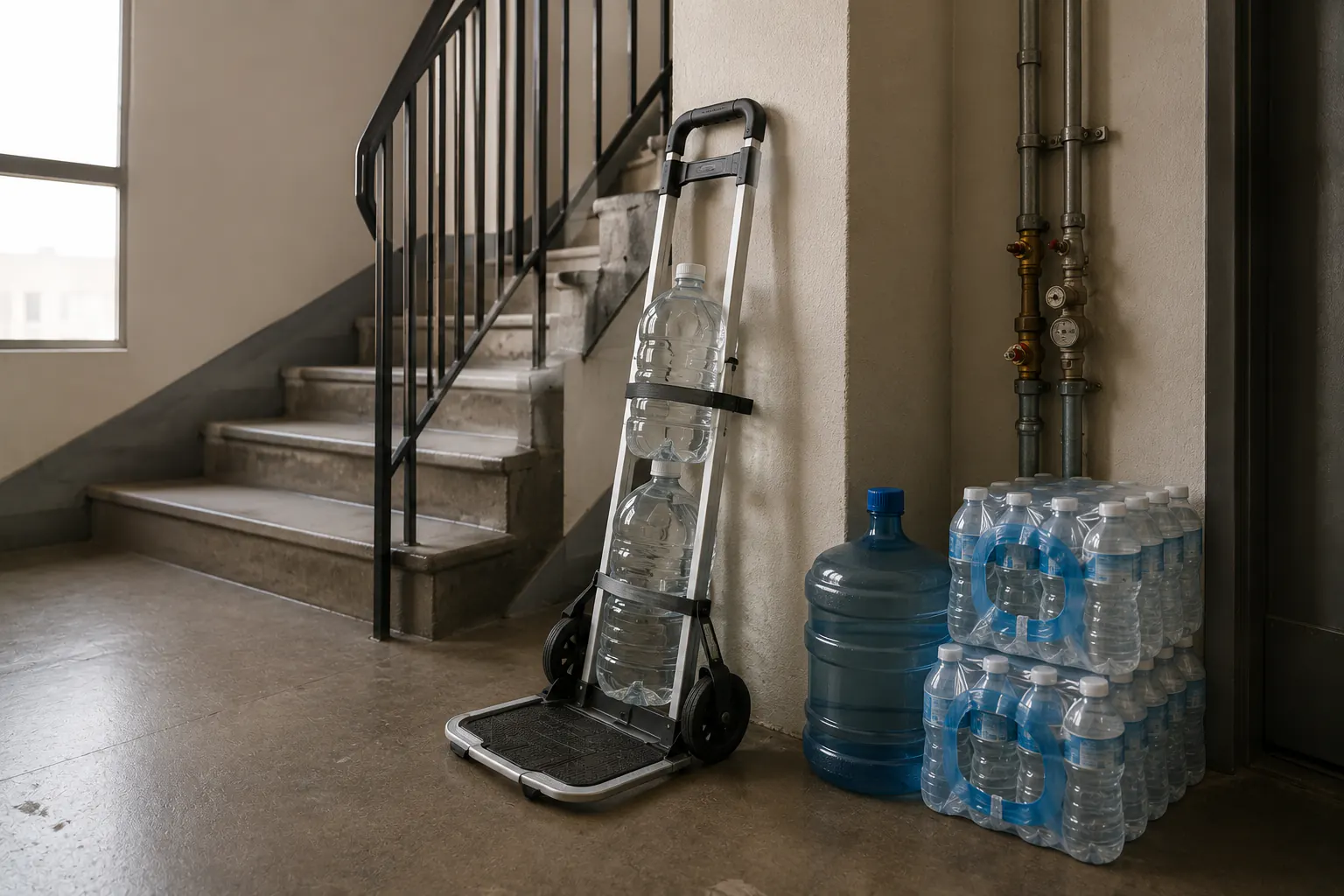
Use smaller sealed containers and more trips only when the person, route, weather, lighting, and event make that safe. A cart may help on level surfaces but can create a stair hazard; do not drag, roll, or balance one on stairs unless a designed system, trained process, and building plan explicitly support it.
Stop for pain, weakness, dizziness, breathing difficulty, loss of balance, damaged packaging, a spill, crowding, poor lighting, smoke, alarm, ice, water on steps, or an official restriction. Contact the appropriate medical or emergency service for symptoms or danger.
Do not leave containers on a landing, wedge a fire door, block a stair, or ask a child to carry a load that adults have not safely planned.
Use helpers without creating a rescue improvisation
Assign the pickup, ground-to-entry movement, stair movement, unit receipt, and storage as separate tasks. One person does not have to own the entire route. Confirm who can perform each task and what happens if that person is unavailable.
Do not ask a building employee, neighbor, caregiver, delivery worker, or responder to exceed their role. Do not combine a water carry with an untrained transfer of a person, wheelchair, medical device, or animal.
Keep the Family Communication Plan updated with helper permission and a fallback. Avoid publicly posting that a resident is alone or that a unit contains medication or expensive equipment.
Keep evacuation water separate
The home reserve may be too heavy to leave with. Stage a carryable evacuation layer based on the route, destination, transport, climate, household, and current authority. Do not delay a required evacuation to move the full reserve.
The apartment evacuation guide owns people, pet, service-animal, mobility, stair, and destination movement. The Pet Emergency Preparedness hub owns animal-specific water under veterinary guidance.
If a destination provides water, verify that fact; do not discard the portable layer based on an assumption.
Dispense without moving the whole reserve
Use a stable dispensing setup that the intended household member can operate. A spigot or pump must be compatible, clean, and maintained under product and public-health instructions. Keep the opening and hands clean and avoid touching cups or utensils to the outlet.
Do not transfer water repeatedly between containers merely to save space. Label stored water with the fill or purchase information and rotate it under current CDC and manufacturer guidance.
Separate confirmed drinking water from water approved only for another purpose. A handwritten label cannot make an uncertain source safe.
Link water loss to sanitation and relocation
Use the Emergency Sanitation hub when toilet, handwashing, or waste systems are affected. Stop normal plumbing use when management or authorities report sewage backup, failed drainage, or another restriction.
Prepare to relocate when confirmed-safe water, essential sanitation, clinically required supply, caregiver support, safe temperature, or an accessible route cannot continue. Follow evacuation orders immediately.
A larger water reserve cannot make fire, smoke, carbon monoxide, sewage, structural damage, extreme temperature, medical interruption, or a closed building safe.
Practise with ordinary conditions
On a calm day, weigh and dispense one filled container, inspect storage, verify the management contact, locate the approved route, and call the backup helper. Do not disable an elevator, crowd a stair, create a spill, or require a person to demonstrate a maximum carry.
Correct the system when a cap leaks, a container is too awkward, the surface is uncertain, the route is inaccessible, or the helper cannot perform the agreed role. Review after a move, floor or building change, health or mobility change, new pet, management procedure, advisory, or actual outage.
Sources reviewed
- Centers for Disease Control and Prevention: How to Create an Emergency Water Supply
- Ready.gov: Water
- ADA.gov and CDC: inclusive emergency planning and assistance networks
Sources reviewed July 15, 2026. Current water and public-health authorities, management, clinicians, emergency services, and qualified professionals control actual supply, building-system, medical, lifting, access, and evacuation decisions.