
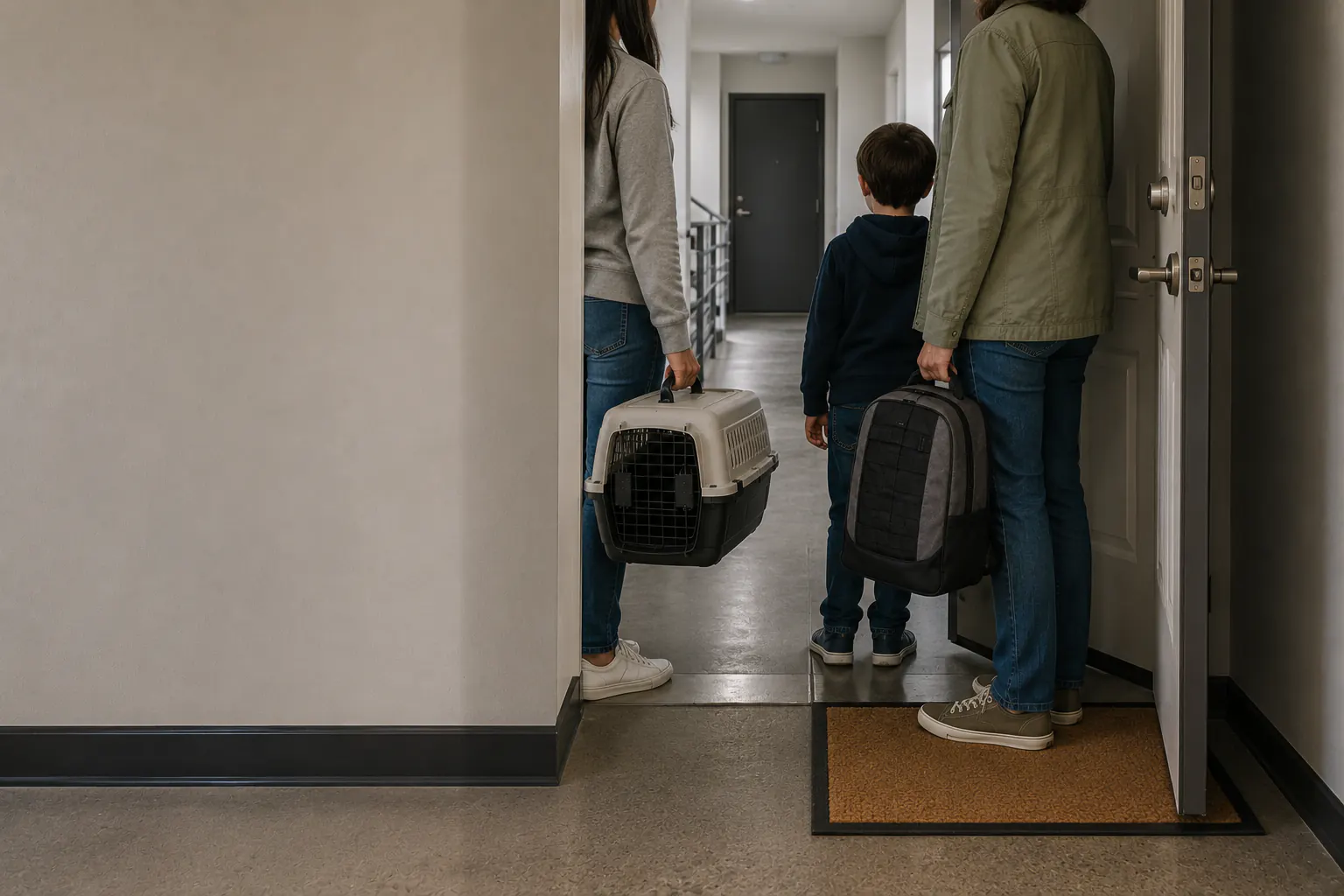
Apartment evacuation compresses several plans into one doorway. A child may need an assigned adult, a cat may hide when an alarm sounds, a service animal must remain part of an accessible route, and a resident who uses a wheelchair may lose the elevator they rely on every day. Those problems cannot be solved safely for the first time in a smoky hall or dark stairwell.
Build the movement sequence on a calm day with the responsible building, fire, emergency, medical, accessibility, transport, and veterinary plans. This page does not authorize an untrained carry or replace current instructions.
Use the Apartment Emergency Preparedness hub for storage, water, blackout, and heat dependencies. Use the all-hazards evacuation hub for destinations, transport, documents, and carry layers.
Identify the event before choosing the route
Fire, smoke, carbon monoxide, floodwater, a gas or chemical release, wildfire, civil unrest, extreme heat, winter failure, and a planned utility outage can require different movement. Follow the current issuing authority and building plan.
Call 911 for fire, smoke, a carbon-monoxide alarm or suspected exposure, immediate danger, a medical emergency, entrapment, or when a resident cannot evacuate safely. Give the building address, unit, floor, current location, route condition, communication need, and immediate hazard.
A route only counts if it stays survivable end to end: smoke, floodwater, a violent scene, electrical water, structural damage, a locked or closed route, or any condition authorities identify as unsafe means stop and choose another. Once out of a dangerous area, stay out — report location information to responders rather than going back for optional supplies or animals.
Keep the fire plan distinct
For a high-rise fire, U.S. Fire Administration guidance tells residents to know the exit stairs, leave and close the apartment door when the route is safe, use stairs rather than elevators unless the fire department directs otherwise, reach the outside meeting place, and tell firefighters if someone is trapped.
Follow the building’s current fire plan and responder instruction. A non-fire evacuation may have different elevator, route, staging, shelter, and reentry rules. Do not apply a fire-only instruction to every event, and do not use ordinary elevator availability as proof that it is authorized during an emergency.
Never pry an elevator door, climb from a stalled car, enter a shaft, prop a stair or corridor fire door, or tamper with an alarm, sprinkler, pull station, emergency light, or access system.
Draw the unit-to-street route
Record the route in observable steps:
- Unit rooms and two ways out where the building and unit provide them.
- Primary and alternate unit exit.
- Primary and alternate building stair or approved route.
- Doors, landings, turns, refuge or assistance locations identified by the building plan.
- Ground-level discharge and any reentry limitation.
- Outside meeting place clear of apparatus, falling debris, traffic, and building access.
- Accessible pickup point and backup outside the same immediate hazard.
Walk the safe ordinary route and confirm where each stair actually exits. Do not assume every stair discharges to the lobby or that a resident can reenter from every door. Ask management about locked gates, garage routes, construction, seasonal ice, and after-hours access.
Keep the unit exit and interior route clear. Report blocked or damaged common exits through the building and fire-safety process rather than moving another resident’s property or altering doors.
Assign one role per person and animal
Write a departure row:
| Responsibility | Primary owner | Backup |
|---|---|---|
| Receive and verify instruction | Named adult | Named adult or approved contact |
| Support each child | Assigned capable adult | Separate named backup |
| Handle each pet | Approved handler | Approved pet buddy |
| Support mobility/access needs | Person and agreed support plan | Qualified fallback path |
| Carry medical layer | Named person within capability | Divided or transport-staged layer |
| Carry shared bag | Named capable person | Reduced essential layer |
| Contact destination/transport | Named coordinator | Out-of-area contact |
| Report anyone remaining | Named communicator | Another adult |
Keep each assignment humanly possible: a child never carries sole responsibility for another child, pet, medication, or route decision, and no single adult should simultaneously carry a child, manage a dog, move a wheelchair, and haul the shared bag.
Reduce the load or add a capable approved helper when a role cannot be performed. A blank backup is an unresolved dependency.
Plan for children without delaying departure
Teach children the alarm, responsible adult, unit exit, outside meeting place, and rule not to hide or return. Use age-appropriate plain language. Keep ordinary shoes, weather layer, identification/contact method, and essential carry items under adult control.
The responsible adult closes the loop by confirming the child is present at the meeting point. Do not tell a child to wait alone in a hall, elevator lobby, stair landing, vehicle, or outside location.
Practise walking the calm route without smoke, darkness, panic, separation, or surprise alarms. The goal is recognition and adult assignment, not testing how quickly a child can descend.
Make pets part of the loading sequence
Keep carriers, leashes, harnesses, records, medication, and the portable animal module accessible without blocking the unit exit. Assign one handler and backup for each animal. The Pet Emergency Preparedness hub owns veterinary, destination, carrier, record, and separation planning.
Carriers stay closed from door to destination — never opened in a hall, stair, parking area, or street — and a pet never rides loose in an elevator or vehicle. A required departure comes first: no delaying it to assemble optional animal supplies, and no reentering danger to retrieve an animal.
Service animals are not pets. Preserve the working team in the household’s accessible route and verify current shelter and transport processes. Do not default a service-animal handler to a separate pet destination.
Build an individualized no-elevator plan
ADA.gov notes that a person with a mobility disability may need assistance leaving a building without a working elevator. Meet before an emergency with the resident, management, local fire department’s planning channel, emergency management, clinicians, mobility or accessibility professionals, paratransit or transport provider, caregiver, and chosen support network as applicable.
Record:
- what the resident can and cannot do under ordinary and emergency conditions;
- accessible alert and communication formats;
- primary and alternate route under the building plan;
- approved location and method for requesting assistance;
- mobility device, service animal, oxygen, medication, power, and transfer needs;
- who contacts 911 and what exact location information is given;
- accessible transport and two destinations;
- caregiver access and backup if the building cannot be reentered.
Stair descent for a person, wheelchair, scooter, oxygen system, medical device, or service animal is planned equipment work, never improvisation. An evacuation chair, sling, drag device, or transfer aid earns its place only with the building approval, individual assessment, training, maintenance, staffing, and responder coordination it requires.
A neighbor buddy can communicate, bring an agreed portable item, or make a call within their capability. They are not a rescue team and must not enter smoke, fire, a closed area, or another dangerous route.
Keep medical continuity portable
Use the Medical Device and Medication Continuity plan to identify the portable medical layer, clinician contacts, manufacturer instructions, backup power, tolerated interruption, transport, and relocation trigger.
Do not disconnect, lift, transfer, refrigerate, power, or substitute medical equipment from generic evacuation advice. The patient, clinician, caregiver, supplier, transport provider, and emergency service control those steps.
Keep the portable layer reachable and assign a capable owner. Do not bury it in the home reserve or load it onto a person who also needs physical assistance.
Reduce bags to the usable route
Use layered evacuation supplies: on-person essentials, a personal carry layer, and only the shared module the assigned person can move through the actual route. The Practical Household Go-Bag Checklist owns contents; the staging guide owns exit-safe placement.
Every bag moves with its carrier: nothing parked on a stair or landing while returning for another, nothing blocking the handrail, nothing stacked so high the person cannot see the steps — and no delaying an order for water, food, documents, or comfort items left behind.
Keep hands available according to the individual’s mobility plan. Divide shared supplies across capable adults or transport rather than creating one oversized apartment bag.
Verify transport and destination access
Choose two destinations in different directions or service areas. Confirm current accessibility, household and caregiver admission, children, pet or service-animal process, medical power, medication storage, parking, transit, check-in, cost, and outage plan.
Build a no-car route through the Car-Free Backup Transportation guide. Verify paratransit and emergency accessible transport before the season; ordinary service may change during an incident.
Record a pickup point that the resident can reach without blocking fire apparatus or standing in traffic, smoke, floodwater, extreme temperature, or falling-object zones. Reconfirm transport and destination during the event when conditions permit.
Preserve communication when household members separate
Use the Family Communication Plan for an out-of-area contact, meeting places, text/voice/radio limits, and charging. Put the apartment address, unit, floor, names, approved assistance needs, destinations, and key contacts on a protected paper card.
Do not publicly post that a resident remains alone, a unit is empty, medication is present, or a household will take a specific route. Share location details with dispatch, responders, the approved contact, transport, and destination as needed.
At the meeting point, account for every person and animal. Tell responders promptly who may remain, their last known location, and relevant communication or mobility need. Do not send another resident back inside.
Decide when to leave early
An official order controls. The household should also prepare to use its verified route before elevator, caregiver, accessible transport, destination, safe temperature, water, sanitation, smoke protection, or medical continuity fails.
The evacuate-or-shelter framework organizes authority, immediate hazards, household constraints, and route/destination facts. It cannot override fire instructions or produce a universal answer.
Early movement is not always authorized or safe. The point is to ask the responsible authority and activate a verified plan while options remain, not to wait until a resident must attempt a dangerous stair.
Practise without manufacturing danger
On a calm day, verify alerts, roles, carriers, portable medical layer, bags, exits, meeting point, pickup contact, and destinations. Walk only the route each participant can safely practise under their individual plan.
Do not disable an elevator, sound an unapproved alarm, create darkness or smoke, surprise children or animals, carry a person on stairs, disconnect medical equipment, or obstruct neighbors. A tabletop walkthrough is the correct practice when physical movement would be unsafe.
Afterward, correct one named gap: missing backup, inaccessible format, blocked route, heavy bag, unconditioned pet, unavailable transport, outdated record, or destination that cannot meet the need. Review after every household, building, health, mobility, animal, vehicle, caregiver, or management change.
Sources reviewed
- U.S. Fire Administration: home and high-rise fire escape planning
- ADA.gov: emergency planning and accessible evacuation
- Centers for Disease Control and Prevention: sheltering, evacuation, and inclusive support networks
Sources reviewed July 15, 2026. Current authorities, responders, building management, clinicians, accessibility and transport providers, veterinarians, and individual plans control actual movement.