
A go-bag should help the household leave on time and function for the first period away from home. It is not a wilderness expedition pack, a substitute for home supplies, or a pile of products that makes an unsafe route safe. Its job is simple: keep the things that cannot be recreated quickly with the person who needs them.
Start with the destination, transport, and people. A bag assembled without those answers is likely to be too heavy, missing the one essential item, or stored where it blocks the exit.
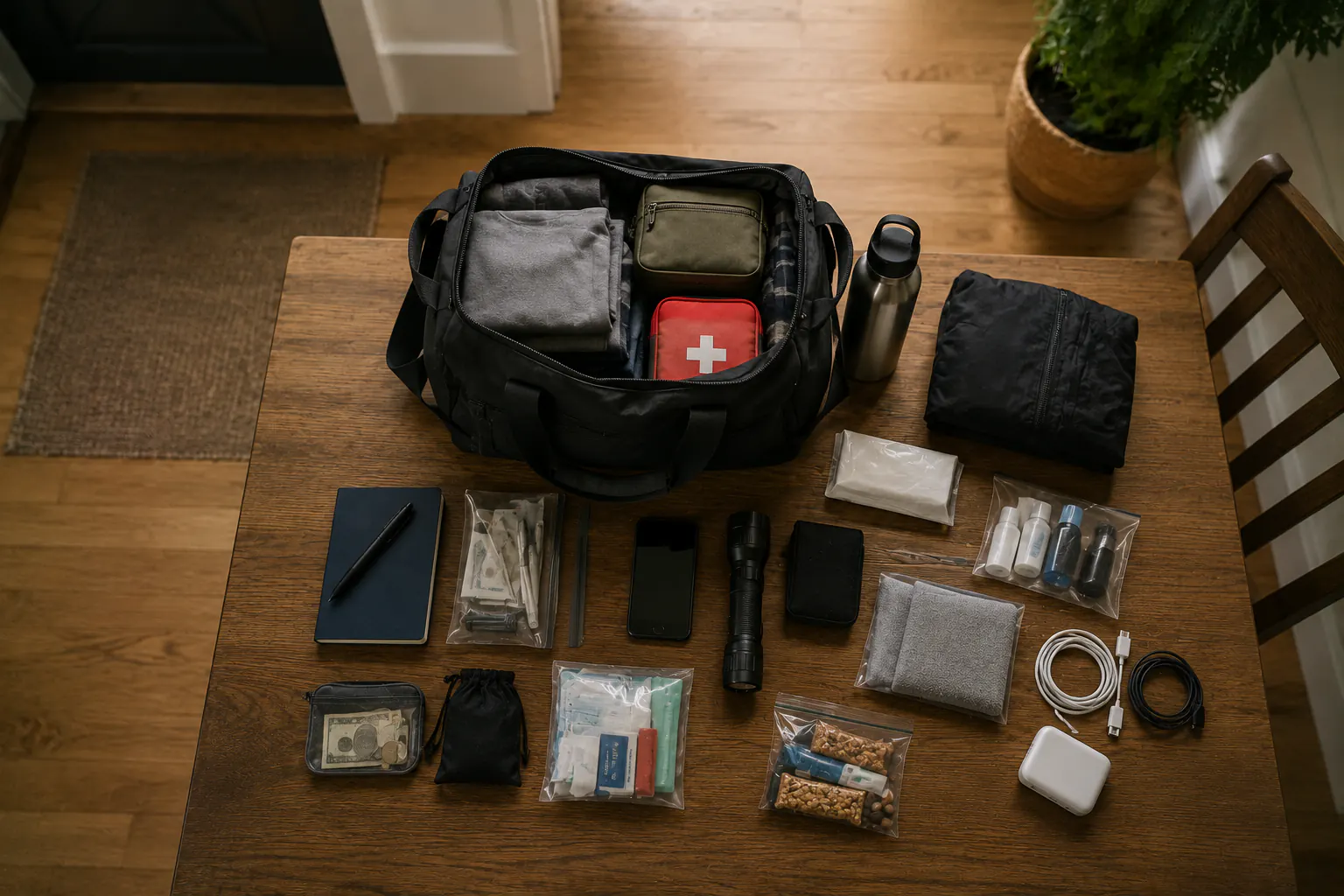
Use a layered system, not one giant bag
The most reliable design separates personal essentials from shared items. Each person who can safely carry a small bag keeps a personal layer. A capable adult, vehicle, or support person carries the shared layer. A dependent person must never be separated from their identity, communication method, essential care information, and comfort or mobility items merely because they are distributed across bags.
| Layer | Owner | Planning question |
|---|---|---|
| On-person | Each person | What must remain with this person even if bags separate? |
| Personal bag | Each person who can carry one | What supports the first period away from home? |
| Care layer | Named caregiver or user | What is individualized and cannot be improvised? |
| Shared bag | Named adult or vehicle | What can one household share without creating a single point of failure? |
The Evacuation Planning hub explains how to attach these layers to a real departure decision, destination, transport plan, and check-in record.
Start with the on-person layer
This layer is deliberately small. It belongs in a pocket, belt bag, accessible wheelchair pouch, or another place that stays with its owner while bags are loaded.
Check the following:
- identification and house, vehicle, mailbox, or work keys relevant to the plan;
- a paper contact card with the out-of-area contact and reunion information;
- phone, appropriate charging cable, and glasses, hearing supports, or communication aid needed immediately;
- any essential personal alert, access, or mobility item;
- a small amount of cash only if the household judges it appropriate and can keep it discreet;
- a method for a child, older adult, or person with communication needs to identify their support person without exposing private details publicly.
Do not put full passwords, recovery codes, bank numbers, a medication list, or a label saying “valuables” in an easily lost pocket. The offline credentials guide describes a minimum-necessary record system.
Build the personal bag by function
Use ordinary items the person can handle and tolerate. Pack for the likely local climate and destination, not an imagined survival challenge.
Water, food, and basic comfort
- water suitable for the expected travel period and any household-specific plan;
- ready-to-eat food the person normally tolerates, including infant, allergy, texture, or dietary needs that have been planned in advance;
- a weather layer, rain protection, closed-toe shoes if appropriate, and a spare change of clothing;
- basic hygiene items and a small comfort item for a child or person who relies on one;
- an empty, lightweight container only where it has a known use and does not add avoidable weight.
The bag does not need to contain the household’s full food reserve. Use the Emergency Food Storage hub to plan food kept at home and replace travel food through normal rotation.
Light and communication
- a simple battery light or headlamp that the user can operate;
- spare batteries only when they match a device already in the plan;
- a charged compact power bank and cable tested with the actual phone;
- a paper map and directions when a phone may lose power or service;
- a small notebook and pen for instructions, confirmations, or a changed contact number.
Do not use candles in a packed bag or rely on a flashlight that nobody has turned on recently. A light is useful only with known batteries, a working switch, and a person who can find it quickly.
First aid and ordinary care
Pack the non-clinical first-aid supplies the household has selected and knows how to use. Keep them compact and inspect them. The First Aid and Compact Medical Kits hub explains kit roles, inspection, training limits, and the difference between equipment and care.
Medication, prescribed treatment, oxygen, home medical equipment, refrigeration, consumables, and clinical triggers need their own verified plan. Use Medical Device and Medication Continuity, not a generic go-bag checklist, to decide what travels, who approves it, and when to relocate.
Assign the shared bag carefully
The shared bag often contains:
- a protected document packet and a paper household departure record;
- a regional paper map and a battery radio where the household knows its alert role;
- shared charging cables, a power bank, and a compact light;
- basic first-aid supplies, hygiene supplies, and household contact information;
- a small amount of practical material for ordinary travel needs, such as labels or tape, without turning the bag into a repair kit;
- pet carriers, leashes, food, water, records, and cleanup supplies assigned to the person who can actually move them.
Keep document records discreet and water-resistant according to the household’s risk. A document pouch should not advertise a vacant home, identity records, or access secrets. Do not assume a shelter, host, or vehicle can secure it for you.
Adapt for children, pets, and access needs
Children need age-appropriate clothing, food, comfort, identification, and a plan for who carries what. Let a child help choose a small item where appropriate, but do not make them responsible for a critical household bag.
For pets and service animals, plan carriers, collars or harnesses, identification, food, water, sanitation, records, and destination rules before the event. A service animal and a pet may be treated differently by a destination. Never leave an animal in a parked vehicle or assume that a bag solves transport, shelter, or veterinary needs.
For a person with mobility, sensory, communication, cognitive, or personal-care needs, the important question is not “what should everyone pack?” It is “what support must be available at the pickup point, on the route, and at the destination?” Contact local emergency-management and accessibility resources before an event where registration or assistance may exist. Keep the plan with the person and support network, not only in a household drawer.
Weigh, stage, and inspect the bag
Load the actual bag and weigh it. Walk a short, safe route in ordinary conditions with the footwear, mobility aid, child carrier, and pet carrier that the plan expects. If it is too heavy, remove duplicates and assign shared items differently before buying more equipment.
Stage bags close to the planned exit without blocking doors, stairs, electrical panels, or fire equipment. Keep keys, shoes, carrier, and mobility equipment in their named places. Do not bury the bag behind bins of water or seasonal storage.
Review it at least twice a year and after any move, new child, new pet, school or job change, changed destination, changed device, or changed care requirement. Check:
- identification and contacts;
- clothing size and seasonal suitability;
- food rotation and water condition;
- batteries, cables, lights, and power-bank charge;
- document relevance and protected-record locations;
- pet, child, and accessibility supplies;
- bag weight and who can carry it;
- the current local evacuation and transport plan.
Do not let the checklist delay departure
When an order, household trigger, fire, floodwater, smoke, or another immediate hazard requires leaving, follow current official instructions. Do not stay to finish packing, photograph property, retrieve optional equipment, or make a shopping trip. A missing item is a reason to update the plan afterward, not a reason to lose the safe departure window.
Sources reviewed
- Ready.gov: Build a Kit; Evacuation; Preparing Makes Sense for People with Disabilities
- CDC: Be Prepared in Case You Need to Evacuate; Personal Needs
Sources reviewed July 15, 2026. This is a planning checklist, not live evacuation direction, medical advice, a product recommendation, or a substitute for current local instructions.