
Start with the first-aid kit you already own. In ordinary, safe conditions, check whether the intended person can find it, open it and read its contents list. Choose one thing to improve: access, a used supply, an unclear label or a training question. The guides below help with that choice; you do not need to build every kit or finish a household inventory first.
This is advance preparation, not an emergency response checklist. Never delay emergency help or a necessary departure to retrieve supplies, make a record or finish an inspection. A kit cannot diagnose an injury, replace professional care or change someone’s prescribed plan.
The American Red Cross recommends keeping a first-aid kit at home and in a vehicle, checking it regularly, and replacing used or out-of-date contents. That is a starting point, not a reason to buy the largest kit on a marketplace listing. The right kit depends on where it lives, who may need it, what training is present, and how quickly professional help can be reached.
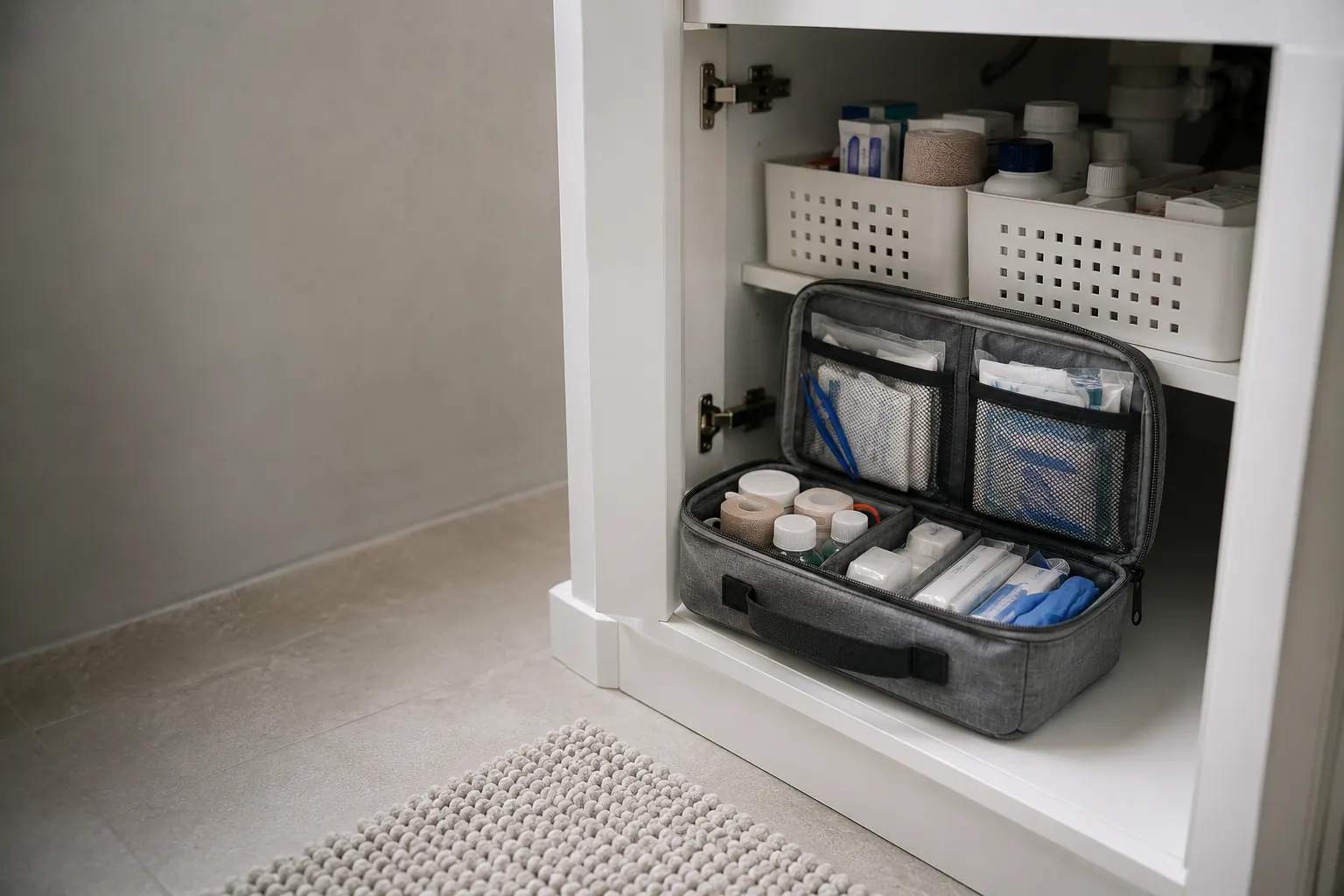
Start with limits, not contents
Decide before an emergency what the kit is for: minor everyday incidents while help is arranged when needed, not diagnosis or advanced medical treatment. It cannot decide whether a symptom is serious, make a prescription safe, replace a clinician’s plan, or turn an untrained person into a responder.
Call emergency services or seek urgent qualified help when someone has a life-threatening condition, severe symptoms, breathing difficulty, loss of consciousness, suspected poisoning, a serious burn, uncontrolled bleeding, or any situation outside the household’s training. Follow dispatcher instructions. Do not delay a call while searching for a special item or reading a blog post.
Match the kit to where it will be used
Check one existing location first. These are different needs to consider, not a requirement to buy four kits:
| Location | Job | What to check |
|---|---|---|
| Main home kit | The household’s primary supply point | Known location, readable contents and storage within actual instructions. |
| Compact carry kit | Short trips or evacuation | Manageable weight, identifiable supplies and no delay to necessary departure. |
| Vehicle kit | Supplies carried with the vehicle plan | Actual securing/storage instructions and a safe way to reach help. |
| Personal supplies | An individual care or accessibility need | Privacy, required care and the person’s clinician or supplier plan. |
The practical home kit guide explains selection by function. The compact kit guide deals with limited space and transport. Coordinate vehicle supplies with the vehicle emergency kit; a convenient-looking spot is not proof of safe storage or securing.
Choose the next guide by the decision in front of you
- Organize the primary home kit: How to Build a Practical Home First Aid Kit.
- Fit supplies into a small home, bag or vehicle: A Compact First Aid Kit for Apartments and Vehicles.
- Check a bargain pouch’s actual contents: What Cheap First Aid Kits Commonly Leave Out.
- Choose between training and more gear: First Aid Training vs. Equipment.
- Inspect and replace general supplies: First Aid Kit Inspection and Replacement Schedule.
- Adapt access for a person or pet: First Aid Kit Planning for Children, Older Adults, and Pets.
- Compare contents, cases and replacement needs: First Aid Kits and Refill Supplies.
Connect the kit to the wider emergency plan
The kit is one layer among communication, sanitation, food, water, transport, and safe exit. Keep its location on the household plan, but do not make it the reason to stay in an unsafe building or ignore an evacuation order. During a power outage, choose battery lighting and a clear path to the kit rather than candles or a cluttered search.
If the household has to leave, take the compact kit only when it is safe and immediate departure is not required. The power-outage plan and hurricane evacuation plan own event-level timing. A first-aid bag cannot change a road closure, floodwater, fire, or a person’s medical deterioration.
Keep the kit organized by function
Start from an authoritative checklist such as the American Red Cross list, then verify the household can store, recognize, and maintain each category. A practical inventory usually needs to account for:
- barriers and basic hygiene supplies;
- dressings, bandages, and materials that remain sealed and identifiable;
- basic tools intended for the kit;
- instructions, emergency contacts, and a way to record what was used;
- household-specific items only when their use, storage, and limits are understood;
- a safe case or container that protects contents without hiding them from inspection.
Avoid converting the kit into a pharmacy cabinet or a collection of specialty devices. A product that a household cannot identify, operate, store, or replace is not an asset merely because it fits in a pouch.
Keep medication and medical devices on their own plan
Medication, prescribed supplies, refrigerated products, mobility equipment, oxygen, and powered medical devices are not generic first-aid inventory. They need the exact clinical, pharmacy, manufacturer, and supplier instructions collected in Medical Device and Medication Continuity. Do not treat a kit expiry check as a medication review, and do not substitute a product based on an emergency-kit list.
Keep a concise emergency contact and care handoff record with the kit only when privacy can be protected. The family communication plan covers the household’s contact structure; the medical-continuity plan covers the individual clinical details.
Make access part of the design
In ordinary conditions with normal safe lighting, check whether the intended person can reach and open the kit. Consider limited grip or a caregiver’s access without creating a difficult rehearsal. Keep its location private where necessary. Preserve child-safety and privacy safeguards when contents create a poisoning, choking, sharp-object or other hazard; do not remove a safeguard merely to speed access. Arrange authorized access without interrupting required care or blocking exits.
Check the actual location against the case and supply instructions, including temperature, moisture and exposure limits. A room name or waterproof-looking bag does not establish suitable storage. Ask the relevant supplier or professional about uncertain conditions; do not move prescribed supplies in a way that interrupts care.
Train for decisions, not confidence theater
Supplies work best alongside current first-aid, CPR, and emergency-response training from a credible provider. Training teaches a person when to call, how to follow emergency instructions, and what not to improvise. The training-versus-equipment guide keeps those roles separate.
During a normal household check, use safe lighting to locate the kit, read its list and find the phone. A private home contact note can help, but a roadside incident needs its actual location rather than the home address. Stop if access is unsafe; do not enter a hazardous area, interrupt prescribed care or rehearse invasive, medication or device procedures outside qualified training.
After the kit is used
Once care and immediate safety are addressed, note the general supplies that need replacing and any access problem. Follow each supply’s instructions in ordinary, safe conditions. Do not handle suspect contents or enter an unsafe area to inspect or move the kit. Ask the appropriate professional about possible contamination or unsuitable storage, and keep prescribed supplies under the individual’s care plan.
Do not turn the post-event review into a medical record. A short inventory note, the date, and a storage observation are enough for the kit. Clinical details belong with the person, caregiver, and qualified provider.
Inspect before the emergency
The most useful inspection checks for used, expired, opened, wet, torn, heat-damaged, contaminated, or missing supplies. It also checks that the case closes, labels are readable, basic tools are present, and the kit still matches the people and locations it is meant to serve. See the first-aid kit inspection schedule.
If a flood, fire, contamination event or water outage affects the kit, an intact outer bag does not prove its contents remain usable. Keep suspect supplies out of use without hazardous handling; follow the relevant instructions and seek professional clarification when needed. Emergency sanitation and safe-water questions belong in Emergency Sanitation and Hygiene.
Sources reviewed
ReadyLience reviewed American Red Cross first-aid-kit and kit-expiration guidance, Ready.gov emergency-kit guidance, and CDC emergency-kit guidance. This hub contains no diagnosis, treatment procedure, dosing, or clinical recommendation. Current product instructions, clinician guidance, and emergency services control actual care.