
This is a comparison framework, not a product ranking. ReadyLience has not purchased, opened, field-tested, or medically evaluated specific first-aid kits or refill supplies for this draft. There are no affiliate links. Until a documented research and hands-on protocol exists, a responsible comparison should help readers ask better questions rather than pretend a single pouch is best for every home.
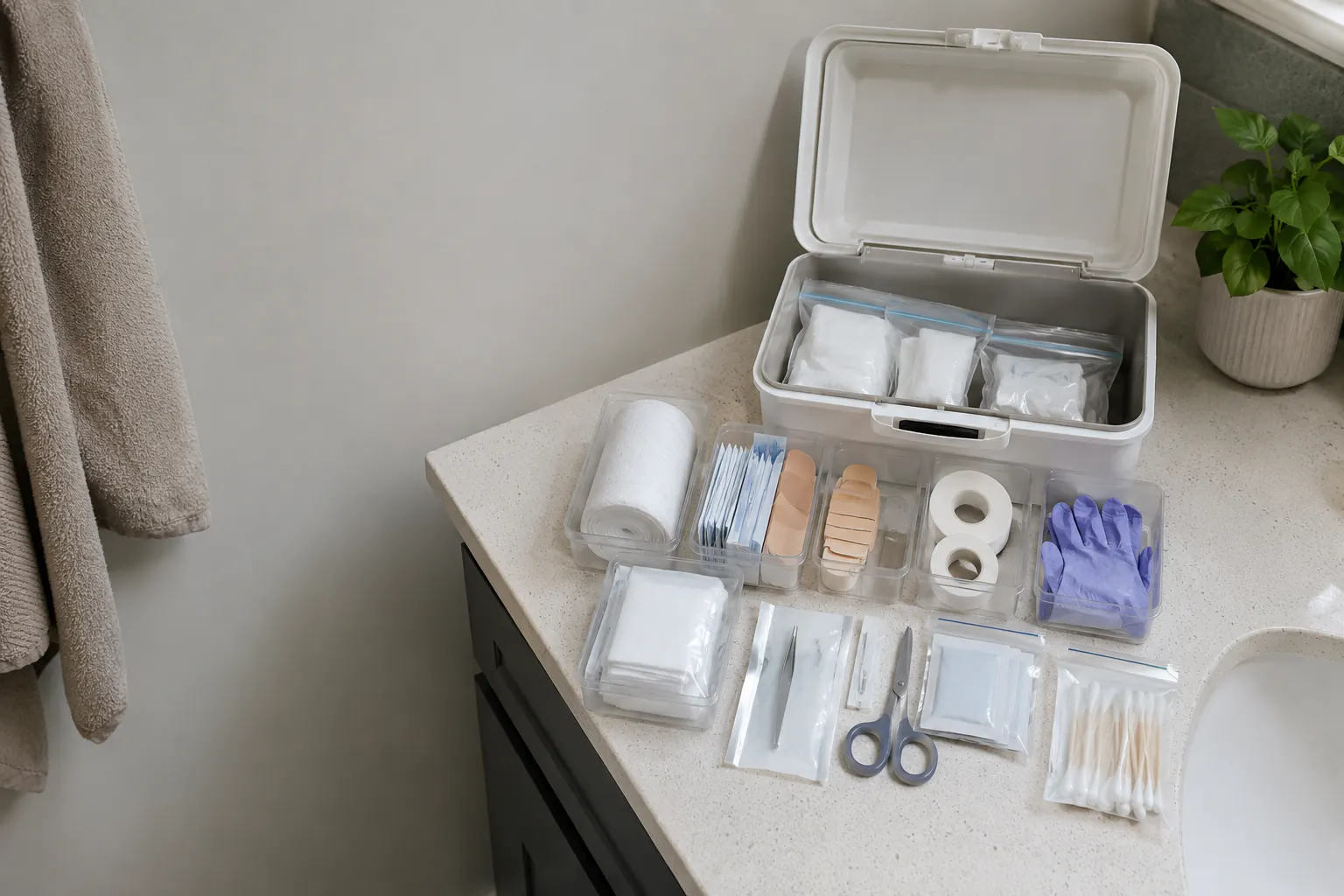
Compare the system, not the bag
A first-aid kit belongs to a household system: home location, compact carry module, vehicle module, training, replacement routine, personal clinical plans, and emergency contacts. A product can be well organized and still be wrong for the available storage, the people who may use it, or the household’s training.
| Comparison dimension | What to verify |
|---|---|
| Contents | Individual item list, category coverage, package sizes, and whether items are identifiable. |
| Organization | Can a user find supplies without emptying the case or damaging sterile packaging? |
| Storage | Case dimensions, closure, label visibility, moisture/heat limits, and location fit. |
| Replacement | Individual dates, refill availability, cost, inventory card, and whether components can be replaced separately. |
| Access | Opening force, readable labels, low-light visibility, child/pet safety, and caregiver handoff. |
| Evidence | Manufacturer instructions, transparent components, documented testing, and honest limits. |
Start from the American Red Cross kit checklist, then identify the actual household gap. The home kit guide provides the system design; the cheap-kit warning explains why item count is a weak metric.
Compare refills against the existing case
A refill is only useful when it matches the original supply’s intended use, storage, size, and the household’s training. Do not blindly buy a bulk refill because it is cheap. It can create a case full of one item while basic categories, labels, or access remain weak.
Before replacing a component, inspect the original inventory and individual package directions. Record whether the item was used, damaged, expired, heat-exposed, or missing. The inspection schedule turns that into a practical routine.
Avoid loose, unlabeled, mixed, or unknown supplies. If an item is not identifiable or its packaging cannot be evaluated, it cannot be responsibly compared or relied upon.
Do not compare clinical needs through a retail filter
Personal medications, prescription supplies, devices, refrigerated products, allergies, infant feeding, disability, and condition-specific needs cannot be selected by a generic first-aid-kit ranking. They need exact guidance from the relevant clinician, pharmacist, manufacturer, supplier, caregiver, or veterinarian. Use Medical Device and Medication Continuity for the clinical continuity record.
A product page, product review, or affiliate link does not make a supply safe for a person. Never replace a prescribed or individually planned item with a similar-looking retail product because a bundle claims broad coverage.
A future ReadyLience review method
Before recommending a product, ReadyLience should document the exact model, date of review, source of product, any affiliate relationship, contents received, individual labeling, case dimensions and weight, opening and organization, storage instructions, replacement path, user-access considerations, and limits. Hands-on review should state what was actually inspected, not imply clinical validation or emergency-field performance.
The protocol should also evaluate whether the kit supports a clean handoff to emergency services, whether it can be inspected without disturbing sealed supplies, and whether the marketing claim matches the visible contents. It should not simulate injuries, make treatment claims, or use a product as a substitute for current qualified training.
Keep commercial intent honest
First-aid products can eventually be an appropriate affiliate category, but only when recommendations are evidence-based, materially disclosed, and useful. Public product links must be affiliate links under ReadyLience policy, open in a new tab, and use the required disclosure. No generic source link or unpaid product link belongs in the article.
Until the research method is documented and applied, the best decision may be no purchase: inspect the existing kit, replace one damaged component under its label, move the kit to an accessible location, or complete relevant training.
Compare the same use case
Do not compare a tiny carry pouch with a family home kit as though their only difference is quality. First decide whether the product is for an apartment cabinet, vehicle, travel bag, caregiver handoff, or a larger household location. Then compare options that actually serve the same role.
Check the path from storage to use: can the case be found in low light, opened with the available grip strength, kept dry, and returned to its location? Does it fit without blocking an exit or becoming loose cargo? A better contents list does not solve a case that cannot be reached.
Treat refills as maintenance, not an upsell
Before ordering a refill, identify which original component it replaces, what the label says, where it will fit, and whether the original was used, damaged, or simply bundled in excess. A credible refill path supports inspection and ordinary use. It should not pressure a household into accumulating components it cannot store, identify, or maintain.
Avoid a mixed “universal refill” when it obscures individual dates or creates loose unlabelled supplies. A smaller number of clearly labelled, intact replacements is more useful than a large opaque bag.
Disclose the limits of future reviews
The future method should include an accessibility check with the actual intended users when possible: opening, label legibility, case placement, and inventory visibility. It should also declare which questions were not evaluated. A product review is not a clinical study, a certification decision, or proof that a kit will be appropriate in every emergency.
What a future recommendation must disclose
Any future product recommendation must identify the exact model and variant, how ReadyLience obtained it, whether a relationship could earn commission, what was inspected, what was not tested, and the practical household fit it is intended to address. It must link back to the non-commercial kit, training, and inspection pages so commercial intent never becomes an isolated decision path.
Exclusions that protect readers
A future comparison will not rank products as a replacement for emergency services, prescribe supplies for a condition, assess treatment effectiveness, infer clinical quality from a certification label, or claim that a kit is “complete” for every family. It will not recommend personal medication, prescription supplies, or devices without the appropriate professional and manufacturer evidence.
That boundary is not a lack of ambition. It prevents a commercial page from making a medical promise it cannot support. The useful result may be a small, transparent kit, a replacement component, better storage, or no purchase at all.
Use this page as a research worksheet now
Before comparing products, write the intended location, expected users, storage constraints, current training, contents gap, replacement process, and budget. Then inspect the existing kit. This reveals whether the reader needs a new case, a refill, a better label, a compact module, or a course. Use the First Aid and Compact Medical Kits hub to reconnect that purchase question to the non-commercial household plan.
Keep the worksheet with household planning notes, not in a product review comment thread. Its value is the clear decision path it creates before marketing language takes over.
Sources reviewed
ReadyLience reviewed American Red Cross kit-building and inspection guidance and Ready.gov emergency-kit guidance. No kit, refill, or product was tested, ranked, or recommended. This comparison contains no diagnosis, dosing, or treatment procedure.