
Start with the first-aid supplies you already own. In ordinary, safe lighting, check that the person likely to help can find the case, open it, and read the labels. Then identify one missing or used general-kit item against the American Red Cross kit guidance and its product instructions. You do not need to replace the whole kit to make that first improvement.
This is not a treatment manual. Finding supplies, completing an inventory, or contacting a routine caregiver must never delay emergency help. Prescribed supplies and medical devices stay under their individual care plans.
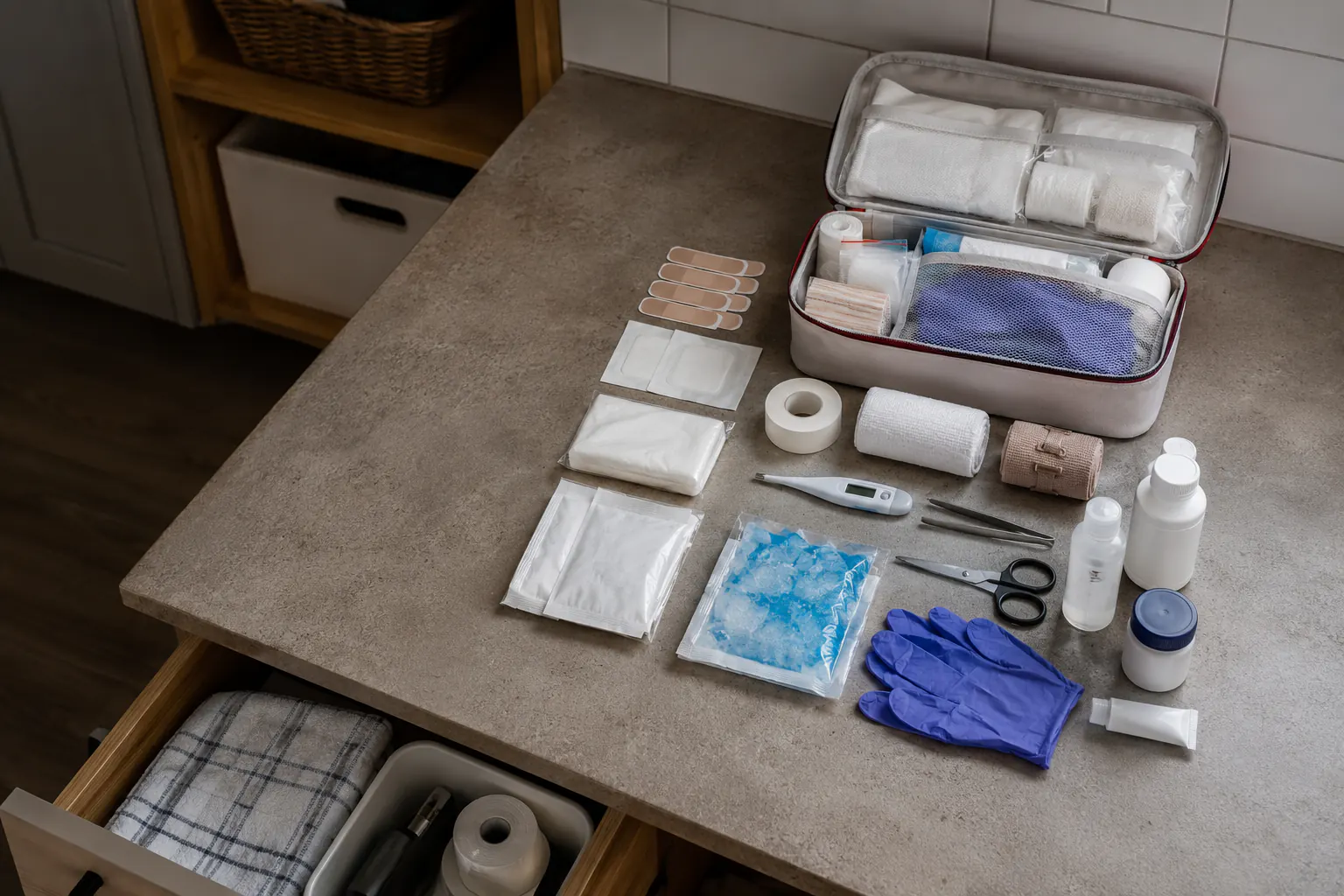
Choose the location before choosing the case
Pick a location that is dry, reasonably temperature-stable, reachable without a ladder, and not blocked by an appliance, storage pile, or locked private room. Everyone who might be home should know where it is. A kitchen-adjacent cabinet can be useful if it is away from heat, moisture, food contamination, and children’s unsupervised access; a bedroom may be useful if a caregiver or vulnerable person spends most time there.
Check the actual conditions rather than ruling out a room by its name. Product storage instructions, heat, dampness, child access, and the route to the kit determine whether a spot works. A vehicle kit has its own storage and inspection needs; it does not replace supplies accessible inside the home. If people use different floors, consider whether a second accessible kit would address a real gap, not just add another case to maintain.
Build from categories, not marketplace counts
An item count does not show whether the kit contains the categories a household can use. Review an authoritative reference list, then organize the case around clear categories:
| Category | What to check |
|---|---|
| Barriers and hygiene | Can you identify the supplies and protect what must stay clean? |
| Dressings and bandages | Are sealed supplies visible, in good condition, and appropriate to your training? |
| Simple kit tools | Are they intended for the kit, recognizable, and stored and maintained as instructed? |
| Information | Can the person helping find instructions, the emergency address, and contacts? |
| Personal needs | Where is the separate, private plan for medications, devices, allergies, and care? |
Do not treat a general kit as a reason to add prescription medication, loose pills, an unfamiliar device, or a specialty item without the relevant professional plan. Those needs belong to Medical Device and Medication Continuity.
Set up one case while conditions are normal
Keep usable supplies in their current appropriate storage while you review them; an empty case is not a prerequisite. Compare existing general-kit supplies with the Red Cross checklist, keeping intact packaging and instructions together. Read each component’s storage instructions before moving it. Note a gap or used item without removing prescribed supplies, changing required storage, or interrupting care.
The first setup should answer these practical questions:
- Who can open this case and read its contents?
- Who is allowed to use or replace the kit?
- How will a person contact emergency services if the normal phone is unavailable?
- Which individual supplies must remain in a separate protected plan?
- Where are accessible supplies or help if the usual room cannot be entered safely?
If access depends on a high shelf, an unavailable caregiver, or an unfamiliar item, address that specific problem while conditions are normal. Keep any required child protection, privacy, and individual care arrangements; do not remove a safeguard just to make the case easier to open. Never enter a wet, smoky, or otherwise unsafe area to retrieve supplies.
Make labels do useful work
The case does not need a catalog label on every item, but it should make three things obvious: where clean sealed supplies are, what has been used, and how to get help. Keep an inventory card in plain language, with quantities only when they help replacement. Avoid putting diagnoses, prescription details, key codes, or personal identifiers on the exterior.
Use a simple “replace” pocket, card, or note for items used during ordinary life. Otherwise, the kit slowly becomes an empty bag after small injuries. Keep receipts and manuals with household records when needed; the kit itself should be readable under pressure.
Plan around ordinary incidents and immediate escalation
The kit should support the household while it calls for help or deals with a minor, familiar issue within its training. It should not become a reason to delay emergency services. Establish these stop rules before an event:
- a serious or worsening condition means emergency services or urgent qualified care, not an online search;
- an unfamiliar product, missing instructions, or damaged required packaging is a reason to pause and ask the appropriate professional, not guess;
- medication, clinical supplies, and devices follow their own professional instructions;
- suspected contamination, floodwater, or fire residue requires appropriate guidance; do not handle suspect contents or enter an unsafe area for an inspection;
- no one performs a procedure that exceeds their current training.
The first-aid training guide explains why a kit is not a substitute for learning when to stop.
Include the household, not an imaginary average family
Review the kit with the people who may use it. Can they read labels in low light? Open the case with reduced grip strength? Reach it without climbing? Identify emergency contacts? Keep it separate from children’s access when necessary? A kit that is inaccessible to the caregiver present is not a household kit.
For children, older adults, disability, pets, infant feeding, or an individual medical need, make the kit a route to the correct separate plan, not a place to make generic medical substitutions. See first-aid kit planning for children, older adults, and pets.
Run a quiet inspection routine
At a predictable time, inspect the outer case, sealed packaging, expiration dates where present, labels, and contents that were used or exposed to heat, moisture, dirt, or damage. Replace according to the product label and the household’s plan. The inspection and replacement schedule gives a short checklist.
Do not use a kit label’s overall expiry date as proof that every item is current. Component dates and package condition matter. The American Red Cross notes that some kit contents are date-sensitive and advises checking individual expiration dates.
Keep an event-ready information card
The card should be factual and short: home address, unit or floor detail where useful, emergency contacts, kit location, and a reminder to call for professional help when the situation is serious. It can also name the location of the protected medical-continuity plan without copying private medical details into the kit.
Update it after a move, new phone number, building-access change, caregiver change, or household composition change. The family communication plan provides the wider household process.
Know what does not belong in the case
Do not store fuel, food, cleaning chemicals, loose batteries, sharp household tools, personal documents, unlabelled medication, or a mix of unknown products inside the kit. They make inspection harder and can contaminate or obscure first-aid supplies. Keep sanitation supplies and waste plans in their own controlled system through Emergency Sanitation and Hygiene.
Finish with one useful change: replace a used general-kit item, make the location clearer, or resolve a storage question. A short, readable note is enough; a detailed household inventory is optional.
Review the kit after a home change
Moving furniture, changing a lock, adopting a pet, adding a roommate, starting care for a family member, or converting a room to a nursery can make an old location impractical. After a meaningful change, check access in ordinary, safe lighting. Do not switch off power, block an exit, interrupt care or required storage, or create an obstacle to rehearse a problem. Discuss an alternative location or source of help instead of trying an unsafe route.
Review whether the kit now sits near a new heat source, leak path, cleaning product, food storage area, or child-accessible shelf. The answer may be a different shelf, a compact second kit, a clearer household map, or an updated contact card. It is rarely a reason to buy unfamiliar medical equipment.
Return to the First Aid and Compact Medical Kits hub when the question is about the whole household system rather than the contents of one case.
Sources reviewed
ReadyLience reviewed American Red Cross kit-building and inspection guidance and Ready.gov emergency-kit guidance. This guide contains no diagnosis, dosing, or treatment procedure; current product instructions, clinician guidance, and emergency services control actual care.