
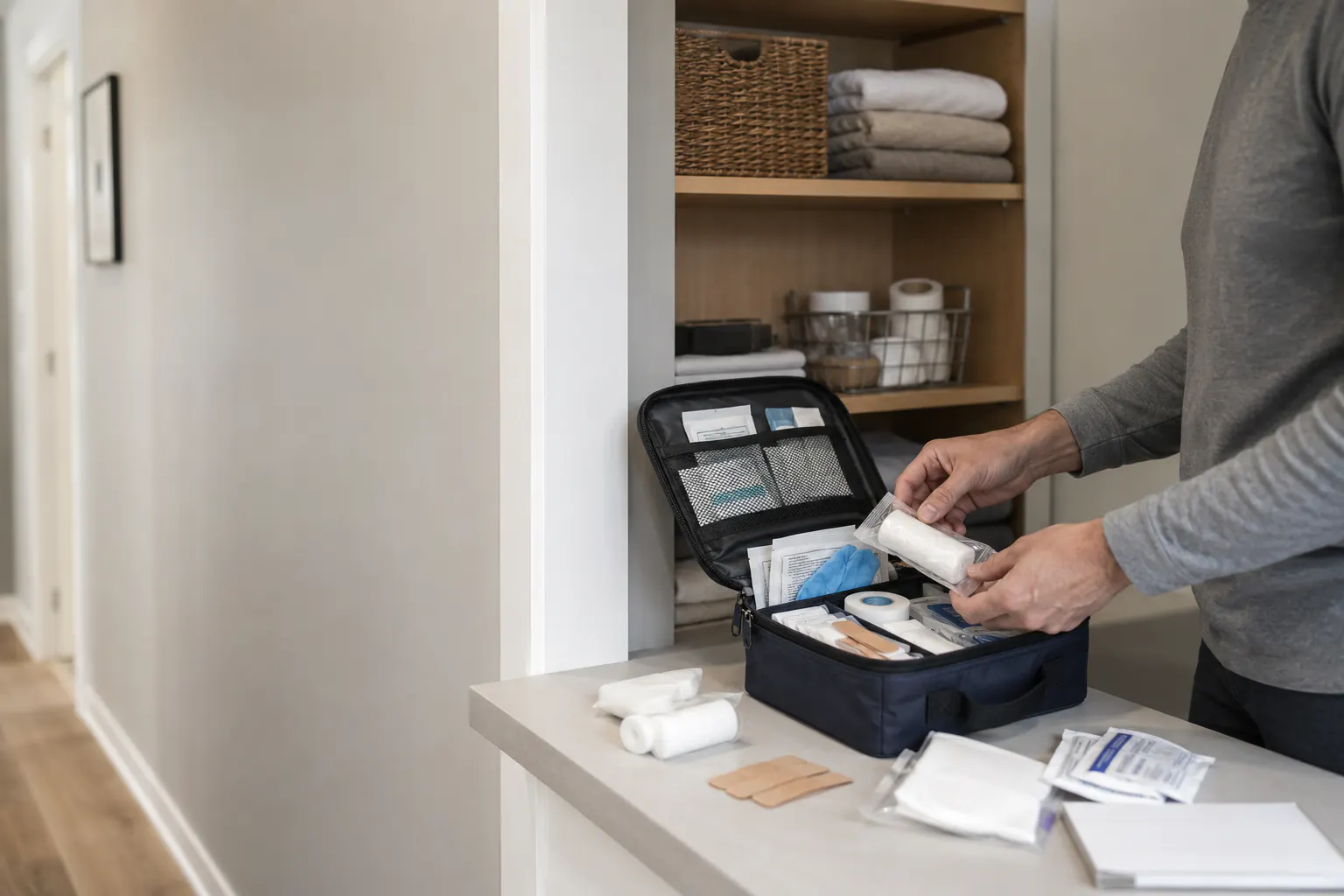
First-aid kits do not stay ready on their own. Supplies are used, packaging tears, adhesives degrade, labels fade, cases get wet, and items are moved into a drawer during an ordinary day. A short inspection routine is more useful than discovering a problem during an emergency.
The American Red Cross advises checking kits regularly and replacing used or out-of-date contents. Inspect individual components, not just the date printed on an outer case.
Keep each kit in a simple readiness cycle
Give each location its own record. A check only counts for the kit that was actually opened.
Set the baseline
Record the kit location, its last check, and the ordinary supplies it is meant to hold.
Check on a real trigger
Review on a household calendar and after use, a move, damage, or an exposure event.
Restock the identified gap
Use the item label and household plan for used, missing, damaged, or date-limited supplies.
Choose a trigger you will keep
Set an inspection date that already exists in the household calendar: the first weekend of a season, the day clocks change, a vehicle-service reminder, or a monthly household reset. Also inspect after any kit use, move, water leak, flood, fire, vehicle overheating, prolonged heat or cold exposure, pest activity, or contamination event.
Write the last check date and the next check date on a simple card. If there are multiple kits, list each location: main home, compact carry, vehicle, caregiver handoff, or workplace-owned kit. The goal is not administrative perfection; it is to know which kit was actually examined.
Use this inspection checklist
- Confirm the kit is in its documented location and can be reached without moving hazards or blocking an exit.
- Check that the case closes, stays dry, and shows no crushing, heat damage, contamination, pest damage, or broken closure.
- Read the inventory card and remove any item that was used, is missing, has an unreadable label, or cannot be identified.
- Check sealed packaging for tears, leaks, swelling, moisture, dirt, or damage.
- Check individual dates where they appear and follow the product’s replacement instruction.
- Confirm basic tools are present, clean, and stored so they cannot injure someone searching through the case.
- Confirm the instruction card, emergency address, and contact method are current.
- Move replacement needs onto a normal shopping or supply list; do not quietly borrow from a protected personal plan.
- Check that children, visitors, and caregivers can follow the household access and safety rule.
- Record unusual exposure, a recall, or a reason to replace the case itself.
The exact contents vary, but an inspection should always discover conditions that make a supply unreliable before someone tries to use it.
Inspect the case and its storage environment
A kit can be compromised by where it lives even when the zipper looks fine. Check for heat, freezing, direct sun, dampness, water intrusion, chemicals, food contamination, dust, smoke residue, and a location that became inaccessible after a storage change. A vehicle kit deserves seasonal attention because a car can experience large temperature swings and vibration.
Move the kit only to a suitable, known location. Do not put it in a bathroom, under a sink, next to fuel or cleaners, behind a heavy storage stack, or where it blocks a fire extinguisher, electrical panel, exit, or child restraint. The compact-kit guide covers apartment and vehicle placement.
Keep medication out of a generic expiry sweep
Medication, refrigerated products, devices, and personal clinical supplies need their own instructions, storage conditions, and professional contacts. FDA advises people to inspect medicines after disasters and to protect them from flood or unsafe-water contact, but a general kit checklist cannot determine whether an individual product is safe or replaceable.
Use Medical Device and Medication Continuity for the medication and device record. Contact a pharmacist, clinician, manufacturer, or supplier as appropriate. Do not use a kit’s printed “expiration” as a medication decision.
Replace with the right item, not just any item
When a component is missing or damaged, use the original label, the authoritative kit checklist, and the household’s training to identify a replacement. Do not buy unfamiliar specialty products because they are bundled, discounted, or marketed as professional. Maintain a kit that the household can recognize and use.
If a kit was exposed to floodwater, fire, chemical contamination, sewage, or unsafe water, separate it from clean supplies. Follow public-health direction and product instructions; do not assume a sealed-looking outer pouch makes every item suitable. Emergency Sanitation and Hygiene covers clean and dirty zones after a utilities disruption.
Keep the replacement record private and short
The inspection card needs dates, location, and basic replacement needs. It does not need diagnoses, prescription names, medical history, account numbers, or private contact details. Store those in the protected clinical and household communication plan. The home-kit guide explains the division.
Check after ordinary use, not only disasters
Most kit failures come from small events: a bandage was used for a routine cut, a caregiver borrowed gloves, a child moved the case, a vehicle was cleaned, or a household member added an unlabeled item. Make replacement part of ordinary life. A kit that receives attention only before a hurricane is likely to be incomplete during a winter outage or a normal weekend emergency.
When something is removed, leave a visible replacement note at once. If a component cannot be replaced with confidence, keep the note and seek reliable product or professional guidance instead of adding a lookalike item.
Use an exposure decision record
After an event, mark the kit as “checked after exposure” when it encountered heat, cold, water, smoke, soot, chemicals, floodwater, sewage, pests, or crushing. Record the date, exposure type, and whether the kit was isolated, cleaned externally, or replaced. Do not record health details.
This small record keeps an outer case from being silently returned to a clean shelf after a contamination event. When public-health or product instructions do not make the next step clear, replace the questionable component or seek the appropriate authority rather than guessing.
Put the next check on the calendar now
Finish each inspection by selecting the next date and the person responsible for it. A shared household may rotate the task, but one named person should confirm it happened. If the home has a main kit and a vehicle kit, give them separate rows; they experience different conditions and should not be marked complete together without being opened.
The purpose is simple: a kit should be predictable when the household is not.
Use a separate row for each kit
One household may have a primary home kit, a compact carry kit, a vehicle module, and a kit associated with a caregiver. Do not mark every location complete because one pouch was opened. Give each its own row with location, last check, next check, exposure, and replacement needs. This makes it obvious when a car kit has been through summer heat or a compact kit has been borrowed for a trip.
The record should never list diagnoses, prescription names, or clinical directions. It simply proves that the container and its general supplies were reviewed. Individual medication and device records remain with Medical Device and Medication Continuity.
Escalate a safety concern instead of making a substitution
If an item appears contaminated, recalled, damaged, unidentifiable, or inconsistent with its label, isolate it and seek the right replacement information. Do not improvise with a similar product, package a loose item for later, or turn a generic inspection into a medication decision. A conservative missing-item note is safer than a questionable “replacement.”
For the complete system, return to the First Aid and Compact Medical Kits hub.
When the inspection finds enough missing that rebuilding is simpler than restocking item by item, the first aid kit and refill supply comparison covers what a household kit needs to contain.
Sources reviewed
ReadyLience reviewed American Red Cross kit-inspection guidance, its kit checklist, and FDA disaster medication guidance. This checklist does not decide medication safety, diagnose illness, or give treatment instructions.