
Start with the kit you already have: can you find it, open it, and recognize the supplies without guessing how to use them? Make that check in ordinary, safe lighting. If an item is unfamiliar, ask your training provider about it rather than trying it on someone. You do not need to finish this check before getting help in an emergency.
A kit puts supplies within reach; training helps you understand their use and your limits. A large pouch is not a qualification, and neither equipment nor a course replaces emergency services or a person’s clinician-led care plan.
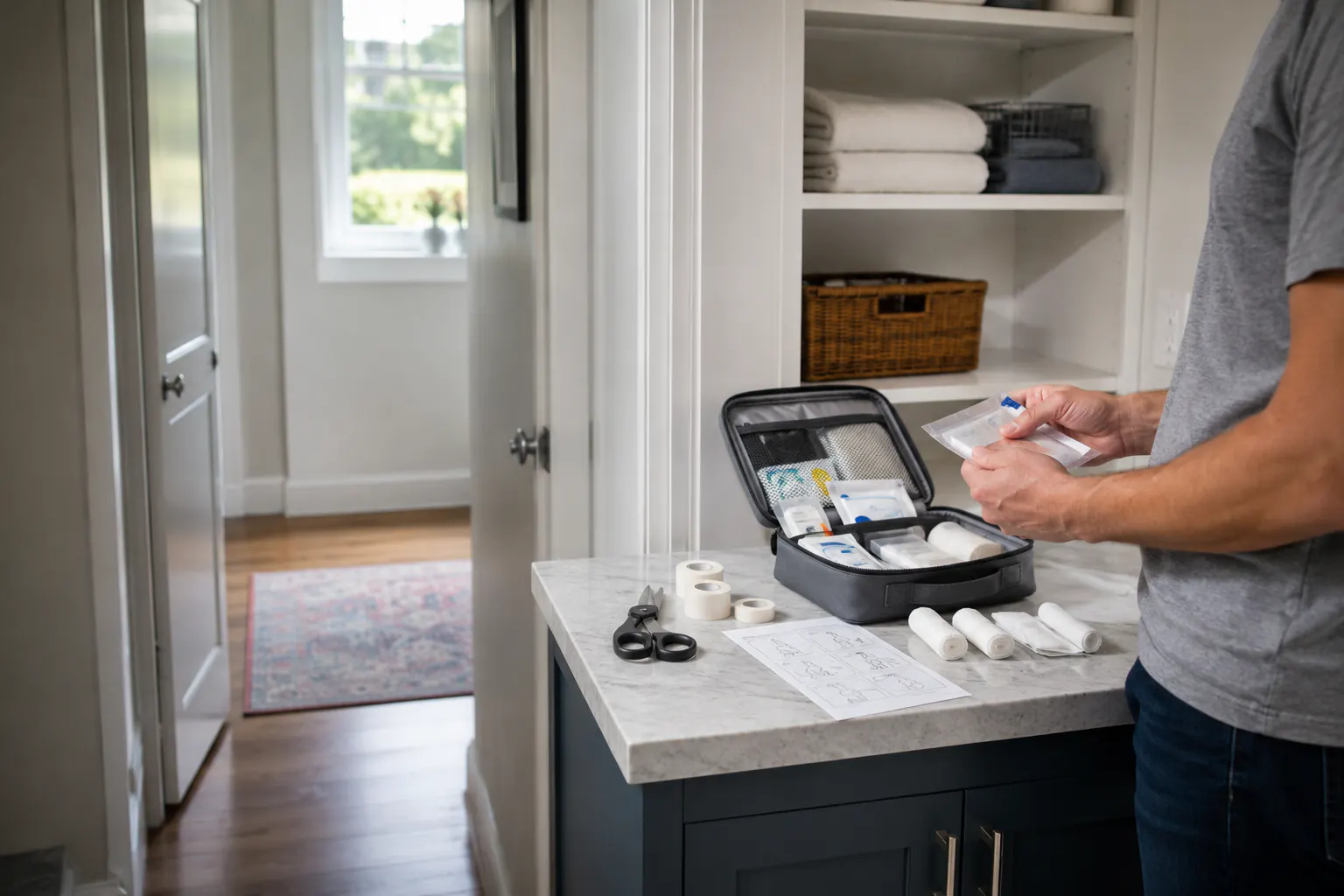
What equipment can do
A maintained kit keeps basic supplies, barriers, instructions, and contacts together instead of scattered through drawers. The American Red Cross recommends knowing where kits are, checking their contents regularly, and replacing used or out-of-date supplies. Keep storage instructions and the user’s training in mind, not just the number of items in the case.
| Equipment can support | Equipment cannot provide |
|---|---|
| Finding basic supplies and emergency contacts | A diagnosis or clinical assessment |
| Following current qualified training or dispatcher directions | Confirmation that a medication or device is suitable for a specific person |
| Keeping supplies together for responders | A substitute for emergency services |
| Checking packaging, dates, and replacement needs | A person’s skill, judgment, or consent |
| Finding the kit at home or while away | Permission to perform a procedure beyond training |
This is why the home-kit guide emphasizes location and inspection rather than a shopping list alone.
What current training contributes
The American Red Cross’s first-aid guidance puts scene safety, calling for help, and care within the person’s training together. A suitable course helps you understand those limits and the supplies it covers. Follow the provider’s renewal guidance and choose training relevant to your role. A class taken long ago may not support confident action now, and an online video is not a substitute for a qualified course when hands-on evaluation is appropriate.
Before choosing a course, ask:
- Who provides and updates the curriculum?
- Does the course include the skills the participant actually expects to use?
- Is there a practical component, evaluation, or renewal requirement?
- Is it appropriate for the participant’s physical ability, language needs, and setting?
- Does the provider make clear what the course does not qualify a participant to do?
Do not claim a certification, skill, or clinical competence that the person does not hold. Training should produce restraint as well as confidence.
Make calling for help part of the household rehearsal
Practice describing the address and how responders can reach you in an ordinary household conversation, not with a test call to emergency services. In a serious emergency, call 911, describe what happened, and follow the dispatcher. Give relevant access and hazard details when asked; an unfinished card, missing kit, or routine caregiver callback must never delay emergency help.
The family communication plan helps preserve those details when phones or networks are strained. Do not put sensitive diagnoses or full medical histories on a public-facing kit label; keep personal information in the protected plan and provide it to responders when appropriate.
Keep roles clear during an emergency
One person can call, another can bring the kit, another can meet responders if it is safe, and another can manage children or pets away from the scene. Decide these roles in a calm moment. No one should be pushed into care they do not understand because they happen to be holding the kit.
Scene safety comes first. Do not enter a fire, smoke, floodwater, traffic lane, unstable building, electrical hazard, chemical spill, violent situation, or other unsafe area to reach a kit or a person. Call emergency services and wait for qualified help when the scene is dangerous.
Use practice that does not create risk
Use ordinary, safe lighting to find and open the kit, read the emergency card, and discuss who would call for help. Do not switch off power, interrupt prescribed equipment or medication storage, block an exit, or introduce hazards for practice. Do not practice invasive skills, medication administration, or unfamiliar equipment on someone without qualified supervision, or act out medical symptoms as a substitute for training.
If a household member has a specific condition or device, use the clinician-led plan in Medical Device and Medication Continuity. General first-aid training does not override the person’s established care plan.
Match the kit to what you are trained to use
After a course, compare its scope to the kit. Add only items the household can store and use according to instructions and training. Set aside loose, expired, damaged, or unidentified general-kit supplies for appropriate replacement or disposal; ask the clinician or pharmacist about prescribed items rather than changing an established care plan. After a kit inspection, identify a genuine training gap rather than buying more equipment by default.
The kit inspection schedule and cheap-kit warning help you check the supplies already at home before buying more. Keep the kit useful without treating it as permission to act beyond your training.
Choose training for the household context
A parent, caregiver, apartment resident, driver, volunteer, or home-repair hobbyist may encounter different risks, but the same rule applies: choose a credible course whose scope is clear, then use its current materials. A course designed for a workplace, outdoor setting, or professional role may include equipment and decisions that do not transfer to a household. Ask the provider how renewal works and how to accommodate hearing, language, mobility, or learning needs.
Keep training records with private household documents, not pasted to the kit. A card can say that a person has been trained only when that is true and when the person agrees it is useful to share.
Avoid two confidence traps
The first trap is “I watched something once.” Public videos can be useful reminders but do not verify technique, current standards, or a reader’s ability. The second is “we have the equipment.” A kit does not identify an illness, interpret a symptom, or give permission to use medication or a device outside the instructions.
For a suspected serious emergency, call 911, describe the situation, and follow the dispatcher. Do not wait to find a training record or work through a supply checklist. Routine course, storage, and product questions belong with the training provider, clinician, pharmacist, or manufacturer as appropriate.
Review a course after the household changes
Revisit training after a move, new child, caregiver change, new job role, new vehicle routine, or a change in mobility. Update the kit only after verifying that the new item belongs to the course scope and can be stored appropriately. A responsible plan can become simpler over time when a specialty item has no clear user or maintenance path.
Make a household training record that stays honest
Keep a private, simple note with the course provider, completion date, renewal expectation, and the participant’s own description of what they are comfortable doing. Do not turn it into a public claim of expertise or ask a visitor to rely on a credential they have not seen. In an emergency, call professional help and describe the situation; the record is for household planning afterward, not a substitute for dispatcher instructions.
At the next inspection, choose one unfamiliar supply or one course question to clarify. Set aside an unidentified general-kit item rather than experimenting with it; do not remove prescribed supplies or interrupt an established care plan. Ask the relevant clinician or pharmacist about those. The First Aid and Compact Medical Kits hub connects the access, training, personal-plan, and maintenance guides.
Sources reviewed
ReadyLience reviewed American Red Cross first-aid education and kit guidance and CDC emergency-kit guidance. This guide contains no treatment procedure, diagnosis, or certification claim; current training providers, product instructions, clinicians, and emergency services control actual care.