
Start with the first-aid kit you already own. In ordinary, safe conditions, check whether you can find it, open it and read the contents list. Choose one gap to resolve: a used supply, an unclear label, an unsuitable storage spot or a training question. Price alone cannot answer those questions, and a larger pouch may not solve them.
These checks are for advance preparation, not an emergency. Never delay emergency help or a necessary departure to inspect a kit, finish an inventory or shop for supplies. Individual professional care plans still control prescribed supplies and devices. No specific kit is ranked or recommended here.
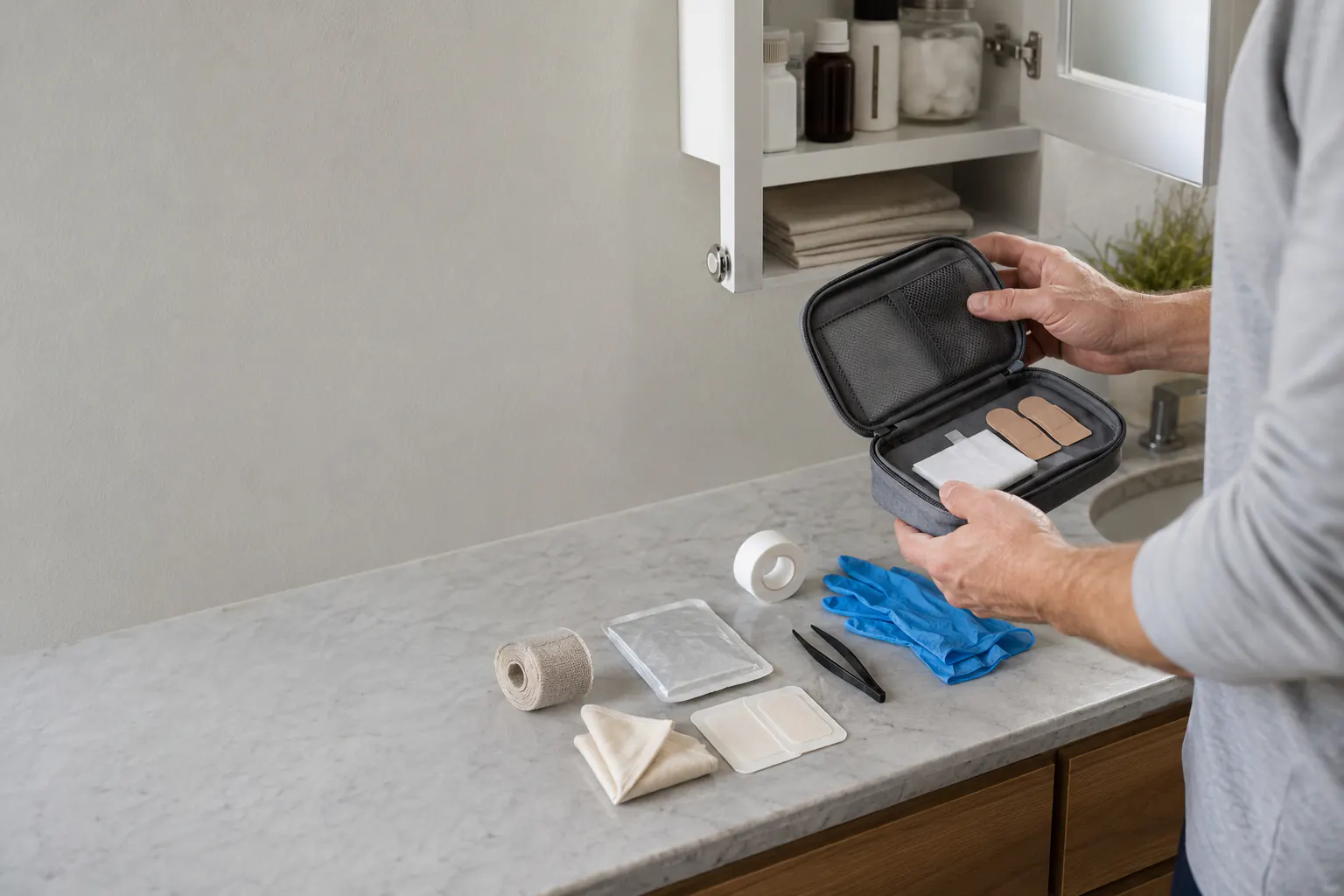
Item count is not readiness
A large item count can include many small or duplicate supplies. Read the actual list: the total alone does not tell you whether the contents suit the household, whether required packaging is intact, or how used supplies will be replaced.
Start with the American Red Cross first-aid-kit checklist as a reference, then use these questions:
| Check | What to look for |
|---|---|
| Contents list | Identifiable supplies, not only a total item count. |
| Household needs | Basic supplies suited to the intended task and current training. |
| Labels and packaging | Readable instructions and dates where applicable; intact required packaging. |
| Finding a supply | An organization method the intended person can use in ordinary conditions. |
| Help and instructions | A way to reach help without relying on the pouch or a completed card. |
| Storage | Actual conditions within product instructions, with safe access and clear exits. |
An item that cannot be identified, has no instructions, is damaged, or exceeds the user’s training should not be counted as a solution.
Common gaps to look for
No replacement system
A low-cost kit can become good value if it has a visible inventory, replaceable basic supplies, and a household habit of checking it. It becomes false economy if a used or expired item is discovered only during an emergency. Look for an organization method that lets a household see what is missing and add a simple replacement card.
Case quality mistaken for content quality
A hard case, waterproof-looking fabric, or a zipper does not prove that internal packaging will survive heat, moisture, crushing, or long storage. Check the actual location against the case and supply instructions. Preserve child-safety and privacy safeguards, required care and clear exits; do not remove a safeguard merely to make access quicker.
Missing fit for the household
A general retail kit cannot know about children, older adults, pets, allergies, low vision, limited grip strength, or a caregiver’s needs. Those facts may change how a kit is accessed and what separate professional plans are needed. They do not justify adding unknown medical products at random. See planning for children, older adults, and pets.
Medication used as a marketing shortcut
Do not treat over-the-counter or prescription products included in a kit as universally suitable. Labels, allergies, interactions, age, conditions, and current clinical instructions matter. Medication, refrigerated products, and medical supplies belong to the individual plan in Medical Device and Medication Continuity, not to a generic product comparison.
Specialty equipment without training
Specialty equipment can create a false sense of capability when it has no current training, instructions, storage plan, or replacement path. More contents do not make a person qualified to diagnose, perform an invasive procedure, or delay emergency services. The training-versus-equipment guide explains the boundary.
Name the gap before buying
Before buying, identify where the kit will live, who can access it and which general-supply or case problem needs solving. One supply question does not require a full household inventory. Compare suitable options by transparent contents and maintenance, not by “professional,” “tactical,” “survival,” or “premium” language.
Avoid kits marketed with claims that sound like guarantees: “everything you need,” “hospital grade,” “for any emergency,” or an unexplained certification badge. A workplace, school, or regulated setting may have requirements that a household kit does not meet; consult the responsible safety or compliance authority instead of assuming a retail kit transfers across settings.
Improve what you already own first
Before replacing an entire pouch, check the existing one if it is safe to access. A private contact note or clearer organization may resolve the problem without a new kit. Follow individual instructions for general-supply replacement; do not handle suspect contents or enter an unsafe area to inspect them. Ask the appropriate professional about uncertain contamination or storage, and do not interrupt prescribed care to move or replace supplies. The home kit guide and inspection schedule help separate supply, access and training questions.
This page makes no claim that a specific product is complete, compliant, or suitable for a particular condition.
Read the listing as a claim to verify
Before a purchase, save the exact contents list, dimensions, storage claims, and seller identity. Marketplace photos can be generic, bundles can change, and a large product image rarely proves that every component is individually labeled or current. Check the package when it arrives against the listing and against the reference checklist. Record only what is actually present.
Do not confuse a word such as “medical,” “emergency,” “trauma,” or “professional” with evidence of quality, regulatory compliance, or personal suitability. A credible listing should still be evaluated by contents, instructions, storage, and the household’s real use case.
Do not buy for a dramatic scenario
Avoid building a household kit around the most frightening image in a product listing. A kit needs to support common, foreseeable household access needs and a prompt call for help when the condition is serious. Specialty equipment marketed for tactical, wilderness, or professional use can be the wrong fit for a home if the user lacks current training, a lawful purpose, safe storage, or a replacement plan.
If an emergency is beyond the kit and training, the correct next step is qualified help. The home-kit hub and training guide make this boundary explicit.
A better replacement decision
Replace a low-cost kit only after naming the gap. For example, the issue may be that the case is inaccessible, the labels are unreadable, supplies were used and not replaced, the kit does not travel well, or household members do not know when to call for help. That diagnosis of the system can be made without diagnosing an injury.
Use the kits and refill comparison for case, contents and replacement criteria. It is a research-based planning guide, not evidence that a particular kit has been tested or is suitable for your household.
Compare price over the maintenance cycle
The first purchase price is only one part of the decision. A kit that cannot be inspected, refilled by identifiable components, stored safely, or used by the household may cost more through waste and replacement. Conversely, a modest kit can remain useful when its contents are transparent, the case fits the home, and the household replaces supplies after use.
Do not try to estimate clinical value from price, brand, a star rating, or a phrase such as “military grade.” Compare practical ownership: access, labels, storage, replacement, and training fit. Then return to the First Aid and Compact Medical Kits hub to make sure a product decision still fits the wider communication, sanitation, and personal-plan system.
Sources reviewed
ReadyLience reviewed American Red Cross kit-building and inspection guidance and Ready.gov emergency-kit guidance. No product was tested, ranked, or recommended. This page contains no diagnosis, dosing, or treatment procedure; current product instructions, clinician guidance, and emergency services control actual care.