
A trunk will happily swallow any amount of gear; usefulness comes from something smaller — a secured, inspected set of modules matched to the vehicle, passengers, season, route, and help available.
Start with the vehicle and transportation resilience hub when the household still needs to define routes, alternate modes, communication, and departure decisions.
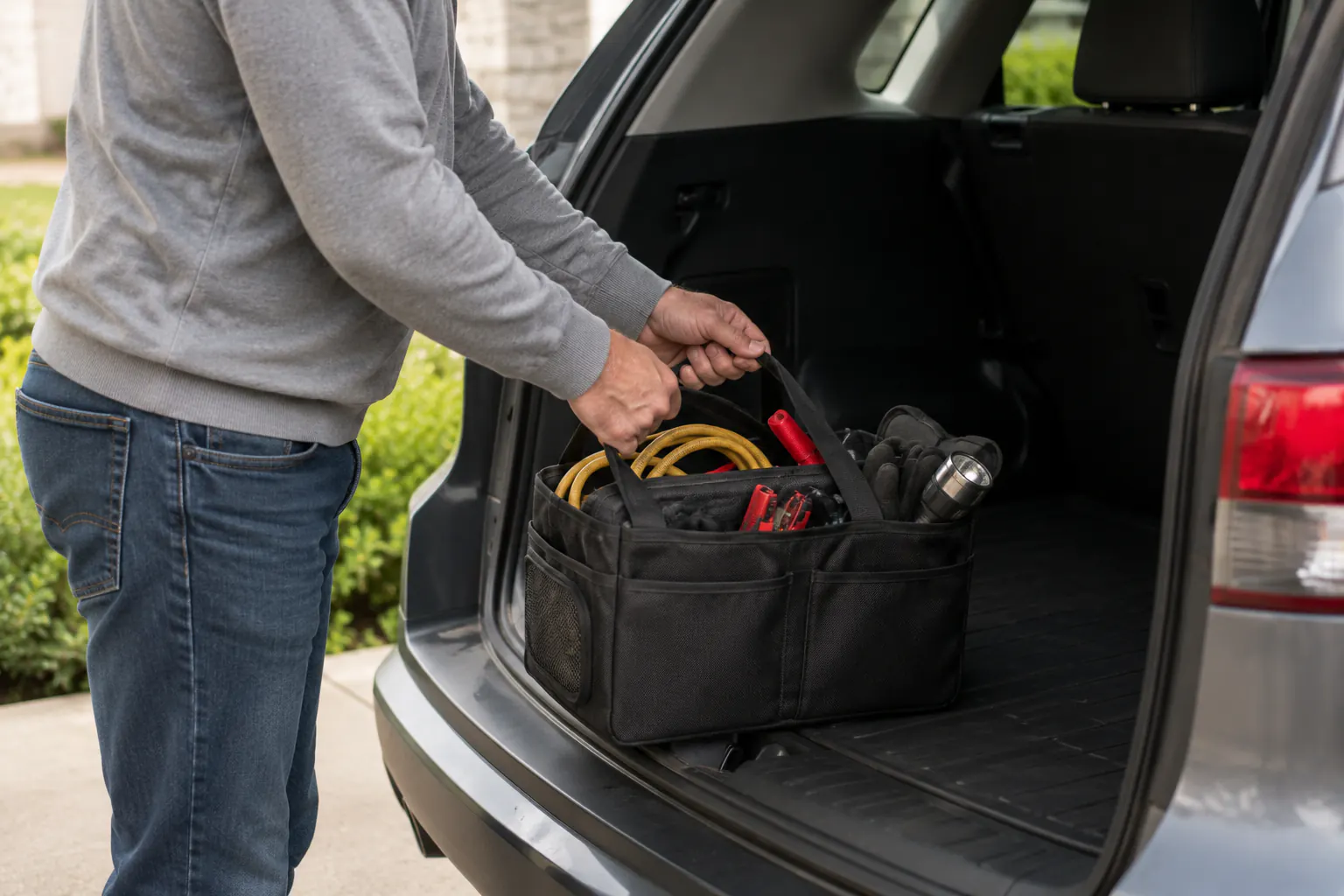
NHTSA recommends carrying a charged phone and charger, first-aid supplies, flashlight, jumper cables, tire-pressure gauge, basic tools, water, nonperishable food, medicines, maps, blankets, and other roadside items. Those categories are a starting point. The household still has to decide what it can use safely and what every regular passenger needs.
If the vehicle is already stopped in danger
Call 911 for a crash, injury, fire, smoke, rising water, downed line, hazardous spill, entrapment, suspected carbon monoxide exposure, or a vehicle in live traffic. Give the location, direction, lane or shoulder, vehicle description, occupants, and visible hazards.
Do not step into traffic to retrieve equipment, place a warning device, inspect damage, or make a repair. Do not crawl under a vehicle supported by a jack. Do not open a hot cooling system, touch high-voltage EV components, transfer fuel, or improvise towing. The kit supports survival and communication; it does not make an unsafe roadside a workshop.
Read the roadside breakdown stop rules before choosing repair-oriented products.
Start with one core module
Keep these items accessible without unloading the entire vehicle:
- charged mobile phone and a compatible vehicle charging cable;
- independent power bank within its storage-temperature instructions;
- LED flashlight or headlamp with inspected batteries;
- paper contact list, roadside-assistance details, and regional map;
- high-visibility vest sized for each regular driver;
- manufacturer-compatible reflective warning equipment where lawful and safe to use;
- basic first-aid kit matched to current training;
- drinking water and shelf-stable food;
- emergency blankets or season-appropriate insulation;
- work gloves, disposable nitrile gloves, and a small trash bag;
- paper and permanent marker for location, condition, or help information.
Keep the phone, light, vest, and assistance information reachable from a seated position when practical. A trunk-only communication kit may be inaccessible after a collision or in traffic.
Add a vehicle-specific module
Read the owner’s manual before buying a generic kit. Record what the vehicle actually uses:
- spare tire, jack, and tools, or the manufacturer’s mobility system;
- correct tow-point and roadside recovery information for professionals;
- tire-pressure specification from the door placard;
- compatible jump-start method, if any;
- locking wheel-nut key;
- spare fuses only when the manual identifies user-serviceable fuses;
- approved washer fluid and ice scraper where needed;
- charging adapters that the vehicle and charging equipment support;
- roadside-assistance and dealer numbers.
Possession is not competence. Changing a tire or jump-starting can be unsafe in traffic, poor weather, unstable ground, fire, floodwater, or near damaged electrical systems. Practice only in a controlled safe location with the manual and qualified instruction. Request assistance when the location or task exceeds that boundary.
Add water, food, and medication by person-hour
The kit should cover the longest credible delay, not merely one snack per vehicle. Include:
- water for each regular occupant, adjusted for heat and access needs;
- food that the household already tolerates and can open without electricity;
- essential medication carried under clinician and pharmacy storage guidance;
- copies of critical prescriptions and contact information without exposing unnecessary health data;
- feeding supplies for infants or anyone needing a medically directed diet;
- pet water, food, leash, harness, carrier, waste bags, and current identification.
Heat and freezing can damage food, water containers, medication, batteries, first-aid materials, and electronics. Do not leave a temperature-sensitive medicine in the vehicle unless the product, pharmacist, or clinician confirms the storage arrangement. Rotate supplies to the home before seasonal extremes.
Use the emergency water storage guide for household quantities, then define a smaller vehicle reserve based on route and climate.
Add a heat module
For warm weather, consider:
- additional drinking water stored within product limits;
- broad-brim hat, lightweight covering, and sunscreen;
- battery fan if it can be stored and used safely;
- instant cold packs for trained first-aid use;
- a plan to reach an occupied cooled location.
A parked vehicle is not a safe cooling shelter in heat. Never leave a child, dependent adult, or animal unattended, even with windows cracked. Air conditioning depends on the vehicle, fuel or charge, exhaust environment, and mechanical condition. If anyone shows confusion, collapse, seizure, or another severe heat-illness sign, call 911 and follow emergency instructions.
The extreme heat preparedness hub explains cooling destinations and early relocation.
Add a cold and snow module
Cold-weather travel needs dry layers, insulated footwear, gloves, hats, blankets or sleeping bags, an ice scraper, brush, compact shovel, and traction material appropriate to the region. Chains or cables must be legal, compatible with the exact vehicle, and practiced away from traffic.
Do not use candles, camp stoves, charcoal, grills, fuel-burning heaters, or improvised flames inside a vehicle. Exhaust can be blocked by snow. The winter car emergency kit and stranding guide covers engine-use limits, visibility, cold illness, and the decision to stay with the vehicle.
Add smoke, flood, and evacuation modules
For wildfire smoke, include clean well-fitting respirators selected under public-health guidance for people who can wear them, spare cabin filters only when the owner’s manual supports user replacement, and a clean interior storage bag. A respirator does not make driving into fire or dense smoke safe.
For flood season, the essential item is route discipline: never drive through floodwater or around a barricade. Boots, recovery straps, a tall vehicle, or all-wheel drive do not change that rule.
For evacuation, add copies of the household plan, destination contacts, paper routes, chargers, cash stored discreetly, pet and child supplies, and documents required at the destination. Secure bags below the seatback or in the cargo area so sudden braking cannot send them forward.
Protect children and people with disabilities
Do not let emergency cargo displace a child restraint, wheelchair securement, mobility aid, service animal, accessible exit, transfer space, or medically required equipment.
Add individual modules for:
- age- and size-appropriate child restraints already installed correctly;
- diapers, wipes, clothing, comfort items, and feeding supplies;
- backup batteries and chargers approved for assistive devices;
- communication cards and a concise support-needs sheet;
- sensory, vision, hearing, dexterity, and cognitive needs;
- an accessible waiting or pickup plan;
- a trusted support contact who understands the equipment.
Do not attach accessories to a child seat or restraint unless its manufacturer permits them. Do not alter medical or mobility equipment to fit the kit.
Secure every item
NHTSA emphasizes that cargo must not drop, shift, leak, or escape. Inside a passenger vehicle, loose tools, extinguishers, batteries, water containers, and metal objects can become projectiles.
Use closed containers anchored to manufacturer-approved cargo points where available. Keep weight low and within payload limits. Do not block windows, lights, sensors, airbag zones, seat latches, vents, pedals, emergency releases, or access to the spare or charging cable.
Separate leaking products, damaged batteries, fuels, chemicals, compressed cylinders, and sharp tools from ordinary supplies. Follow product and local hazardous-material rules; do not move a suspect item into the passenger compartment.
Use a quarterly inspection card
Record the date and check:
| Category | Inspect | Replace or escalate when |
|---|---|---|
| Communication | cables, power bank, contacts, maps | swelling, damage, obsolete connector or contact |
| Light and visibility | operation, battery, vest, reflectors | corrosion, weak output, damaged warning item |
| Water and food | seal, date, temperature exposure | leak, swelling, expiration, unknown storage |
| Medical | contents, instructions, personal needs | expired, opened, heat damaged, care plan changed |
| Vehicle tools | presence, compatibility, condition | missing, corroded, wrong model, no safe training |
| Seasonal module | current forecast and passenger fit | wrong size, season, route, or household need |
| Cargo | anchors, container, clearance | movement, leak, blocked restraint, excessive weight |
Inspect after every use, service visit, vehicle change, household change, or extreme-temperature exposure. Keep a short replacement list rather than assuming a sealed commercial bag remains ready for years.
Buy by verified function
Before considering a product, define the measurable requirement: light runtime, operating temperature, power-bank capacity, vest size, water-container rating, storage dimensions, or compatibility with the exact vehicle. Reject kits that hide component models, expiration dates, specifications, or replacement paths.
The planned vehicle emergency equipment comparison will separate researched product categories from personally tested claims. No product should be described as lifesaving, professional-grade, or tested without evidence.
Sources reviewed
- NHTSA: Summer Driving Tips; Winter Driving Tips; Secure Your Load
- Ready.gov: Build a Kit; Car Safety and Emergency Preparedness
Sources reviewed July 14, 2026. Current vehicle, product, road, emergency, medical, child-restraint, accessibility, and local legal instructions control actual kit selection and roadside use.