
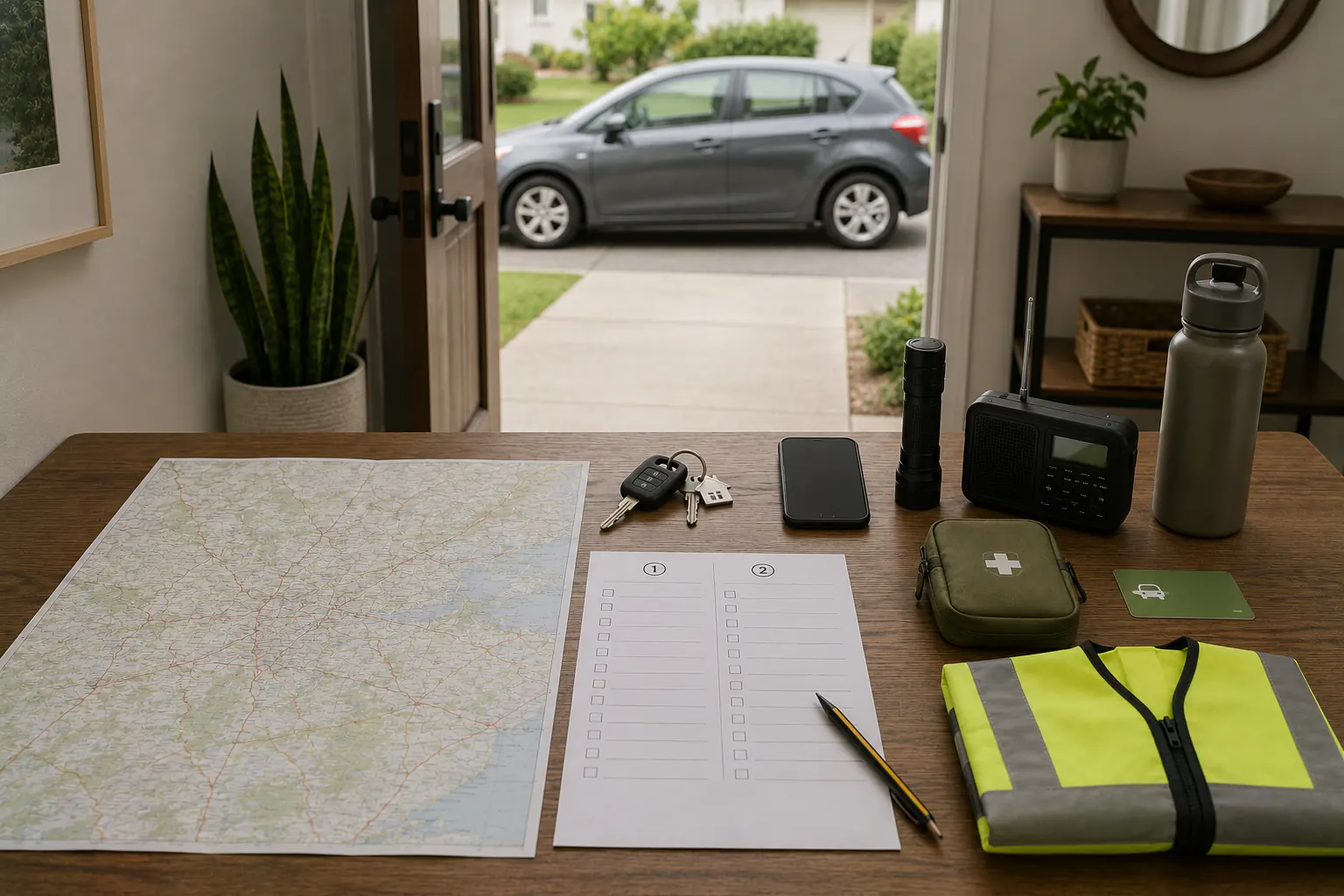
Start with one essential trip and its backup: destination, a method that can carry everyone and a place to wait if it fails. Check current road or transit instructions before moving. A maintained vehicle and supplies support the plan; neither makes a closed or flooded route safe.
A household plan should work on an ordinary Tuesday as well as during a blackout, storm, evacuation, fuel disruption, charging outage, transit suspension, or building closure. It should also work when the primary driver is unavailable, a caregiver must travel with medical equipment, or the household has no private vehicle.
This hub organizes that system. It does not teach high-risk roadside repair, towing, fuel transfer, battery work, high-voltage EV service, or traffic control.
Choose the guide that matches the decision
| Need | Start here |
|---|---|
| Build and inspect supplies | Practical emergency kit for every vehicle |
| Prepare the vehicle before weather | Preventive vehicle checks |
| Plan a disrupted commute | Realistic get-home plan |
| Prepare for winter travel or stranding | Winter car emergency kit and stranding guide |
| Preserve EV mobility through an outage | Electric vehicle outage plan |
| Respond to a breakdown without creating another incident | Roadside breakdown stop rules |
| Build transportation without depending on a private car | Car-free backup transportation |
| Compare kits, jump starters, inflators, and lights | Vehicle emergency equipment comparison |
If travel is dangerous now
- Call 911 for a crash, injury, fire, trapped occupant, suspected carbon monoxide exposure, downed line, hazardous spill, vehicle in live traffic, or another immediate threat.
- Follow closures, evacuation routes, emergency alerts, law-enforcement directions, and transit instructions.
- Do not drive around a barricade, enter floodwater, stop under a damaged tree or line, or follow a navigation app onto a closed or unsuitable road.
- Share location, direction of travel, vehicle or transit details, occupants, medical needs, and the safest callback method.
- Stay belted in a protected location unless fire, smoke, water, traffic position, official direction, or another immediate hazard requires movement.
- Do not attempt a repair beside moving traffic or beneath a vehicle. Request trained roadside or emergency help.
The safest plan may be to stay where you are, leave earlier, use a different mode, or relocate before conditions deteriorate. A kit cannot make a closed road safe.
Build five layers instead of one car plan
| Layer | Question | Minimum evidence |
|---|---|---|
| Go or no-go | Is this trip necessary and is the route officially open? | current alerts, road or transit status, destination confirmation |
| Vehicle or mode readiness | Can the selected method safely make the trip? | maintenance status, fuel or charge, accessibility, operator notices |
| Occupant continuity | Can everyone tolerate delay or rerouting? | water, medication, temperature protection, mobility and child needs |
| Communication | Who notices a missed arrival and what happens next? | route, ETA, overdue time, check-in and backup contact |
| Recovery | What happens if the first method fails? | alternate route, second mode, safe waiting place, roadside assistance |
Review all five layers before severe weather and before an evacuation. The household does not need identical answers for every event, but it needs named decisions and stop conditions.
Maintain the vehicle before it becomes an emergency asset
Follow the owner’s manual and manufacturer service schedule. NHTSA emphasizes tires, recalls, fluids, cooling, batteries, lights, wipers, brakes, belts, hoses, and secure floor mats in seasonal travel guidance. The exact systems vary for gasoline, diesel, hybrid, and electric vehicles.
A preparedness inspection should answer:
- Are registration, insurance, roadside assistance, and emergency contacts current?
- Are recalls checked and scheduled for repair?
- Are tires correctly inflated using the vehicle placard and free of visible damage?
- Do lights, hazard flashers, wipers, defrosters, heat, and air conditioning work?
- Are warning lights, leaks, unusual odors, noises, vibration, or charging faults unresolved?
- Is the spare, mobility kit, or manufacturer alternative present and understood?
- Is fuel or charge above the household’s event-specific departure threshold?
The preventive vehicle checklist turns these questions into a repeatable pre-weather review. It does not authorize opening hot systems, touching high-voltage components, crawling beneath a vehicle, or improvising a repair.
Carry a kit by function and occupant
A generic retail kit rarely covers the people who actually ride in the vehicle. Build modules for:
- communication and location;
- visibility and safe waiting;
- water, food, medication, and temperature;
- first aid appropriate to the household’s training;
- vehicle-specific items named in the manual;
- children, older adults, disability, service animals, and pets;
- seasonal heat, cold, smoke, rain, or flood detours.
Secure every item so it cannot become a projectile or block a pedal, airbag, seat adjustment, child restraint, exit, or cargo cover. Rotate water, food, medication, batteries, and temperature-sensitive items. The practical vehicle emergency kit provides a modular inventory and inspection log.
Separate commuting from evacuation
A get-home plan addresses an ordinary origin such as work, school, medical care, or shopping when the normal trip fails. An evacuation plan moves away from an official hazard toward a designated destination. They may use opposite directions and different timing.
For each frequent origin, record:
- the safest ordinary route and one realistic alternative;
- official road, 511, transit, campus, or employer information sources;
- safe occupied places where a person can wait;
- household check-in and overdue times;
- walking, transit, rideshare, bicycle, paratransit, and trusted-person options that are truly usable;
- barriers such as bridges, tunnels, flood-prone roads, steep grades, gates, elevator dependency, extreme heat, or poor lighting;
- a decision point for sheltering where the person is rather than forcing movement.
Do not publish or share sensitive routes, home vacancy, medical details, equipment, or live location more widely than needed. Use the realistic get-home planning guide with the family communication plan.
Plan for gasoline, hybrid, and electric limits
Fuel stations and charging sites can lose power, communications, payment systems, staff access, or supply. A route shown in an app may still be closed or the equipment unavailable. Keep a normal operating reserve appropriate to the household and increase it when a forecast, evacuation watch, or known disruption justifies doing so.
For an EV, know the usable connector, charging speed, payment methods, at least two networks, and several reachable locations outside the expected impact area. Download or print essential station information before the network is congested. Temperature, speed, elevation, cargo, detours, climate control, towing, and battery condition can change actual range.
Do not connect an EV to household wiring through an improvised adapter, energize a building from a vehicle without a specifically compatible listed system and approved installation, or touch a damaged high-voltage component. The EV outage planning guide distinguishes mobility reserve from optional bidirectional-power features.
Make roadside behavior a separate plan
Breakdowns require decisions about traffic, fire, water, weather, visibility, and whether leaving the vehicle is more dangerous than remaining inside. There is no universal instruction to exit or stay; location and official direction control.
The driver should know how to report:
- road name or number and direction;
- nearest exit, intersection, mile marker, or landmark;
- lane or shoulder position;
- vehicle color, type, plate, and hazard-light status;
- number of occupants and mobility or medical needs;
- smoke, fire, fuel, water, lines, unstable slope, or traffic exposure.
Never stand between vehicles, cross a high-speed road for convenience, work on the traffic-facing side, place warning devices in live traffic, or remain in a vehicle threatened by fire or rising water. The roadside breakdown stop-rules guide supports the call for help without pretending every roadside has the same safe action.
Build a car-free transportation network
Ready.gov advises people without a car to plan evacuation transportation with family, friends, or local government. That principle also applies to households whose vehicle is unavailable.
Document public transit alerts, local emergency transportation, paratransit enrollment, school and employer plans, accessible taxi or rideshare options, trusted contacts, community pickup locations, and destinations that can receive people, service animals, pets, mobility aids, and medical supplies.
Test the plan during normal operations. A nominal option is not a backup if it requires an inaccessible stairway, an app the user cannot operate, a child seat that is unavailable, a pet policy that excludes the animal, or a reservation process that was never completed. See the car-free backup transportation guide.
Inspect and practice quarterly
Use a short recurring drill:
- verify vehicle, transit, and assistance contacts;
- inspect and rotate the kit;
- check one frequent route and one alternative;
- confirm the destination can still receive the household;
- test the check-in and overdue process;
- review fuel or charge thresholds;
- update child, pet, disability, medical, and seasonal modules;
- record one improvement with an owner and date.
Practice from a parked vehicle or at home. Do not rehearse roadside exits, warning-device placement, repairs, or emergency maneuvers in traffic.
Sources reviewed
- NHTSA: Summer Driving Tips; Driving in Severe Weather; Winter Driving Tips; Recalls; Electric and Hybrid Vehicle Safety
- Ready.gov: Evacuation; Preparedness for People With Disabilities
- FHWA: 511 Traveler Information
- Department of Energy Alternative Fuels Data Center: Electric Vehicle Charging Station Locations
Sources reviewed July 14, 2026. Current road, evacuation, transit, emergency, manufacturer, service, charging, and local legal instructions control actual travel and roadside decisions.