
Start with one regular trip: where could you wait safely if the usual way home failed, and who would know? Confirm destination, transport and current instructions before moving. Getting home is not the goal when home or the route is inside the hazard.
The vehicle and transportation resilience hub places this commute plan inside the household’s broader vehicle, evacuation, car-free, and roadside system.
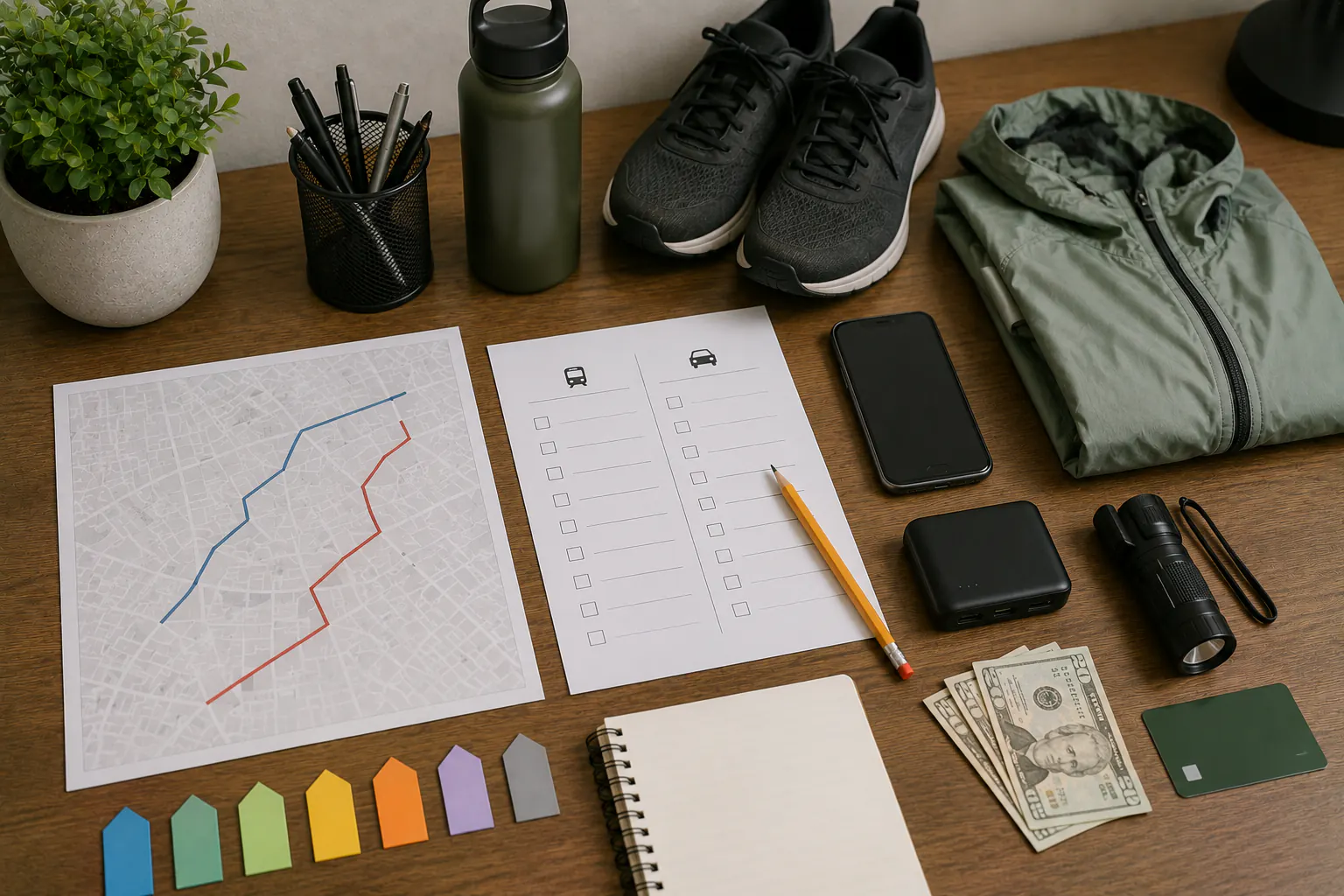
Ready.gov’s commuter plan asks people to record normal and alternative routes, public transportation, fares, taxi or other options, and local traffic information. The valuable part is not the worksheet itself. It is making those choices before phones, roads, transit, and household members are under pressure.
Separate three different movements
Do not use one route for every problem.
- Get home: move from a routine location toward the household when that destination is safe.
- Evacuate: move away from an official hazard toward a designated destination, which may be opposite home.
- Shelter where you are: remain at work, school, a medical facility, or another occupied building when movement creates greater exposure.
Flooding, wildfire, chemical release, active violence, severe weather, or an evacuation order can make home the wrong destination. The plan must allow that conclusion without treating it as failure.
If the disruption is happening now
- Follow emergency alerts, building or campus instructions, transit announcements, road closures, and law enforcement.
- Call 911 for immediate danger, injury, fire, violence, rising water, downed lines, or another life threat.
- Tell the household whether you are staying, moving, or waiting, using a brief pre-agreed format.
- Do not begin a long walk, bicycle trip, or drive merely because navigation still draws a route.
- Confirm the destination is safe and can receive you before departing.
- Set the next check-in time and the action the household should take if contact fails.
Avoid public posts with live location, an empty home, a child’s location, medical details, or a route. Share only with people who need the information.
Map the real starting points
Create one plan for each location visited regularly:
- workplace and secondary job site;
- school, childcare, or campus;
- medical, therapy, or caregiving destination;
- shopping or recreation area;
- transit station or park-and-ride;
- a relative’s home or shared-custody location.
For each, note ordinary arrival and departure times, who is usually present, building emergency procedures, after-hours access, charging availability, accessible exits, and whether the location can support an extended wait.
Shift workers need nighttime assumptions. Caregivers need to know whether the person they support can remain safely without them. Parents must follow the school or childcare reunification process rather than creating conflicting pickup instructions during an emergency.
Build a route card, not a line on a map
For each origin, record:
| Field | Primary | Alternative |
|---|---|---|
| Safe destination | home or named location | second occupied location outside the same hazard |
| Mode | car, transit, bicycle, walking, arranged ride | genuinely available second mode |
| Route | ordinary authority-supported route | route avoiding the same bridge, tunnel, low point, or station |
| Information | road authority, 511, transit operator | local emergency management, radio, destination contact |
| Wait location | staffed public or workplace site | second accessible occupied site |
| Check-in | person, time, channel | out-of-area contact and fallback time |
| Stop rule | closure, warning, unsafe heat, smoke, water, violence | conditions that make sheltering safer |
FHWA describes 511 as a traveler-information service used in many states for traffic, transit, highway conditions, weather advisories, and emergency warnings. Record the state’s official service and website before the event. Keep a paper regional map because a live map can be unavailable, stale, or unaware of a local closure.
Audit route dependencies
A route may fail because of one hidden dependency:
- bridge, tunnel, ferry, rail crossing, mountain pass, gate, or drawbridge;
- flood-prone underpass, creek crossing, drainage channel, or coastal road;
- wildfire corridor with one exit;
- elevator needed to reach a vehicle or platform;
- traffic signal outage at a dangerous intersection;
- fuel pump, EV charger, toll, ticket, or fare system requiring power or data;
- sidewalk, curb ramp, station, or transfer that is inaccessible;
- school zone, stadium, industrial site, or evacuation traffic bottleneck;
- extreme heat, cold, smoke, darkness, or distance beyond the traveler’s ability.
Two routes that share the same bridge are one route. Two apps showing the same road are one information source. Choose alternatives that remove a dependency rather than changing only the first few turns.
Decide whether walking is truly viable
Do not convert a driving time into a walking plan without field checking it in ordinary conditions. Evaluate distance, grade, crossings, shoulders, lighting, heat, cold, smoke, flood exposure, crime conditions, water, footwear, mobility, medication, daylight, and places to stop.
Walking along an interstate, controlled-access highway, rail line, tunnel, bridge without pedestrian access, evacuation route, flood channel, or wildfire area may be prohibited or deadly. Never enter a closed zone or cross moving water.
Set conservative limits based on the least mobile regular traveler. A get-home bag does not cancel heat illness, cold exposure, respiratory risk, disability, injury, or the need to care for a child.
The plan should name safe waiting locations so that “do not walk” still leads to an action.
Create a small commuter module
Keep supplies appropriate to the normal trip and storage environment:
- phone, charging cable, and compact power bank;
- paper contact and route card;
- transit fare or payment backup accepted locally;
- water and a familiar snack;
- essential medication under proper storage conditions;
- season-appropriate layer, comfortable footwear, and compact rain protection;
- flashlight and small first-aid supplies matched to training;
- well-fitting respirator where public-health guidance and the user’s health allow it;
- disability, communication, menstrual, infant, or service-animal essentials as applicable.
Do not leave temperature-sensitive medication, swollen batteries, pressurized products, or valuable identity documents in a hot or freezing vehicle. Keep the module light enough for the person to carry without losing access to mobility aids or handrails.
The larger vehicle emergency kit stays with the vehicle; the commuter module must still work when the car or garage is inaccessible.
Use an overdue protocol
Choose one household contact and one out-of-area contact. Agree on a message format:
SAFE / LOCATION TYPE / STAYING OR MOVING / DESTINATION / NEXT CHECK-IN
Examples should use categories rather than unnecessary detail: “safe at work,” “waiting at staffed library,” or “on designated bus to family destination.”
Record:
- expected arrival window;
- first overdue time;
- who calls the traveler, destination, employer, school, or transit provider;
- when circumstances justify 911 or a missing-person report;
- what medical, disability, child, or threat information responders need;
- which actions household members must not take, such as entering a closed area to search.
There is no universal waiting period for reporting someone missing. Immediate danger, vulnerability, a known threat, disaster conditions, or an abandoned vehicle can justify prompt law-enforcement contact.
Use the family communication plan to coordinate channels and privacy.
Account for accessibility and care
Test whether every route, waiting place, and mode supports the traveler’s actual needs:
- wheelchair or scooter dimensions, securement, charger, and transfer help;
- cane, walker, service animal, hearing, vision, communication, or cognitive support;
- paratransit eligibility, service area, hours, reservations, and emergency policy;
- refrigerated medication or powered medical-device continuity;
- accessible toilets and safe water;
- a child restraint for any arranged ride;
- caregiver availability and backup authorization.
Do not assume paratransit is an on-demand evacuation service. Local eligibility, hours, service area, capacity, and emergency arrangements vary. Register and practice routine use before relying on it.
Practice without manufacturing danger
Once each season:
- review the route card and official information sources;
- visit the waiting location during its real operating hours;
- make a normal transit or alternate-mode trip where appropriate;
- test the check-in message and overdue sequence;
- inspect the commuter module;
- update destination, care, fare, accessibility, and seasonal assumptions.
Do not practice walking on dangerous roads, entering closed areas, emergency cycling, crossing rail lines, roadside repairs, or evading public-safety controls. A tabletop review can test those decision points.
Keep the commuter essentials with the person when feasible; a kit in an inaccessible vehicle cannot support another mode. The vehicle equipment comparison covers specific equipment gaps, not permission to walk through an emergency.
Sources reviewed
- Ready.gov: Commuter Emergency Plan; Make a Plan; Evacuation; Preparedness for People With Disabilities
- FHWA: 511 Traveler Information
- NHTSA: Driving in Severe Weather
Sources reviewed July 14, 2026. Current public-safety, road, transit, employer, school, campus, emergency-management, accessibility, and destination instructions control actual movement.