
Item count is the easiest number to advertise and the least useful one to buy by. Vehicle emergency equipment earns its place when it fits the exact vehicle, remains usable after months of storage, performs a defined function within published limits, can be inspected and replaced, and does not encourage a roadside task the user cannot perform safely.
Define the transportation system first in the vehicle and transportation resilience hub, then buy only the equipment that fills a measured gap.
ReadyLience has not completed hands-on comparative testing for the products in this category. This page therefore provides a research and buying framework, not product rankings or performance awards. Affiliate links will not be added until a product is individually documented under the testing methodology and Amazon Associates requirements.
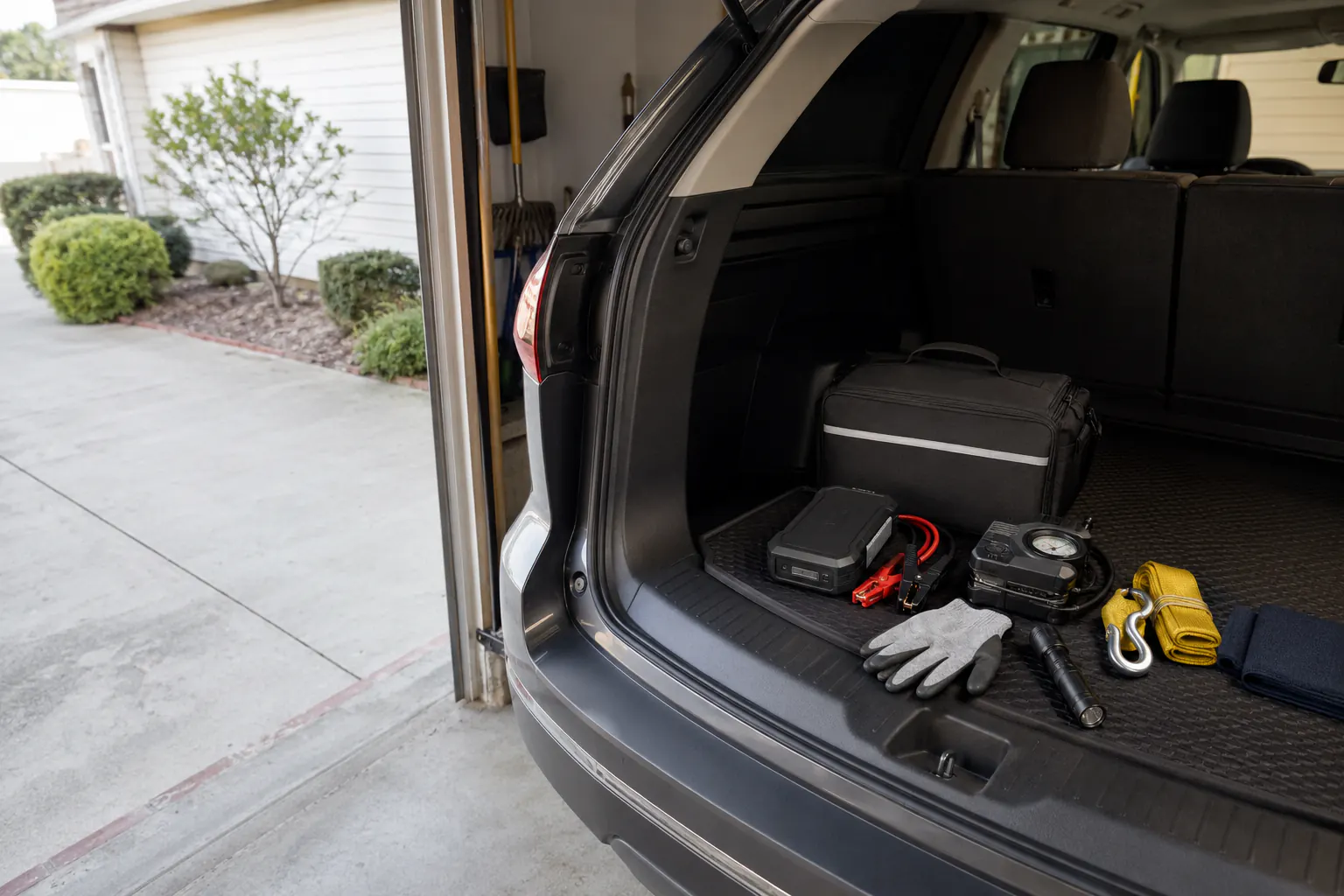
Decide whether equipment can be used safely
Before buying a jump starter, inflator, jack, tool, flare, or repair kit, read the roadside breakdown stop rules. A high-speed shoulder, narrow bridge, live lane, flood, wildfire area, downed line, extreme weather, or unstable surface can make any repair attempt unsafe.
Call 911 for immediate danger, injury, fire, smoke, rising water, hazardous material, entrapment, suspected carbon monoxide exposure, high-voltage damage, or a vehicle in traffic. Request trained roadside service when the location or task exceeds the manual and the user’s controlled-location practice.
Never crawl under a vehicle supported by a jack, open a hot cooling system, touch damaged high-voltage components, transfer fuel at roadside, or improvise a tow point.
Compare complete kits by transparency
Premade emergency kits can be convenient, but an inflated item count may include duplicates or supplies that do not fit the vehicle. Require an itemized list with model, size, rating, quantity, shelf life, and replacement path.
| Criterion | Useful evidence | Warning sign |
|---|---|---|
| Vehicle compatibility | stated voltage, connector, tire range, manual fit | “works with all vehicles” without limits |
| Component identity | brand, model, rating, instructions | unnamed light, cable, gauge, or first-aid contents |
| Storage | temperature and humidity range | no vehicle-storage guidance |
| Inspection | charge indicator, expiration date, replaceable cells | sealed bag presented as maintenance-free |
| Safety | listing or certification applicable to product, recalls checked | vague “certified” logo without directory evidence |
| Training | clear manual and controlled practice | marketing that implies anyone can repair roadside |
| Replacement | individual parts available | entire kit becomes waste after one expired item |
Build the core practical vehicle emergency kit by module. A premade kit should fill a verified module, not define the entire plan.
Keep general household tools in the essential home toolkit unless the vehicle manual or a defined travel task requires a separate secured copy. A trunk should not become storage for loose, heat-sensitive, sharp, or unfamiliar workshop equipment.
Compare jump starters by the exact vehicle
Portable jump starters store substantial energy and can create fire, burn, reverse-polarity, short-circuit, and battery hazards. Some vehicles have model-specific jump points or procedures; some faults should not be jump-started at all.
Record before shopping:
- nominal system voltage and manufacturer-approved jump procedure;
- gasoline or diesel engine size where relevant;
- hybrid, EV, motorcycle, or other model-specific restrictions;
- specified operating and storage temperatures;
- required cable reach from the approved connection points;
- clamp design and protection features;
- recharge method and inspection interval;
- whether the battery can be replaced or the unit must be retired;
- applicable third-party safety certification that can be verified.
UL identifies UL 2743 as a safety standard for portable power packs, including products with a vehicle-booster function. A certification claim should be verified for the exact model in the certifier’s directory rather than inferred from a logo or a certified internal cell.
Peak-amp marketing does not prove reliable starting under the household’s temperature, battery condition, cable, and vehicle constraints. Future hands-on testing should record state of charge, ambient temperature, vehicle or calibrated load, connection process, protections, cable temperature, recharge energy, and repeat attempts.
Do not test by deliberately disabling a road vehicle or repeatedly stressing its battery.
Check lithium-battery recalls and condition
CPSC has documented jump-capable portable chargers that overheated or caught fire. In November 2025, CPSC warned consumers to stop using specified older HALO Bolt ACDC 58830 units after fire reports. That warning does not apply to every portable jump starter; it demonstrates why model, manufacture date, recall status, age, and condition matter.
Before purchase and each seasonal inspection:
- identify the exact model and date code;
- search current CPSC recalls and safety warnings;
- inspect for swelling, cracking, leakage, odor, corrosion, impact, or heat damage;
- verify the charger and cable are the specified type;
- follow storage-temperature and recharge instructions;
- keep the unit secured away from direct sun, water, loose metal, and child access.
Stop using a suspect or recalled product. Do not place a recalled or damaged lithium-ion battery in household trash, curbside recycling, or a general retail battery box. Contact the manufacturer and local household-hazardous-waste authority for case-specific handling and transport instructions.
Compare tire inflators by pressure and duty cycle
An inflator should match the vehicle’s tire pressure and volume, not just advertise a high maximum pressure.
Compare:
- supported supply voltage and connector;
- power draw and fuse requirements under the vehicle manual;
- hose and cable reach to every tire;
- readable gauge range and resolution near the placard pressure;
- auto-stop behavior and whether it can be independently verified;
- duty cycle, cooldown time, and thermal protection;
- operating and storage temperature;
- noise, vibration, stability, and gloves-on controls;
- adapters stored without becoming loose projectiles;
- replacement hose, fuse, and connector availability.
Use the vehicle placard pressure when tires are cold. Do not use the maximum pressure molded on the tire as the routine inflation target. A compressor cannot make a cut, bulge, exposed cord, damaged wheel, failed valve, or repeatedly leaking tire safe.
Future testing should use a calibrated reference gauge, defined tire size, starting and target pressure, ambient temperature, run time, surface temperature, accuracy before and after use, and full cooldown. It should never be performed beside traffic.
Treat sealant kits as vehicle-specific temporary systems
Some vehicles replace a spare with a compressor and sealant kit. Follow the vehicle and kit instructions for puncture type, location, tire-pressure monitoring system, temperature, speed, distance, expiration, cleanup, and professional inspection.
Sealant is not appropriate for every puncture, sidewall or wheel damage, tire separation, repeated pressure loss, or large opening. It can expire even when unused. Record the exact replacement cartridge and date.
Do not buy a universal sealant solely because it fits the valve. Compatibility with the tire, wheel, sensor, vehicle, and repair pathway matters.
Compare lights by task rather than lumens alone
One light rarely performs every vehicle task. Define:
- inspection light: broad close-range beam used only in a safe parked location;
- headlamp: hands-free light with low mode and secure fit;
- cabin light: diffused low output that preserves night vision;
- signal light: legally appropriate visibility equipment for a disabled vehicle;
- personal marker: high-visibility garment or light for official-directed movement.
Compare runtime at useful output, replaceable versus rechargeable cells, storage temperature, water and impact rating, switch lockout, low-battery indication, beam control, and ability to operate with gloves. Check batteries for leakage or swelling during every kit inspection.
Do not place a light or triangle in traffic, aim a high-output or strobe mode at drivers, or assume a flashing product is legal in every state. Flares add ignition and burn hazards, especially near fuel, dry vegetation, and wildfire conditions.
Compare gauges, cables, and warning equipment separately
Low-cost bundles often hide the specifications of critical components.
For a tire gauge, prioritize an appropriate range, legible increments, repeatability, cold-weather operation, and a way to compare it periodically with a reliable reference.
For jumper cables, compatibility, conductor material and gauge, insulation, clamp design, length, storage, and the vehicle procedure matter. Longer or lighter cables can change performance. A cable set does not remove battery-gas, polarity, damaged-battery, traffic, or model-specific risks.
For reflective equipment, verify visibility, stability, storage size, state requirements, and whether deployment can occur without entering traffic. Do not buy a traffic-control illusion: consumer warning equipment does not create a closed lane.
Include the ownership cost
Calculate cost over a realistic service interval:
purchase + replacement batteries + expired cartridges + damaged cables + recall replacement + required charger + storage case
A cheaper kit may cost more when the light, battery, sealant, first-aid contents, and food all expire together without individual replacement. A premium product can still be poor value if it does not fit the vehicle or cannot tolerate vehicle storage temperatures.
Record purchase date, serial number, receipt, warranty, recall source, inspection dates, charge level, expiration dates, and retirement criteria in the kit log.
Use a future ReadyLience test matrix
Any product promoted as tested should disclose:
| Category | Minimum recorded evidence |
|---|---|
| Identity | exact model, firmware where relevant, purchase source, date |
| Claims | manufacturer specification being checked |
| Method | equipment, environment, sequence, repeats, limitations |
| Safety | controlled location, stop rules, no traffic exposure |
| Performance | measured output, runtime, accuracy, temperature, usability |
| Storage | inspection after realistic hot and cold limits without abusive testing |
| Recall | CPSC and manufacturer status on review date |
| Fit | vehicles or tire sizes actually evaluated |
| Independence | sample source, affiliate relationship, sponsor involvement |
Research-only products must be labeled research-only. Reader reports can identify questions but cannot substitute for controlled verification.
A disciplined buying order
- Complete the preventive vehicle checks.
- Read the vehicle manual and inventory included equipment.
- Define occupant, route, season, and roadside-assistance needs.
- Buy communication, water, medication, warmth or heat protection, and visibility essentials first.
- Add vehicle-specific equipment only when compatibility and safe use are clear.
- Check recalls and certification claims for exact models.
- Practice in a safe controlled location without creating a fault.
- Secure the equipment and schedule inspections.
Equipment is the final layer, not the first. A maintained vehicle, an early cancellation decision, a communication plan, and professional roadside support prevent more risk than a trunk full of unfamiliar tools.
Sources reviewed
- NHTSA: Summer and Winter Driving Tips; Recalls; TireWise
- CPSC: Recalls and 2025 HALO Bolt ACDC 58830 Safety Warning
- UL Solutions: Portable Power Pack Testing and UL 2743 overview
Sources reviewed July 14, 2026. Current product recalls, vehicle and equipment manuals, certifier listings, state law, road authorities, emergency services, and qualified service professionals control selection and use.