
In safe parked conditions, check the owner’s manual, unresolved warnings and service needs before planning a trip. Arrange qualified service or another ride early. A watch or warning does not guarantee time to repair the vehicle; required evacuation must not wait for a completed checklist.
Use the vehicle and transportation resilience hub to connect this inspection with routes, occupants, alternate modes, and roadside help.
This checklist is for observation, records, ordinary user checks authorized by the owner’s manual, and professional escalation. It is not a repair manual.
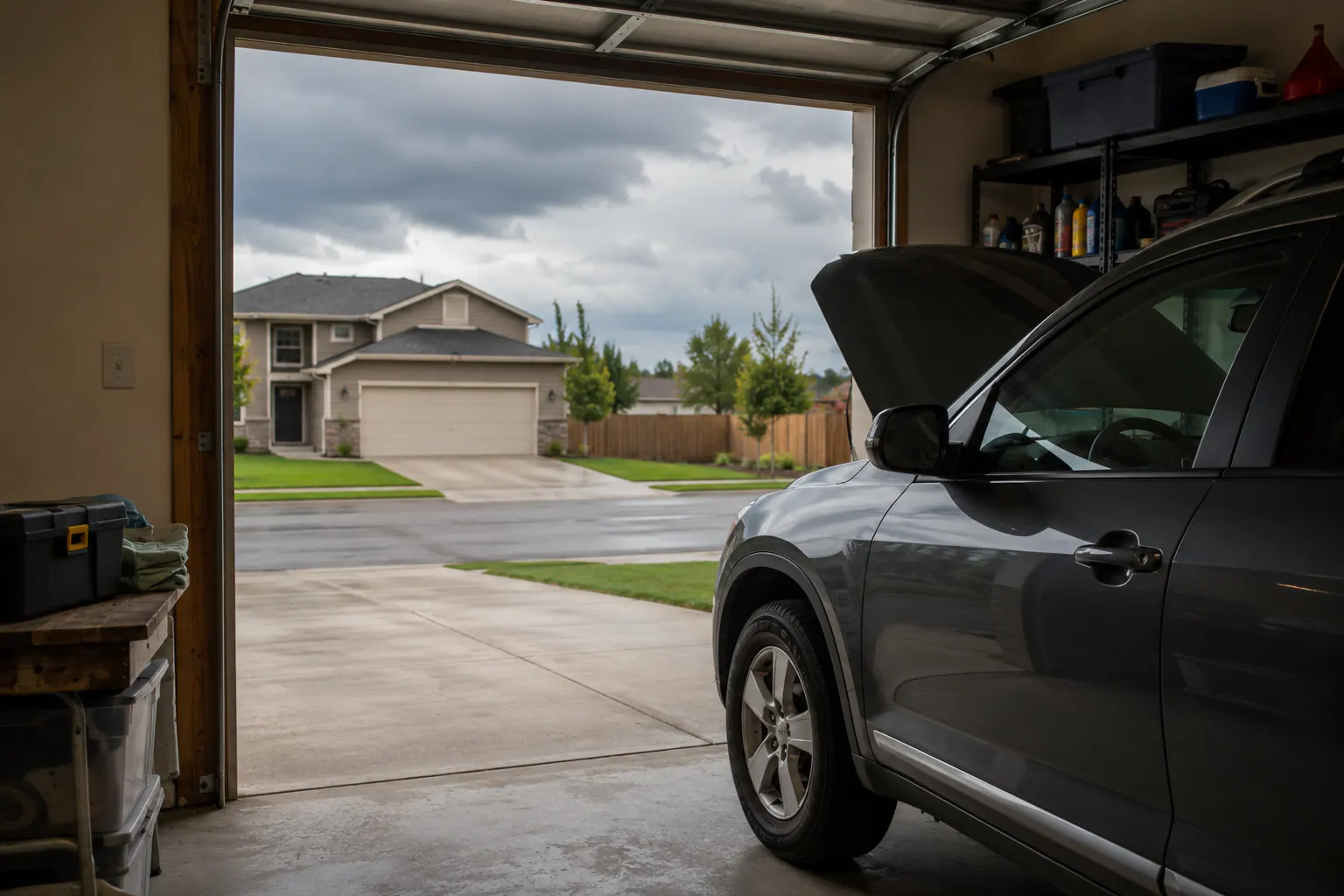
Stop before inspecting
Do not inspect a vehicle in traffic, floodwater, wildfire smoke, lightning, deep snow, extreme heat, or beneath damaged trees or lines. Park on a stable, level, legal surface, engage the parking brake, turn the vehicle off as the manual directs, and keep children and pets away from the work area.
Use a qualified professional when you find:
- a safety warning or unresolved recall;
- tire cuts, bulges, exposed material, repeated pressure loss, or severe uneven wear;
- a brake, steering, suspension, or restraint concern;
- fuel, burning, electrical, exhaust, or strong chemical odor;
- smoke, overheating, arcing, leaking fluid, or charging fault;
- impact, flood, fire, or high-voltage battery damage;
- a check requiring work under the vehicle, wheel removal, a hot system, or unfamiliar disassembly.
Never open a hot cooling system. Never touch orange high-voltage cables or damaged EV components. Never rely on a jack as support beneath a vehicle.
Four weeks before the season
Check recalls and service history
Use NHTSA’s official recall lookup with the license plate or vehicle identification number. Add the vehicle, tires, child restraints, and other equipment to the recall reminder process. Recall repairs are handled through the manufacturer’s dealer network; a home inspection cannot clear a recall.
Review the owner’s manual and service records for time- and mileage-based work. Schedule a qualified inspection when the history is missing or the trip will expose the vehicle to heat, cold, mountains, remote roads, towing, or evacuation traffic.
Review tires by vehicle specification
Find the recommended cold inflation pressure on the vehicle placard or in the owner’s manual, not the maximum molded on the tire sidewall. Check every road tire and the spare when cold, using a reliable gauge. Some spares require a different pressure.
Look for cuts, cracks, bulges, punctures, objects, uneven wear, exposed cords, age concerns, or a tire-pressure warning. Confirm tread and tire type meet manufacturer recommendations, weather needs, and state law. NHTSA advises a tread depth of at least 2/32 inch, but weather performance can become inadequate earlier; use the vehicle, tire, and qualified professional guidance.
Do not mix incompatible sizes, types, load ratings, or severely different wear. EVs and heavily loaded vehicles still require correct tire capacity and maintenance.
Verify the restraint and cargo system
Check seat belts, child restraints, wheelchair securement, head restraints, doors, locks, and emergency releases. Ensure every regular passenger has an appropriate seating position. Remove cargo from footwells and airbag zones.
Check roof racks, cargo boxes, trailers, and tie-down points under their ratings and instructions. Emergency supplies must not shift, leak, block visibility, or prevent access to an exit.
One week before forecast impact
Lights, glass, and visibility
From a safe parked location, verify:
- headlights, taillights, brake lights, turn signals, and hazard flashers;
- license-plate, marker, and trailer lights where applicable;
- wiper condition and correct washer-fluid level;
- windshield, mirrors, cameras, and sensors are clean and undamaged;
- defroster, heater, and air conditioning operate normally.
A cracked windshield, failed defroster, poor wiper sweep, or nonworking light can become decisive in rain, smoke, snow, darkness, or evacuation traffic. Schedule repair before the event.
Fluids, leaks, belts, and hoses
Follow the manual for user-checkable fluid levels and the conditions under which they can be checked. Inspect the parking location for new spots and look from above for obvious leakage, damaged belts, or swollen or cracked hoses only where safely visible.
Do not taste, touch, or identify fluid by smell at close range. Keep people and animals away. A qualified technician should diagnose the source, compatibility, and repair.
Conventional and hybrid vehicles may require engine oil, coolant, brake, transmission, power-steering, and washer-fluid checks. EVs also have cooling, brake, and washer systems, but high-voltage traction components are not user-serviceable.
Battery and starting or charging system
For a conventional 12-volt battery, look only for obvious case damage, leakage, loose mounting, or terminal corrosion from a safe position. Have a professional test the battery and charging system when cranking is slow, lights fluctuate, the battery is old, or cold or heat is approaching.
Hybrid and electric vehicles also use a low-voltage system. Follow the manufacturer’s exact jump-start and service instructions. Do not assume a procedure transfers from another model.
For an EV, verify ordinary charging works at home and at a second compatible location. Inspect user-accessible charging cables and connectors for damage, contamination, overheating, or looseness under the manual. Stop using damaged equipment and contact the manufacturer, charging operator, electrician, or service center as appropriate.
Forty-eight hours before impact
Confirm fuel or charge and route
Set an event-specific departure reserve before demand increases. Fuel or charge early enough to avoid forecast congestion while following local emergency guidance. Do not store gasoline in the passenger compartment, fill unapproved containers, or charge through an improvised cord or adapter.
Check official road conditions, 511 where available, closures, evacuation routes, bridge and tunnel restrictions, charging or fuel options, and the destination’s status. Keep one authority-supported alternative and a paper map.
The realistic get-home plan covers commuting disruptions; hurricane, flood, and wildfire evacuation pages address event-specific departure authority.
Load the kit without overloading the vehicle
Inspect the vehicle emergency kit, then secure it. Respect payload, axle, roof, hitch, and trailer limits. Include the weight of people, water, pets, mobility devices, and equipment.
Keep heavy items low and restrained. Do not place hard objects beside a child’s head, obstruct rear visibility, cover required lamps, or attach unapproved accessories to child seats or airbags.
Confirm communications
Update roadside assistance, insurer, dealer, emergency contacts, destination, route, expected arrival, and overdue time. Download essential maps and charging details. Charge phones and power banks within product limits.
Avoid public posts revealing an empty home, exact route, live location, fuel, medication, or valuable equipment.
Immediately before departure
Walk around the parked vehicle and verify:
- tires appear normally inflated and undamaged;
- no new fluid, smoke, odor, warning light, or obvious damage is present;
- windows, mirrors, roof, hood, lights, cameras, and sensors are clear;
- doors, hatch, hood, charging door, and fuel cap are closed;
- cargo, pets, mobility devices, and every occupant are restrained;
- the route remains open and the destination remains available;
- fuel or charge preserves the planned reserve;
- the driver is rested, sober, medically fit, and not pressured to beat worsening conditions.
Cancel when the road authority closes the route, visibility or traction is unsafe, the vehicle develops a warning, the destination cannot receive the household, or the return trip will occur after conditions worsen.
Do not drive through floodwater. Do not drive around barricades. Four-wheel drive, vehicle height, tires, and emergency equipment do not make moving water safe.
Adjust for the hazard
| Hazard | Readiness focus | Reason to stop an ordinary trip or change the plan |
|---|---|---|
| Heat | cooling system, A/C, tires, battery, water | failed cooling, unsafe cabin temperature, wildfire or road closure |
| Winter | tires, battery, heat, defrost, washer fluid, kit | blizzard or ice warning, closure, poor visibility, inadequate reserve |
| Hurricane | early service, fuel or charge, evacuation route, cargo | official order, tropical-storm winds approaching, route deterioration |
| Flood | alternate routes, lights, wipers, alerts | water over road, barricade, flash-flood warning affecting route |
| Wildfire | evacuation status, air, multiple routes, charge or fuel | order, fire on route, dense smoke, closure, delayed departure window |
| Blackout | garage access, pumps or chargers, communications | no safe exit, no reachable energy, unsafe signals or destination |
The table concerns ordinary travel, not permission to ignore evacuation. An evacuation order means follow the instructed movement plan, not cancel departure. If transport fails or a route is unsafe, contact the designated emergency service; do not delay for repairs or enter a closed road.
Keep a readiness record
Record date, mileage, tire pressure, visual condition, recall check, maintenance due, lights, climate control, kit inspection, fuel or charge threshold, route status, and any service appointment. Keep receipts and professional findings with the vehicle record.
After the event, document unexpected energy use, delays, failed gear, poor visibility, passenger needs, and route problems. Convert each observation into one assigned action before the next season.
Sources reviewed
- NHTSA: Summer Driving Tips; Winter Driving Tips; Recalls; TireWise; Electric and Hybrid Vehicle Safety; Driving in Severe Weather
Sources reviewed July 14, 2026. The owner’s manual, manufacturer, safety recall, qualified technician, road authority, emergency order, and local law control the actual vehicle and travel decision.