
Find your official evacuation zone and confirm how every person and animal will reach a suitable destination. Start with transport or care needs requiring extra time. When ordered to leave, follow designated routes promptly; do not wait to complete a bag or property task.
Make the plan before a storm enters the forecast. Once surge closes a road, fuel becomes scarce, elevators lose power, or tropical-storm-force winds begin, an otherwise good destination may no longer be reachable. Evacuation is one decision inside the wider hurricane preparedness plan; this page owns the leaving part.
Follow the official evacuation decision
Find the evacuation zone assigned by state or local emergency management. Storm-surge maps, flood maps, forecast cones, and wind categories provide context but do not replace a local order.
Evacuate immediately when ordered. Use posted or officially designated routes and do not take shortcuts around barricades. Ready.gov guidance emphasizes that shortcuts may be blocked and directs households to state transportation and emergency-management sources for localized routes. (Source: FEMA, How to Prepare for a Hurricane, reviewed July 2026.)
Plan earlier movement when someone needs extra loading or travel time, transport is shared, the destination is far away, or the home is a mobile/manufactured home or other locally identified unsafe structure. Do not delay solely because the storm’s wind category seems low.
Record two destinations
Choose a primary and backup destination that fit the hazards and household.
For each one, confirm:
- full address and paper directions;
- whether it is outside the evacuation and flood-risk area relevant to the event;
- current opening or host confirmation;
- expected arrival deadline;
- parking or drop-off arrangements;
- accessibility and restroom needs;
- pet or service-animal policy;
- medication refrigeration and approved medical-device power;
- length of stay and what supplies are required;
- a second contact method if phone service is unreliable.
Possible destinations include family or friends, a hotel, an official shelter, or another location identified by local authorities. A shelter listing can change during the event. Confirm through current official channels before departure.
Do not make an informal host inside the threatened area your only plan. Ask whether their structure, flood exposure, household capacity, backup power, pets, and accessibility are appropriate.
Build routes around official information
Record the designated route and one authority-supported alternative. Mark bridges, causeways, tunnels, low-water crossings, rail crossings, and fuel or charging points that may matter. Keep a paper regional map because turn-by-turn service may fail or direct traffic toward a closed road.
Never use floodwater as a route. Do not drive around a barricade. Six inches of moving water can stall or affect some vehicles, and deeper or faster water can carry vehicles; the exact risk varies with the road, current, vehicle, and hidden damage. Turn around.
Set a decision point for abandoning the route and contacting authorities rather than improvising through local streets. The backup destination needs a compatible route, not just a different address at the end of the same vulnerable bridge.
Plan without a car
Do not wait for an evacuation order to discover that ordinary transit has stopped.
Before the season:
- Ask local emergency management about evacuation transportation and registration programs.
- Identify paratransit, accessible pickup, shelter transport, community buses, or other official options.
- Arrange a named driver and backup driver when using family or neighbors.
- Record pickup place, earliest activation, baggage limits, pet rules, and missed-pickup procedure.
- Keep the bag carryable and mobility aids labeled.
- Plan how to reach the pickup point if elevators or electronic doors fail.
A rideshare app is not a guaranteed evacuation system. Driver availability, pricing, network service, road closures, and pet acceptance can all change.
Account for disability, medication, and medical devices
An individualized plan may need more time, space, electrical capacity, refrigeration, oxygen safety, communication support, or trained assistance.
Confirm with the care team, device manufacturer, pharmacy, utility program, facility, and local emergency resources:
- how long approved batteries last;
- which adapters and chargers are approved;
- medication temperature and replacement instructions;
- whether the destination can support the device;
- what change in health or equipment function triggers earlier movement;
- how mobility equipment will be transported and secured;
- where care is available if the destination cannot meet the need.
Do not change prescribed settings, medication, oxygen arrangements, or fluid plans based on a generic checklist. Utility medical programs can support planning but may not guarantee priority restoration.
Plan for pets and service animals
Keep carriers, leashes, harnesses, current identification, photos, vaccination records, medication, food, water, cleanup supplies, and comfort items together. Practice getting each animal into its carrier or vehicle.
Confirm destination policy. Service animals and pets are governed differently; do not assume a pet is accepted everywhere. Identify a pet-friendly backup, boarding arrangement, or official co-located shelter option before the storm.
Never leave an animal chained outside, on a balcony, or in a parked vehicle. Do not sedate an animal unless a veterinarian has prescribed and explained the plan for that animal.
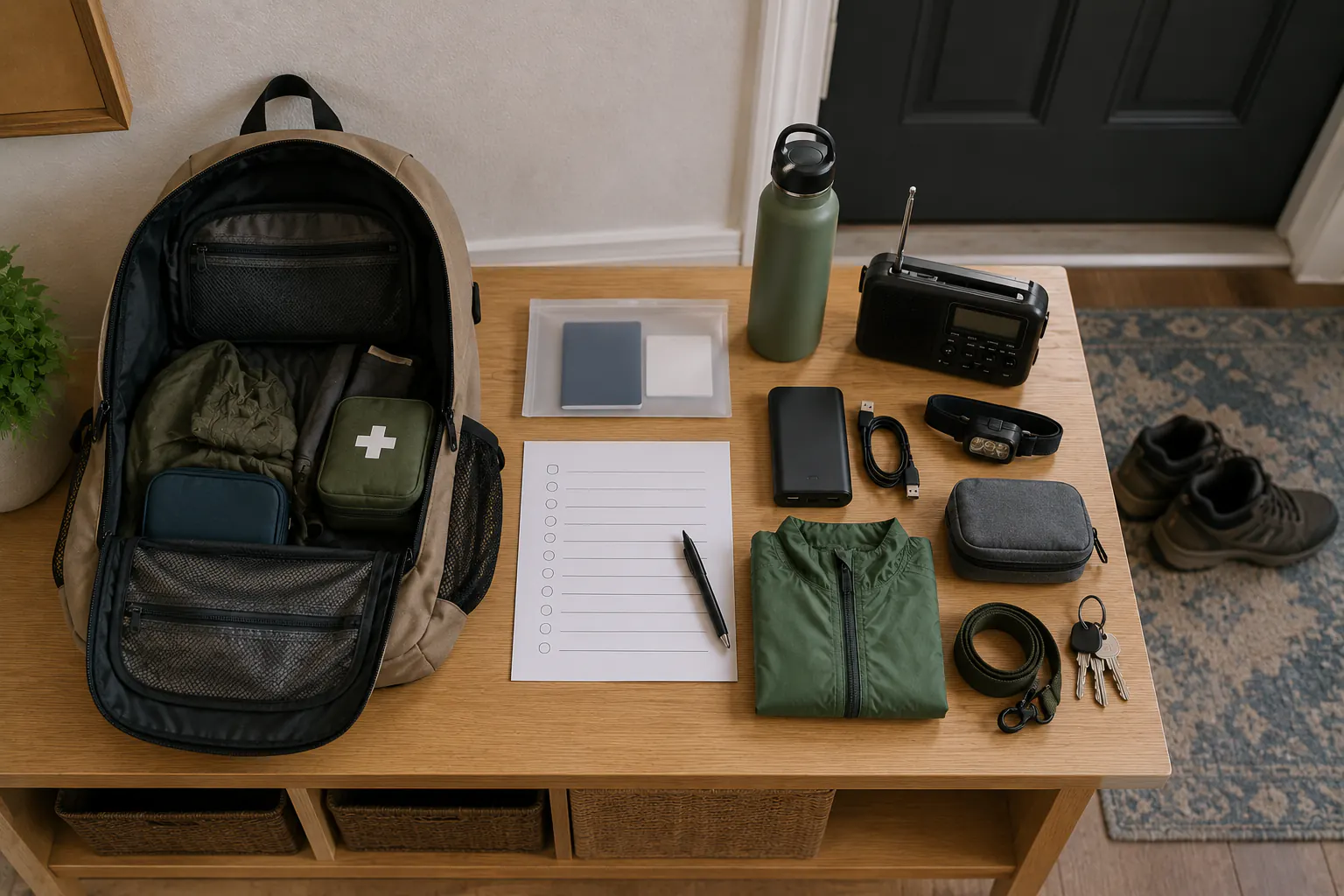
Pack a carryable hurricane go bag
The bag supports travel and the first period away from home. It is not the household’s entire emergency inventory.
Documents and communication
- identification and protected copies of insurance and critical records;
- paper contacts, addresses, routes, and confirmation numbers;
- phones, cables, compact power banks, and a battery radio;
- a small notebook and permanent marker;
- cash appropriate to the household, stored discreetly.
Health and personal needs
- permitted medication supply in original or clearly identified packaging;
- written medication and medical-device information;
- glasses, hearing supplies, mobility accessories, and communication aids;
- first-aid basics and personal hygiene supplies;
- masks or respirators appropriate to the person’s plan and cleanup exclusions.
Food, water, and clothing
- water and travel food suitable for the household;
- infant, dietary, and feeding supplies;
- lightweight rain protection, sturdy closed-toe shoes, and changes of clothing;
- a compact blanket or layer for cooled shelters.
Practical items
- flashlight or headlamp and spare compatible batteries;
- keys for home, vehicle, destination, locks, and storage;
- pet or service-animal supplies;
- a small amount of essential repair tape or cord only for ordinary travel needs, not structural storm repair.
Weigh the bag. Split shared supplies among capable adults without separating a child or medically dependent person from essentials. Use a rolling bag only if the route and transport support it; stairs, debris, and crowded loading can make wheels less useful.
Prepare the vehicle
Maintain tires, brakes, lights, wipers, fluids, cooling, battery, and spare or repair system before hurricane season. Fuel or charge early as the local plan advises. Keep the vehicle emergency kit current.
Load heavy objects low and secure them so sudden braking does not turn them into projectiles. Preserve driver visibility and passenger restraints. Never carry gasoline, propane, or another hazardous material in an unsafe container or arrangement; follow local rules and product instructions.
Download or print route information, but continue listening for changes. Do not drive when exhausted, impaired, or unable to see through severe rain. Pull into a safe location only as authorities and conditions permit.
Coordinate the household departure
Use a written sequence:
- Official trigger or earlier household trigger is met.
- Destination and route are reconfirmed.
- People and animals are accounted for.
- Medication, devices, documents, water, and bags are loaded.
- The home is closed using only preplanned safe steps.
- The out-of-area contact receives departure time, route, destination, and next check-in.
- Everyone travels together unless the plan documents separate vehicles and reunion points.
- Arrival is reported; unnecessary calls are avoided when networks are congested.
Use the hurricane preparation timeline to place departure before the outdoor stop-work deadline.
Do not let home shutdown delay evacuation
Know how household water, electricity, gas, alarm, garage, and entry systems work, but operate utilities only when local authorities, the utility, the equipment instructions, or a qualified professional directs it. An incorrect gas or electrical action can create a new hazard.
Do not stay to finish shutters, move furniture, photograph property, or wait for a package once the evacuation trigger is met. The house can be documented and prepared earlier; the safe travel window cannot be restored.
Communicate without creating confusion
Assign one out-of-area contact. Each traveler should carry the number on paper. A useful update contains:
- who is together;
- departure location and time;
- intended route and destination;
- any health or transport problem;
- next check-in time.
Avoid posting an empty home, exact route, medication details, or shelter location publicly. Use the family communication plan for message templates and missed-contact escalation.
Returning is a separate decision
An evacuation plan ends only after authorized, safe re-entry, not when the wind stops. Wait for local authorities to reopen the area. Confirm roads, water, power, fuel, medical access, and destination conditions before traveling back.
Bring protective clothing and supplies appropriate to the official guidance, but do not enter a home with obvious structural damage, downed lines, gas odor, fire, active flooding, or an official restriction. Follow the returning home after a hurricane guide before cleanup.
Run a 20-minute evacuation drill
- Send the practice trigger.
- Pack and weigh the bags.
- Load people, mobility equipment, and pet carriers.
- Time the route to the vehicle or pickup point without blocking exits.
- Open the paper map and identify the backup route.
- Send a test message to the out-of-area contact.
- Record the slowest step and assign a correction.
Drill in ordinary safe conditions. Do not simulate dangerous driving, lift a person without appropriate training, or stress an animal merely to meet a time target.
The best evacuation bag is the one attached to a verified movement plan. Supplies cannot compensate for an unknown destination, unavailable transport, or a departure delayed beyond safe conditions.
Sources reviewed
- FEMA: How to Prepare for a Hurricane
- Ready.gov: Hurricane Hazard Information Sheet
- CDC: Preparing for Hurricanes or Other Tropical Storms
- NOAA National Hurricane Center: National Storm Surge Risk Maps
Sources reviewed July 14, 2026.