
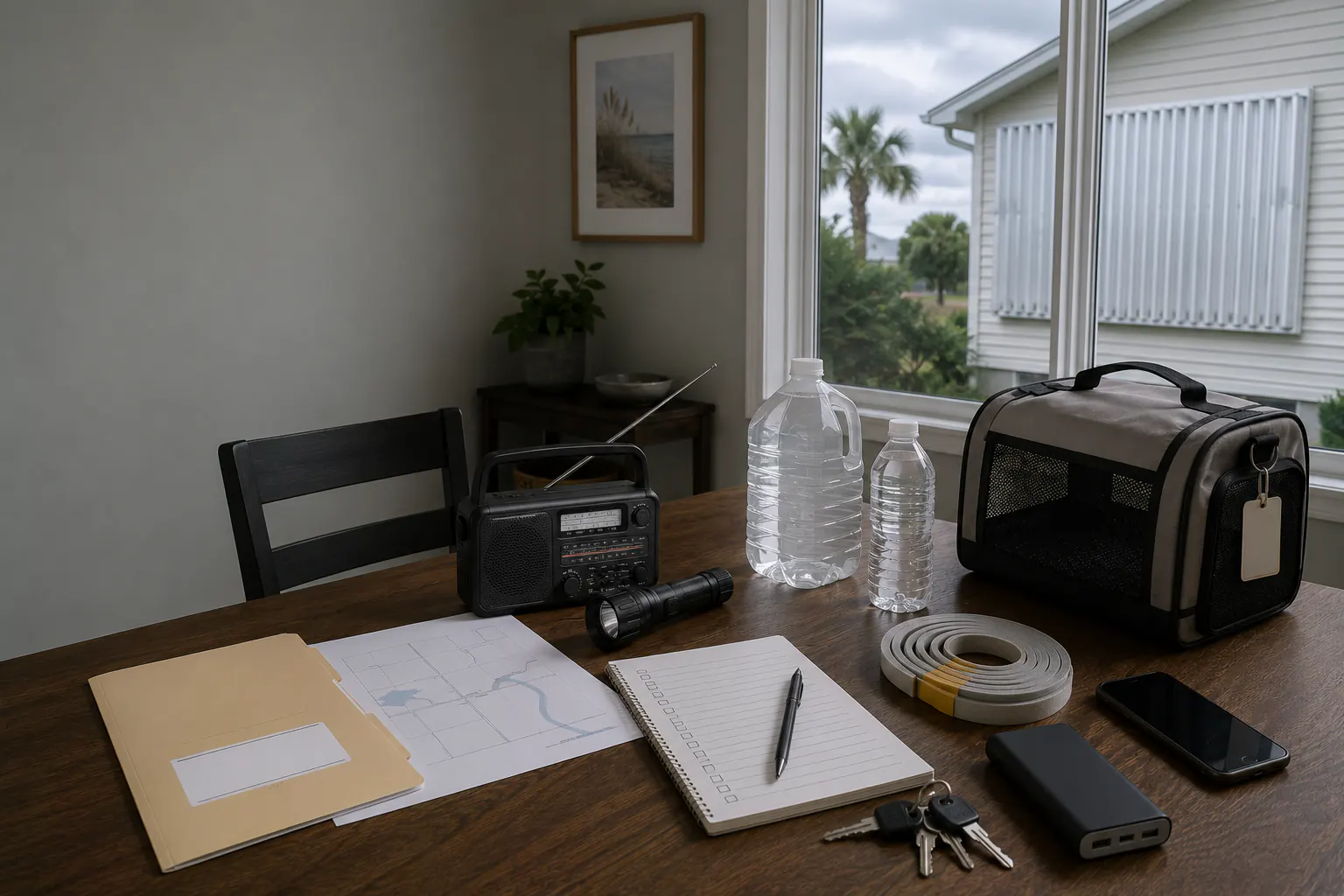
Check current local evacuation and building instructions before a property task or shopping trip. Begin with who needs extra time or help to reach a suitable destination. Follow an order promptly; the hurricane category and a full kit are not reasons to stay.
A strong plan answers five questions before a storm threatens:
- What hazards can reach this address?
- Who needs more time or help to move?
- What official instruction will trigger evacuation?
- What must be protected if the household stays or leaves?
- What conditions must be confirmed before anyone returns?
Use current National Hurricane Center, local National Weather Service, emergency-management, utility, and public-health information for the actual event. Local evacuation orders and building instructions take priority over this general guide.
If a hurricane threatens now
- Check the latest official advisory and local hurricane statement, not a screenshot or social-media track graphic.
- Determine whether the home is in an evacuation zone, storm-surge area, flood-prone location, mobile or manufactured home, or building with another local vulnerability.
- Follow evacuation orders promptly. Do not use the hurricane’s category as a reason to ignore local instructions.
- Confirm two destinations and the route to each. Include pets, accessibility, medication, and approved medical-device needs.
- Charge communication and backup-power equipment while power remains available.
- Secure outdoor objects and complete only home-protection tasks that can be finished before conditions deteriorate.
- Store water, protect documents, set refrigerator and freezer procedures, and move vehicles as local guidance permits.
- Stop preparation and shelter before tropical-storm-force winds arrive.
National Hurricane Center guidance explains that preparations become difficult once tropical-storm-force winds begin. Hurricane watches are generally issued about 48 hours before those winds are possible, and hurricane warnings about 36 hours before they are expected. Those are alert definitions, not guaranteed personal work windows. (Source: NOAA National Hurricane Center, Glossary of NHC Terms, reviewed July 2026.)
Understand the hazards at your address
Storm surge and storm tide
Storm surge is an abnormal rise of water generated by a storm. Storm tide combines that surge with the astronomical tide. It is not limited to the beach: water can move through bays, rivers, canals, and low-lying routes many miles inland.
Check the evacuation zone designated by local emergency management. A FEMA flood-insurance map and an NHC storm-surge risk map serve different planning purposes and do not replace the local evacuation decision. The National Hurricane Center directs people in a surge-vulnerable area to identify their official evacuation zone and decide in advance where and how they will go. (Source: NOAA National Hurricane Center, National Storm Surge Risk Maps, Version 4, 2026.)
Rainfall and inland flooding
Tropical cyclones can cause destructive flooding far from the coast and after the center has moved away. Do not treat inland location as automatic safety. Know whether roads, bridges, underpasses, rivers, drainage channels, dams, or low spots can isolate the home or the evacuation route.
Never drive through floodwater. Water can hide a washed-out road, carry debris, contain contamination, and move a vehicle. Turn around and use a route directed by authorities.
Wind and tornadoes
The Saffir-Simpson category describes maximum sustained wind, not rainfall, storm surge, tornado risk, geographic size, or impact at a specific address. Dangerous conditions can occur outside the forecast center and outside the hurricane-force wind area.
When sheltering from wind, use the building-specific location recommended by local authorities: generally an interior area away from windows on the lowest level that is not threatened by flooding. A storm-surge evacuation zone, mobile home, damaged building, or flood-prone lowest floor changes that decision.
Rip currents and coastal conditions
Hazardous surf and rip currents can occur far from the storm center and before obvious local weather arrives. Stay away from beaches, seawalls, piers, flooded waterfronts, and sightseeing areas when officials or forecasts warn of dangerous conditions.
Decide early: evacuate or shelter
Evacuation decisions belong to state and local authorities because risk depends on local surge, roads, building types, timing, and emergency capacity. Your household plan makes compliance practical.
Plan to evacuate when ordered and prepare for earlier movement when a household member needs more time, transportation is limited, the building is unsuitable, or the destination is distant. A voluntary evacuation can also be reasonable before an order if local authorities permit travel and the household’s risk plan supports it.
Do not leave at the last moment into deteriorating wind, surge, or flooded roads. Do not stay merely to protect property. The hurricane evacuation plan covers route selection, vehicle and no-car options, shelter questions, pets, accessibility, and the go bag.
If authorities say to shelter, remain ready to move if the order changes or the building becomes damaged. CDC advises staying inside and away from windows and waiting for an official message that the hurricane is over; the calm eye can be followed by a rapid return of dangerous weather. (Source: CDC, Preparing for Hurricanes or Other Tropical Storms, updated May 28, 2026.)
Build a five-day decision timeline
Forecast timing and confidence change, so use milestones rather than assuming every storm provides five full days.
Before the season
- Learn evacuation zones, flood and surge exposure, and shelter options.
- Review insurance, home inventory, contacts, medication, and pet plans.
- Inspect shutters or other approved window protection and arrange professional work early.
- Maintain the vehicle, generator, CO alarms, batteries, drainage, and trees within qualified scope.
- Practice communication, utility shutoff awareness, and an accessible exit.
When the storm enters the planning horizon
- Monitor official forecasts at consistent times.
- Contact the out-of-area person and potential hosts.
- Refill prescriptions according to insurer, pharmacy, and clinician rules.
- Check supplies by household function rather than buying random cases of products.
- Photograph the property and important contents before moving or protecting items.
When a watch is issued or local action begins
- Complete evacuation and destination decisions.
- Fuel or charge the approved transport method.
- Move outdoor objects and vehicles according to the home plan.
- Install only preplanned, approved protection while conditions are safe.
- Freeze water containers safely and set food-temperature monitoring.
- Withdraw needed cash only if appropriate; keep receipts and records secure.
Before tropical-storm-force winds
- End exterior work.
- Move people and pets to the evacuation destination or shelter location.
- Send the final movement message to the out-of-area contact.
- Keep weather alerts and a battery radio available.
- Stay away from windows and do not go outside during a deceptive lull.
The hurricane preparation timeline organizes flexible milestones, not an exact forecast clock.
Prepare the home without improvising dangerous work
Bring in or secure outdoor furniture, tools, planters, grills, trash cans, decorations, and anything that can become windborne. Follow local collection and storage instructions for propane cylinders, fuels, chemicals, and batteries. Do not move fuel into living spaces.
Use permanent shutters or other opening protection designed and approved for the building. Improvised last-minute drilling, roof work, ladder work in wind, or unverified fastening can injure people and damage the structure. Renters and condominium residents should obtain management instructions before altering windows, balconies, facade elements, or common property.
Clear gutters and drains only in safe pre-season conditions. Tree removal, roof repair, service-panel work, gas work, structural changes, and installation of transfer equipment belong with qualified professionals and required permits.
The pre-storm exterior and drainage checklist sets a written stop time and keeps observation on stable ground before wind, lightning, rain, ice, or evacuation instructions close the work window.
The home hurricane preparation guide separates permitted household tasks from qualified work and apartment constraints.
Plan for power, water, food, and communication
Expect utility failures even if the home avoids direct structural damage.
Power
Define essential loads and test batteries before the season. Never operate a portable generator indoors, in a garage, on a porch, in a carport, or near openings. Follow current manufacturer and CPSC placement guidance. Keep working CO alarms and never connect a generator to home wiring through a receptacle.
Use the power outage preparedness hub and generator carbon monoxide safety guide for the existing detailed plans.
Water
Store a household reserve in food-grade containers and follow current public-health advisories after the storm. Flooding, pressure loss, and system damage can make tap water unsafe. Boiling kills germs but does not remove every chemical or toxin; follow the water authority’s specific instruction.
The emergency water storage guide covers quantities, containers, labeling, storage, and rotation.
Food
Use appliance thermometers, keep doors closed, and document outage time. Floodwater-contact food and improperly refrigerated perishables need authoritative discard decisions; smell and appearance cannot establish safety.
Communication
Assign one out-of-area contact and two meeting destinations. Keep paper contacts, local frequencies, utility numbers, insurance information, and building contacts. Send concise status messages with location, people accounted for, destination, and next check-in.
Use the family outage communication plan as the shared communication layer.
Protect documents and recovery evidence
Keep identification, insurance policies, medical information, property records, lease or mortgage contacts, pet records, and a current home inventory accessible in a protected physical set and an appropriately secured digital backup.
Photograph rooms, important contents, exterior elevations, vehicles, and completed protective measures before the storm when conditions are safe. Preserve receipts for evacuation, temporary repairs, lodging, supplies, and cleanup. Do not enter a dangerous area merely to improve documentation.
Know how to start an insurance claim and how the insurer wants emergency repairs documented. Avoid contractors who demand full payment immediately, pressure you to assign benefits, or cannot provide required identity, license, insurance, and written scope information. Requirements vary by state.
Treat the period after the storm as a new incident
Do not return because rain stopped or a neighbor posted a photo. Wait for official clearance and confirm that the route and destination are accessible. Hazards can include floodwater, unstable structures, gas leaks, downed lines, damaged trees, heat, contaminated water, displaced animals, mold, sharp debris, and carbon monoxide.
Stay away from downed lines and anything touching them. Never use a wet electrical device. Do not energize flooded wiring or enter a building with structural movement, collapse signs, fire, gas odor, active flooding, or an official restriction.
CDC warns that floodwater may contain germs, chemicals, waste, animals, debris, and downed power lines. The storm being over does not mean the danger is over. (Source: CDC, Safety Guidelines: After a Hurricane or Other Tropical Storm, reviewed July 2026.)
The return checklist starts with official clearance and stop rules, not structural, electrical, gas or contaminated-water DIY.
Run a hurricane plan review
Before each season, sit down for 30 minutes and verify:
- Current evacuation zone and two destinations.
- Transport for every person and pet.
- Medication, mobility, communication, and powered-device continuity.
- Safe deadline for ending outside preparation.
- Indoor wind-shelter location and flood conflict.
- Water, food, lighting, radio, charging, and CO alarms.
- Property inventory, insurance contacts, and protected documents.
- Named person responsible for each action.
- Missed-contact and route-failure alternatives.
- Official clearance required before return.
A useful hurricane plan reduces last-minute work. It makes leaving easier, sheltering calmer, and returning slower when the evidence says slow is safer.
Sources reviewed
- Ready.gov: Hurricanes
- CDC: Preparing for Hurricanes or Other Tropical Storms
- CDC: Safety Guidelines After a Hurricane or Other Tropical Storm
- NOAA National Hurricane Center: Hurricane Hazards
- NOAA National Hurricane Center: Glossary of NHC Terms
- NOAA National Hurricane Center: National Storm Surge Risk Maps, Version 4
Sources reviewed July 14, 2026. Current official alerts, evacuation orders, public-health guidance, building instructions, and qualified professional assessments take priority over general planning information.