
Small-apartment storage works when every emergency function has a reachable home and nothing compromises ordinary safety. It fails when water sits on a questionable shelf, a go-bag narrows the only exit, batteries bake beside a radiator, or the household cannot find a medication pouch behind seasonal boxes.
This guide organizes categories across the apartment. Specialist pages still control water, food, sanitation, medication, batteries, tools, and evacuation. Start with the Apartment Emergency Preparedness hub and build only the modules the actual household plan requires.
When the immediate issue is keeping a small layout legible rather than deciding what each module contains, use the Small-Space Preparedness Storage Map. It creates a private four-zone location card without asking for a visible inventory.
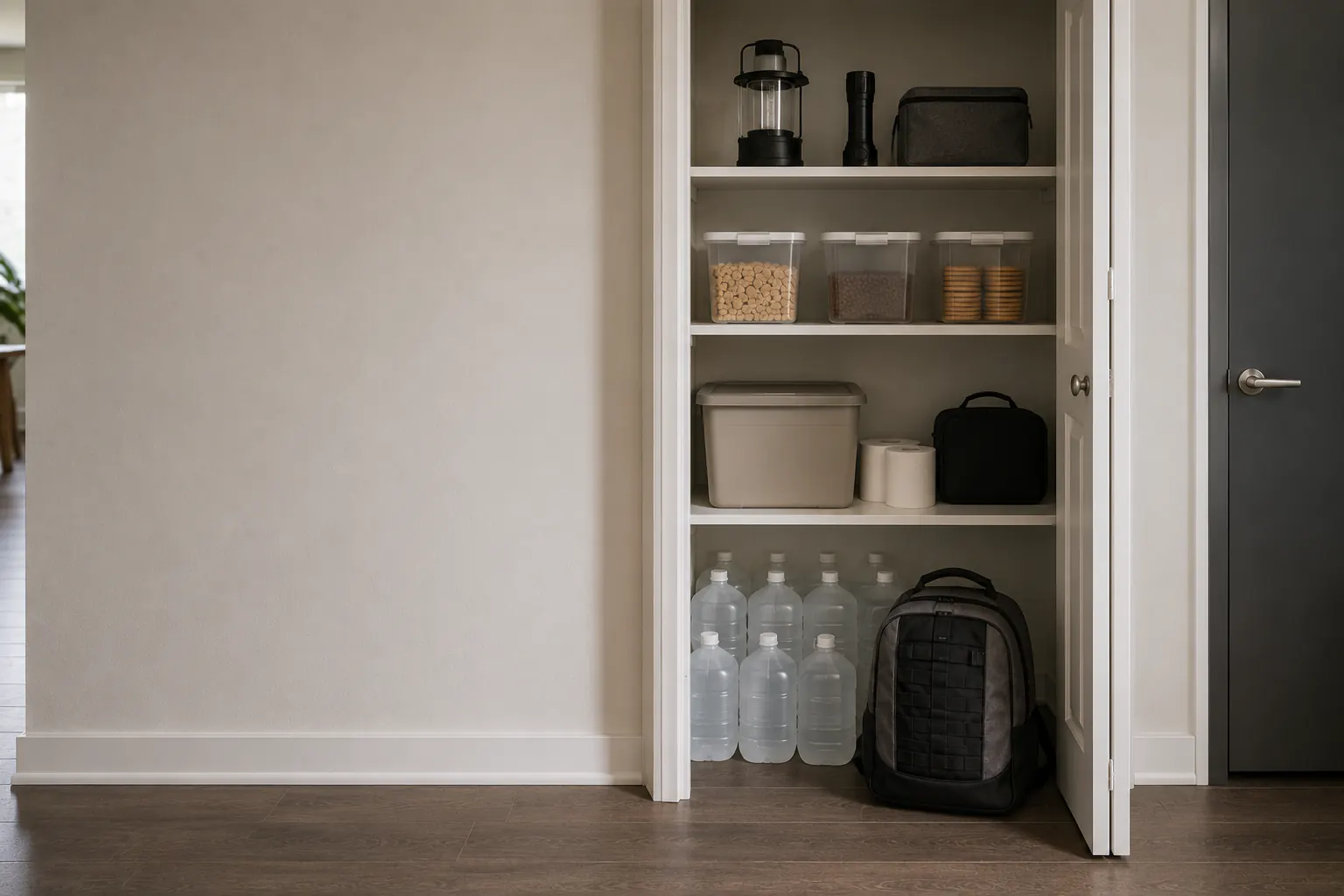
Protect the exit before measuring storage
Walk from each sleeping and occupied area to the unit exit. Preserve the clear route required by the building and household fire plan. Open doors fully and check that storage cannot fall, slide, spill, or trail a cord into that path.
Do not store supplies in a shared hall, stair, landing, fire-door swing, alarm or extinguisher area, electrical or mechanical room, elevator lobby, or another common space unless building management has explicitly created and approved that use. Never attach a shelf, bag, hook, or container to sprinkler piping, alarms, radiators, electrical panels, or fire equipment.
An emergency item that slows evacuation is in the wrong place. The go-bag staging guide owns exit-side placement for carryable bags.
Inventory functions before containers
Write one row for each required function:
| Function | Existing plan | Storage need |
|---|---|---|
| On-person continuity | keys, contacts, identification, daily medical essentials | private and immediately reachable |
| Evacuation | personal and shared carry layers | exit-side without obstruction |
| Water | drinking, cooking, hygiene, pet and medical adjustments | food-grade, stable, dispensable |
| Food | ordinary shelf-stable meals and dietary continuity | cool, dry, visible rotation |
| Sanitation | toilet, hand hygiene, waste, caregiver and personal care | separated clean and waste modules |
| Light and communication | flashlights, lanterns, radio, charging | routine access and battery inspection |
| Medical continuity | medication, records, devices, approved backup power | protected and professionally specified |
| Animal continuity | carrier, records, food, water, sanitation | assigned to each animal and handler |
| Seasonal hazards | heat, cold, smoke, storm, flood | active only when the season requires it |
Do not start with storage furniture. First remove duplicate, expired, recalled, damaged, incompatible, or no-longer-approved items through the proper process. Then measure the remaining modules.
Create four access zones
Use location by timing rather than by product aesthetics:
- Immediate zone: keys, approved contacts, flashlight, daily access needs, and event instructions.
- Exit zone: carryable evacuation layers and footwear without blocking the door or route.
- Stay zone: water, food, sanitation, lighting, charging, and ordinary household continuity.
- Seasonal zone: inspected modules brought forward before heat, cold, smoke, hurricane, or winter conditions.
Keep one printed location map in a private household place. A helper should be able to find a named module without opening every cabinet. Do not label a visible bin with diagnoses, valuables, travel dates, access codes, or detailed absence information.
Put heavy supplies only on confirmed support
Water, canned food, batteries, tools, and dense sanitation supplies can create concentrated loads. Store heavy items low on stable surfaces appropriate for the load, but do not claim that an unknown shelf, floor area, cabinet, or bed frame is safe because it looks sturdy.
Check manufacturer ratings for storage furniture and containers. Ask management or a qualified professional when the building, floor, built-in cabinet, wall attachment, or proposed load is uncertain. Do not drill, anchor, suspend, or alter the rental without required approval.
Divide water into manageable containers instead of one large vessel the household cannot dispense or relocate. Keep each container upright and protected from impact. The water-without-elevator guide owns movement planning and intentionally sets no universal safe carry weight.
Keep water usable
Use the Emergency Water Storage guide for current quantity, food-grade container, labeling, rotation, and advisory rules. Store water away from chemicals, fuel, flood exposure, heat, direct sun, pests, and items that can puncture or contaminate a container.
Keep enough clearance to inspect for leaks. A hidden leak can damage the apartment and compromise the entire reserve. Do not place a container where a failure would reach electrical equipment, an exit, medication, or another resident’s property.
Test dispensing on an ordinary day. A full container that cannot reach a sink safely or accept a cup without tipping is not operational storage.
Separate food from chemical and sanitation hazards
The small-apartment food guide owns pantry quantity, package, rotation, temperature, pests, and low-resource meal planning. Keep food visible enough to rotate into ordinary use.
Keep cleaners, fuels, pesticides, automotive products, batteries, waste supplies, and personal-care chemicals under their labels and away from food, water, medication, children, and animals. Do not decant chemicals into food or beverage containers. Do not mix products to reduce bottle count.
The Compact Apartment Sanitation Kit separates clean handwashing and personal-care items from toilet and waste modules. Compact does not mean combined.
Protect batteries and powered equipment
Follow device, battery, charger, and building instructions for temperature, ventilation, clearances, charging, storage, damage inspection, and disposal. Keep equipment away from radiators, direct sun, wet areas, bedding, exits, and combustible clutter.
Do not charge on a bed, sofa, unstable stack, or inside a closed storage bin. Do not leave a damaged, swollen, leaking, hot, wet, recalled, or unfamiliar battery in the emergency module. Use the manufacturer’s and responsible disposal process.
The apartment power-station guide owns load matching and product evidence. A power station does not authorize prohibited generator, fuel, balcony, extension-cord, or solar-panel use.
Make medical and accessibility supplies reachable
Store medication and medical equipment according to clinician, pharmacist, manufacturer, and supplier instructions. Do not transfer prescriptions into an unlabeled general kit or place them where temperature, moisture, children, visitors, or theft can compromise them.
The Medical Device and Medication Continuity plan owns clinical contacts, power, storage, interruption, and relocation. Keep its portable layer reachable even when the stay-at-home reserve is deeper in storage.
Place routine equipment so the intended resident can reach and operate it. Preserve wheelchair, walker, cane, service-animal, caregiver, and transfer space. Storage that requires a resident to climb, crawl, lift beyond their individual plan, or move furniture during an outage is not accessible.
Use furniture and overlooked space cautiously
Under-bed, closet-floor, cabinet, shelf, and furniture-integrated storage can be useful only when the product is intended for the load, the route remains clear, and inspection remains possible. Avoid compressing supplies against heaters, pipes, outlets, ventilation, damp exterior walls, or pest paths.
Do not stack containers above head level where they can fall during an earthquake, impact, or hurried retrieval. Do not conceal leaks, mold, electrical damage, pest activity, or maintenance access. Report property problems instead of building around them.
Use uniform container sizes only when that improves access; do not repackage regulated, medical, chemical, or labeled products merely for visual consistency.
Keep tools bounded and secure
Use the Compact Apartment Toolkit for authorized inspection, assembly, minor adjustment, and outage tools. Sharp, heavy, powered, and chemical-adjacent items need secure storage under the safe tool-storage guide.
Do not let an emergency label expand renter scope. Shared electrical, gas, elevator, sprinkler, alarm, structural, roof, HVAC, and plumbing systems remain with management, the utility, emergency services, and qualified professionals.
Keep any tool needed for ordinary approved shutoff or assembly visible within its module. A specialty tool buried beneath unrelated supplies will not help during a leak or departure.
Build privacy into the layout
Avoid displaying expensive equipment, full names, medical details, unit-absence plans, or inventory values through windows or in common areas. Use plain internal labels and a protected inventory.
Give a backup helper only the access and location information needed for the agreed role. Do not hide keys in a public or predictable place. Keep documents in the protected evacuation record, not taped to a storage bin.
Photograph the module layout for insurance and household recovery only when that record can be protected. Update it after major changes without publishing it.
Inspect one zone at a time
Use a recurring schedule that the household can maintain:
- immediate and exit zones after every use or household change;
- water, food, medication, batteries, and sanitation by their earliest label or professional date;
- seasonal modules before and after the relevant season;
- carriers, bags, furniture, shelves, and containers after damage, leaks, pests, construction, or a move;
- contacts, building procedures, destinations, and helpers whenever management or household circumstances change.
Record the date, problem, correction, and owner. Rotate ordinary consumables into normal use when safe. Remove obsolete items through their correct disposal or return process rather than pushing them deeper into storage.
Run a retrieval check
On a quiet day, ask the responsible person to retrieve the flashlight, evacuation bag, water module, sanitation module, medical layer, pet carrier, and building contact without turning off utilities or creating darkness. Confirm that doors open fully and no item enters the route.
Do not time a person as a measure of fitness. The check is about location, access, lighting, labeling, and missing ownership. Stop if reaching an item requires unsafe climbing, lifting, electrical access, or moving a mobility device out of position.
A successful apartment system looks ordinary. Its supplies are distributed, inspectable, correctly separated, reachable by the people who need them, and absent from the path they may need most.
If the supplies have outgrown the storage rather than the other way round, organising a practical preparedness storage area covers dedicating space without turning a room over to it.
Sources reviewed
- Ready.gov: Build a Kit
- U.S. Fire Administration: home and high-rise escape planning
- Centers for Disease Control and Prevention: inclusive preparedness and emergency water storage
Sources reviewed July 15, 2026. Building rules, leases, product labels, current authorities, clinicians, and qualified professionals control actual storage, access, structural, fire, electrical, plumbing, medical, and hazardous-material decisions.
Sterilite’s current 1751 ClearView specifications and exact Amazon Sweet Plum two-container pack were checked October 12, 2026 for ordinary lightweight organization. No load, stacking, handling, access-control or moisture-protection result was tested; the wider building and specialist storage review remains separate.