
A practical preparedness storage area is not a bunker, a secret room, or a shopping project that takes over the house. It is one calm place where a household can see what it already has, find the next useful item without opening every closet, and rotate ordinary supplies before they become waste.
The useful version may be one cabinet, a low shelf in a closet, part of a basement room, or several linked zones in an apartment. Its job is continuity: light, water, ordinary food, communication, sanitation, documents, and a carryable departure layer. It should never make an exit narrower, hide a leak, advertise valuables, or encourage a household to stay when current authorities say to leave.
Start with the Apartment and Small-Space Preparedness hub if building systems, a lease, stairs, elevators, or limited storage shape the plan. The hub routes each specialist decision without turning storage furniture into a safety promise.
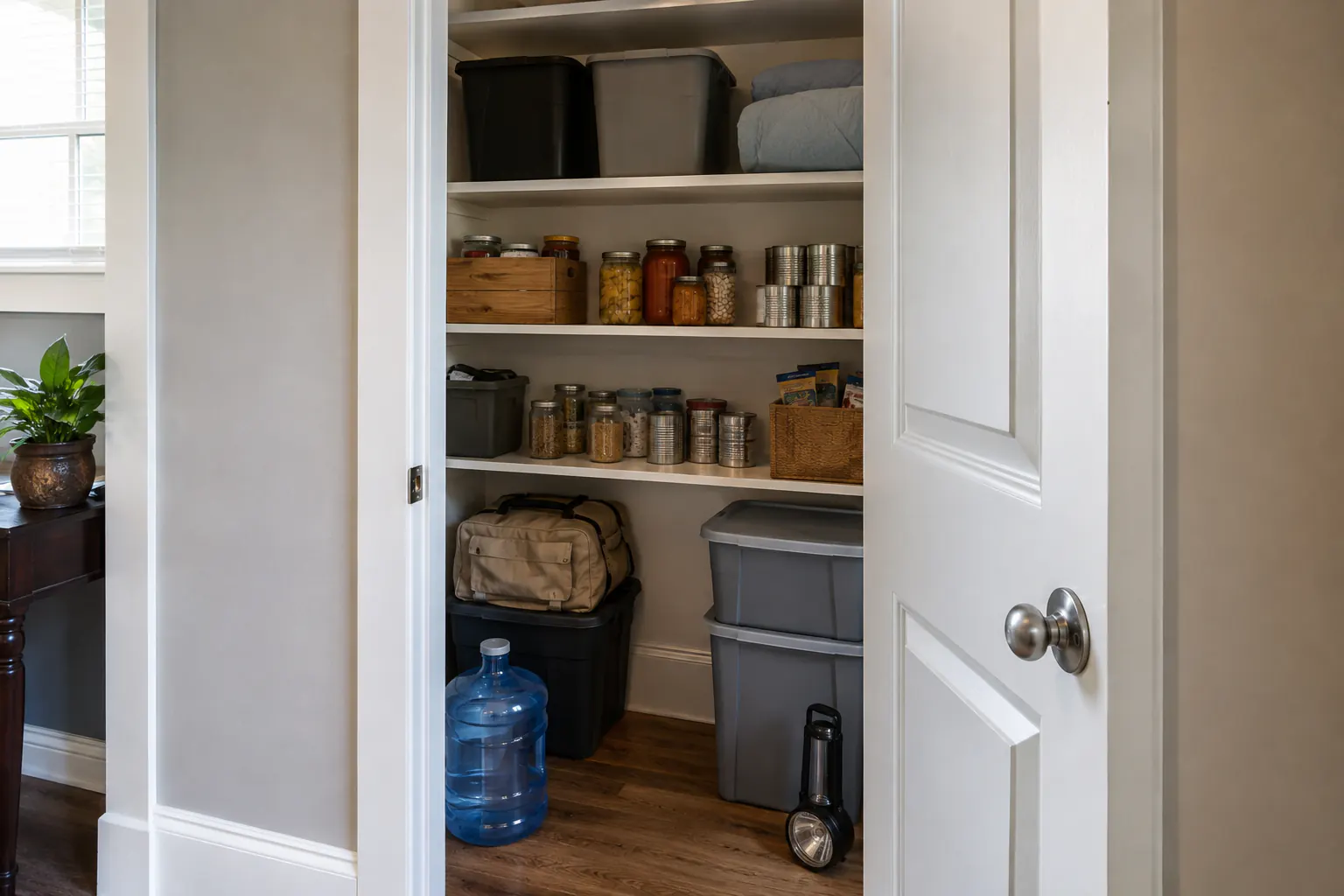
Start with the route, not the room
Walk from every occupied room to the outside route before assigning a shelf. Doors should open fully. The household should be able to reach the exit in normal lighting and in a dark, disrupted home. Do not use common halls, stair landings, mechanical rooms, fire-door swings, electrical panels, alarms, sprinkler piping, radiators, heaters, or required access space as overflow storage.
Then choose the smallest location that can pass four tests:
| Test | Useful question |
|---|---|
| Reachable | Can the intended person retrieve a module without climbing, moving furniture, or crossing an exit? |
| Inspectable | Can the household see a leak, pest issue, expiry date, damaged battery, or missing item? |
| Separated | Can food, water, documents, batteries, cleaners, and waste supplies remain in their appropriate modules? |
| Private | Does the layout avoid advertising valuables, health information, travel plans, or access details? |
If the answer is no, shrink the module or split it across locations. A bigger room is not automatically a better system. The small-apartment storage guide covers exit protection, loads, building constraints, and category separation in more detail.
Give each function a visible home
Label by household function, not by a dramatic scenario. A person looking for a flashlight at night should not need to remember a complicated inventory code.
| Function | Keep it together | Send it elsewhere when the decision is specialized |
|---|---|---|
| Immediate access | flashlight, verified contacts, current instructions | live alerts and local directions |
| Water | containers, label, rotation note, dispensing method | quantities and advisories to Emergency Water Storage |
| Food | ordinary shelf-stable meals, opener, dietary notes | food safety and quantity to the Emergency Food Storage hub |
| Communication | charged power bank, cables, radio instructions | family contact plan to Family Communication Plan |
| Sanitation | clean hygiene supplies separated from waste supplies | household sanitation plan |
| Departure layer | go-bags, footwear, controlled document packet | staging and evacuation choice to Go-Bag Staging |
Do not turn the storage area into the only place a necessary item can exist. A daily flashlight, a routine food pantry, a current contact card, and a safely staged bag can be part of ordinary life while the area holds backup and rotation records.
Use zones based on access time
Keep the map simple enough that another adult can understand it without a tour.
- Immediate zone: items needed in the first minutes, kept close to ordinary activity and never hidden behind storage.
- Exit-side zone: carryable items placed near, but never in, the exit route.
- Stay zone: water, meals, hygiene, light, charging, and household supplies used while it remains appropriate to stay.
- Seasonal zone: items brought forward before the locally relevant heat, cold, smoke, storm, or flood season.
The Small-Space Preparedness Storage Map makes a printable location-and-check card without asking for an inventory of private property.
Put weight, heat, and hazards in the right conversation
Water, canned food, tools, batteries, and some sanitation supplies are dense. Keep heavy items low only on a surface suitable for their actual load. A shelf that looks substantial is not evidence of a safe capacity. Check product instructions and seek building or qualified professional guidance where an anchor, floor, cabinet, wall, or stored load is uncertain.
Keep food and water away from chemicals, fuel, pesticides, automotive products, dampness, pests, direct sun, and heat sources. Keep batteries, chargers, and powered equipment according to their manufacturer instructions. Do not charge inside a closed bin, on soft furniture, or beside combustible clutter. Remove damaged, swollen, hot, wet, leaking, recalled, or unfamiliar batteries through the correct process.
The storage area does not authorize generator use, fuel storage, electrical changes, plumbing access, medical storage changes, or repair work. Each of those systems has a higher-consequence owner than a shelf label.
Build a rotation that survives ordinary life
Use supplies you can actually inspect and replace. A simple card near the area can record the earliest date to check, the person who owns the review, and the next ordinary meal or use that will rotate an item.
Review after a move, household change, new pet, medication or device change, construction, leak, pest issue, building rule update, weather season, or real disruption. Test a normal retrieval: can the household find the light, water method, food module, contact card, and carryable bag without turning the exercise into an emergency?
Do not run a power outage, disable building systems, move someone through stairs, or use flame, fuel, or medical equipment merely to make a storage drill feel realistic. The point is to expose a confusing label or missing owner while normal help remains available.
Let the area support ordinary maintenance
A storage area becomes more useful when it supports normal household care instead of competing with it. Keep a simple note for the next home task, weather season, or contact review alongside the relevant module. A storm-season tote can come forward before the season. A pantry item can become dinner before its quality date. A flashlight can be used and returned after a routine household job.
This avoids the false divide between emergency supplies and the rest of a home. It also reveals whether a household has duplicates that create clutter, a single item with no backup method, or a category that no person can realistically maintain. Make the smallest correction that fixes the actual gap; a new shelf is not always the answer.
When household storage changes after water damage, smoke, pests, renovation, or a move, inspect the property condition separately. Do not conceal a leak, damaged outlet, mold, or structural concern behind new containers. The preparation area should make ordinary maintenance easier to notice, not provide a reason to postpone it.
Keep the room ordinary and the plan flexible
The best preparedness area does not look like a display. It looks like maintained household storage with a clear purpose. It gives the household a place to begin, then routes each decision to the guide that owns it. If evacuation, smoke, flooding, unsafe temperatures, medical continuity, sewage, structural damage, or an official order changes the situation, leave the shelf behind and follow the current instructions.
Sources reviewed
- Ready.gov: Build a Kit
- U.S. Fire Administration: home escape planning
- Centers for Disease Control and Prevention: emergency water storage
Sources reviewed August 3, 2026. Current authorities, building management, product instructions, clinicians, and qualified professionals control actual storage, egress, structure, fire, electrical, plumbing, medical, and hazardous-material decisions.