
A useful small-space plan answers a locating question, not an inventory question: where would the household look first for the function it needs? This private map gives four ordinary locations a job, then prints a short reminder that can live in a controlled household place.
It does not save data, measure a shelf, approve an apartment layout, or decide whether it is safe to stay. Do not enter private property details, access information, medicines, valuables, travel plans, or anything a visitor should not see.
Private in-browser worksheet
Small-space storage map
Assign a location and one check for each function. The worksheet stays in this browser tab and does not evaluate load, building rules, or safety.
Use four zones, not one crowded closet
The four labels in the worksheet represent timing:
- Immediate access is for the first minutes: a light, verified contacts, and event instructions.
- Exit-side carry layer is for items that leave with the household, placed near but not in the route.
- Stay-at-home supplies holds the water, food, sanitation, light, and communication modules appropriate while the home remains safe.
- Seasonal rotation brings forward the items that matter for expected heat, cold, smoke, flood, or storm conditions.
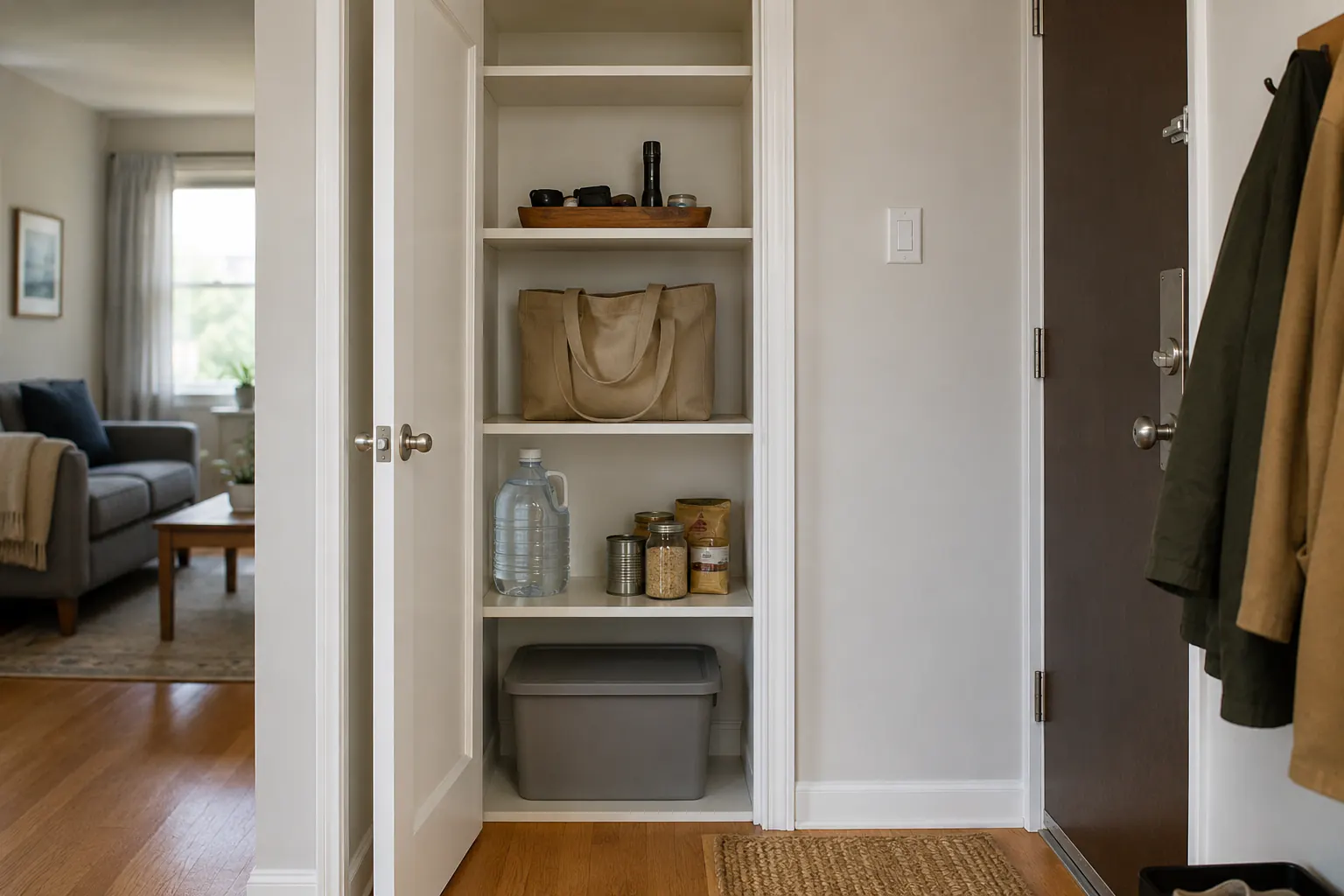
You do not need all four in different rooms. A studio apartment may use one cabinet with four visible sections. A house may use several rooms. What matters is that a person can find the function without opening every container or moving through a blocked route.
Start with Emergency Preparedness for Apartments and Small Spaces for building-system and accessibility questions. Use the small-apartment storage guide when exits, furniture, water weight, chemical separation, pets, medication, or building rules affect the layout.
For a whole-home version of the same location logic, read Prepper Room Ideas for an Ordinary Home. Use Emergency Water Storage before assigning any water module; this worksheet deliberately does not calculate quantity or verify a container.
Add location clues, not private labels
Good clues are practical and low-risk: “low hall closet shelf,” “kitchen lower cabinet,” or “plain tote by the inside wall.” Avoid labels that expose who is away, what is expensive, which condition a person has, or where access information lives.
The map is not a substitute for controlled records. Keep passwords, recovery codes, financial records, medication details, device instructions, and document images in their appropriate systems. The go-bag staging guide owns the narrow question of keeping departure items available without turning them into an obstacle.
Run a calm retrieval check
On an ordinary day, have the intended adult locate a light, the water module, the household contact card, and the carryable departure layer. Check that every door opens fully, no cord crosses a route, no heavy item is above a person who will retrieve it, and no storage covers a detector, electrical panel, fire equipment, or building access point.
Stop rather than improvising if the check would require moving a mobility device, climbing, lifting beyond the person’s plan, entering a shared space, or changing a building system. A blank row on the map is useful evidence that a household needs a different storage arrangement or a specialist conversation.
Review after the layout changes
Update the card after a move, a new roommate or caregiver, a pet, a change in access needs, construction, a leak, a seasonal shift, or any real event that made a module hard to find. Rotate consumables through ordinary life instead of sealing them away indefinitely.
The map works when it remains small enough to be read and maintained. It is a reminder of where to begin, not proof that the home can safely withstand any disruption.
Sources reviewed
- Ready.gov: Build a Kit
- U.S. Fire Administration: home escape planning
- Centers for Disease Control and Prevention: inclusive preparedness
Sources reviewed August 3, 2026. Current authorities, building management, product instructions, and qualified professionals control actual storage, fire, accessibility, structural, electrical, plumbing, and medical decisions.