
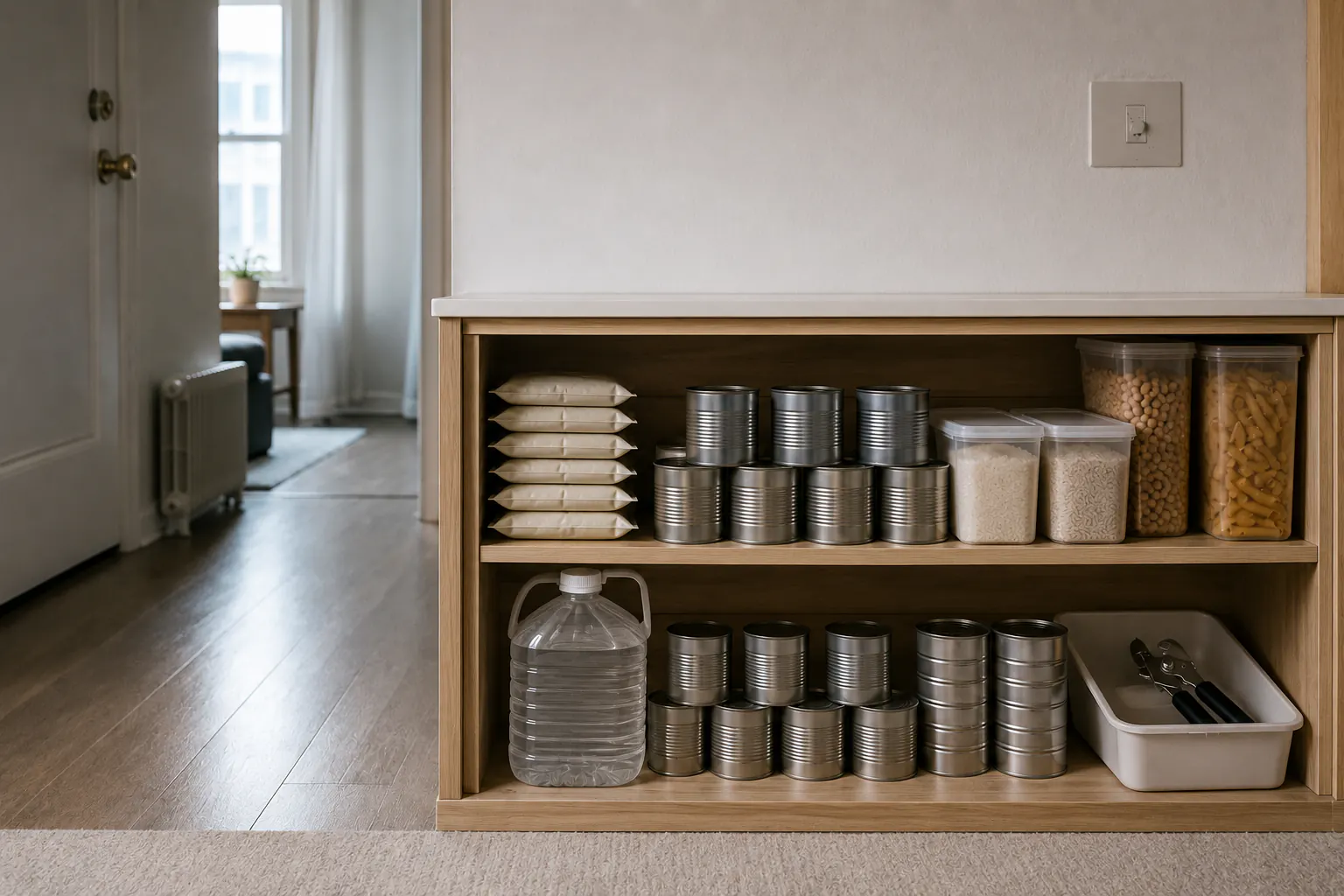
You do not need a spare room to start an emergency pantry. Choose familiar meals, then find a reachable shelf where their labels stay visible and the weight is within the shelf’s stated limit. Keep the route out of the apartment clear before adding another package.
The emergency food storage hub helps plan the meals and quantities. Here, the question is where they can live without crowding the kitchen, hiding protected food, or creating a difficult load when you need to leave.
Start with a three-day layer of familiar food. Add toward two weeks only after the first layer fits safely and is being used in normal life. A small reliable reserve beats a bulky stockpile that blocks an exit, overheats beside an appliance, or vanishes behind furniture.
Protect egress before finding storage volume
Keep hallways, apartment doors, stairs, windows intended for emergency escape, electrical panels, utility controls, and access to fire-safety equipment clear. Do not turn a landing, balcony, closet opening, bathtub, or under-bed space into a pile of food if it impairs safe movement, creates a trip hazard, or conflicts with building rules.
Storage should be stable enough that containers do not shift in a quake, storm vibration, or hurried exit. Avoid stacking heavy cans above shoulder height or placing large quantities on shelves, furniture, or racks that were not designed for that weight. Water is especially heavy; plan it separately through Emergency Water Storage rather than treating it as an add-on to a food shelf.
Use a zone system
Choose a few small, repeatable zones instead of scattering supplies around the home.
| Zone | Best use | Avoid |
|---|---|---|
| Everyday pantry shelf | Older food first, visible labels, normal rotation | Letting reserve food disappear behind unrelated items. |
| Upper cabinet or stable closet shelf | Lightweight duplicate meals and paper inventory | Heat, moisture, inaccessible height, or a blocked door. |
| Under-bed container only when it stays dry and accessible | Flat, sealed, lightweight supplies | Heavy cans, anything that makes the bed hard to move, or unsorted piles. |
| Kitchen tool location | Manual opener, utensils, labels, small cleanup supplies | Relying on a powered can opener or a single hard-to-reach drawer. |
| Protected-food location | Allergy-safe, infant, or prescribed-diet items | Mixing protected items with common snacks or letting anyone borrow them. |
Choose cool, dry locations protected from leaks, pests, and sunlight. Do not store food under a sink, beside a stove, next to cleaning chemicals, in a damp basement, or where a leak can reach it unnoticed. Shelf-stable does not mean immune to heat, moisture, damaged packaging, or label instructions.
Keep a suitable utensil holder or reachable drawer you already have. If the familiar meal tools cannot be reached in that drawer, a vertical holder is another layout to compare, but only where a measured dry counter location stays clear of heat, splashes and appliance access. Keep sharp items separately secured.
Build a food reserve that can move
Apartment emergencies can require relocation because of building damage, fire, flooding, utility loss, or an official order. Do not make the entire reserve dependent on one immovable container. Keep a small, clearly identified subset of ready-to-eat food, water, manual tools, diet-protected items, and contacts that can move with the household when conditions allow.
This is not a promise that every item should be carried. It is a reason to decide in advance what is essential, what stays, and what goes. The three-day and two-week food list helps identify the meals; evacuation planning explains why official instructions and safe exit conditions control.
Choose packages for the apartment reality
Package size affects more than shelf space. A large can or pouch may be economical but can create leftovers that need refrigeration after opening. Many small packages create more packaging and waste, but may fit a one- or two-person household better during a disruption. Read the exact label, count label servings, and use the household food planner to account for the meals you chose.
Make the first layer ready to eat whenever possible. Some dry foods need substantial water, heat, utensils, and washing. Low-water and low-fuel meals helps expose those dependencies. Do not bring outdoor-only fuel-burning equipment inside as an apartment workaround; safe outage cooking explains the equipment boundary.
Keep a short paper inventory
In a small home, a simple list can save more space than a sophisticated system. Record item, package size, label date or rotation month, location, preparation needs, and whether the food is general stock or protected for someone’s diet. Update it when food is used, not through a daily administrative ritual.
Once a month, inspect for damaged packages, pests, moisture, unknown food, and any item the household would not willingly eat. Move older acceptable food into ordinary meals. The FIFO pantry rotation guide explains the routine.
Include the rest of the system
Food storage is incomplete without a safe-water, hygiene, waste, lighting, communication, and exit plan. An apartment kitchen may be dark, crowded, and unable to support normal washing. Keep hand hygiene and cleanup in Emergency Sanitation and Hygiene. Keep food-safety decisions for the refrigerator, freezer, cooler, and floodwater in Power Outage Food Safety.
The goal is not to replicate a warehouse in a studio. It is to make several days of familiar meals possible without turning the home into a hazard.
Watch seasonal storage changes
Apartment temperature and humidity can vary by room and season. A closet near a hot water line, a kitchen cabinet next to an oven, a sun-facing wall, or a damp lower-level room can be a poor reserve location even when it looks convenient. Check conditions during the warmest and coldest parts of the year, after leaks, and after building work.
If a storage area becomes wet, contaminated, pest-damaged, or inaccessible, do not assume sealed packaging solves the whole problem. Inspect labels and packaging, move usable stock according to its label, and use public-health guidance for flood or contamination concerns.
Share only what needs to be shared
Roommates, neighbors, and building staff may need to know where a clear exit, fire extinguisher, or protected food zone is located. They do not need private dietary, medical, or household inventory details unless the person has chosen to share them. Agree on a simple emergency rule for common areas, especially where multiple people use the kitchen or a shared storage closet.
During a move, apartment inspection, or new roommate arrangement, review the locations again. A reserve that ends up in a moving box, a locked storage room, or a newly blocked closet is not available when the household needs it.
Choose a reachable inspection routine
Small homes make it tempting to put the reserve in the least convenient void. Instead, choose a location that can be inspected without moving furniture or climbing unsafely. A ten-minute monthly check should reveal leaks, damaged cans, pests, forgotten food, and the opener location. If the food cannot be inspected, it cannot be rotated with confidence.
Consider how the space works during a nighttime outage: a high shelf may be fine in daylight but inaccessible when lighting, balance, or a clear path are limited. Keep the first meals and manual tools lower and easier to reach.
Keep leases and building systems in view
An apartment plan has limits that a detached-house guide cannot assume. A landlord may control exterior areas, storage rooms, balconies, electrical equipment, and repairs. Building staff may need access to a utility cabinet or hallway. Food storage cannot claim those spaces, interfere with maintenance, or turn a shared route into a private pantry.
Read the current lease and building rules during normal conditions. Ask a specific question when a storage choice affects a shared area or a safety system. The answer may be a smaller indoor reserve, more frequent rotation, or an alternate location within the permitted living space. Those constraints are not a failure of preparedness; they are part of a plan that people can actually keep.
Plan the first thirty minutes
The first food decision after an outage should be simple: locate the paper inventory, use a ready-to-eat meal if needed, keep appliance doors closed, and check official alerts. A compact plan that handles that first half hour can prevent a rushed search through every cabinet and preserve the apartment’s limited clear space.
Sources reviewed
ReadyLience reviewed Ready.gov emergency-kit guidance, USDA FSIS shelf-stable-food guidance, and USDA FNS home-storage best practices. Product labels, building rules, local emergency instructions, and public-health advice control the situation.
Sterilite’s current 1751 ClearView specifications and the exact Amazon Sweet Plum two-container pack were checked October 12, 2026 for ordinary outer organization. No food-contact, preservation, storage-load or product-performance test was performed; nominal box dimensions do not approve a shelf or the food inside.
Joseph Joseph’s exact 85119 Grey documentation and the single-item Standard/Compact Amazon listing were checked October 12, 2026. The manufacturer’s UK model page and the US listing agree on model identity, drawer-height requirement and hand-wash care. No regional delivery, drawer fit, slip resistance or utensil capacity was established; the manufacturer page is not a US-market manual or a substitute for instructions supplied with the item.
OXO’s current 1071352 and expandable-organizer documentation and exact single-item listings were reviewed October 12, 2026. The regional OXO page identifies 13321900 where the US page omits a numeric SKU; it does not establish US supplied instructions or universal drawer fit. Rotating access, raised ledge, open tool area and removable caddies are documented features, not stability, reachability, load, cleaning or preservation results. No physical product tests were performed.
OXO’s current US 13362300 documentation and the exact Large single-holder listing were reviewed October 13, 2026. The removable hinged dividers and dishwasher-safe care are documented features, not measured reach, stability, cleaning or utensil-capacity results. No product or supplied package was physically inspected; current received-item instructions control actual use.