
Before buying a portable toilet or another box of supplies, ask building management what residents should do if toilets or wastewater service stop. You need an approved toilet or collection option, handwashing, and a permitted waste route, not just a container that fits in the closet.
Build it around the apartment, number of users, care needs, management rules, and an approved waste path. A bucket or bag purchased online is not a sanitation plan by itself. The kit implements, in a small footprint, the framework from the emergency sanitation hub.
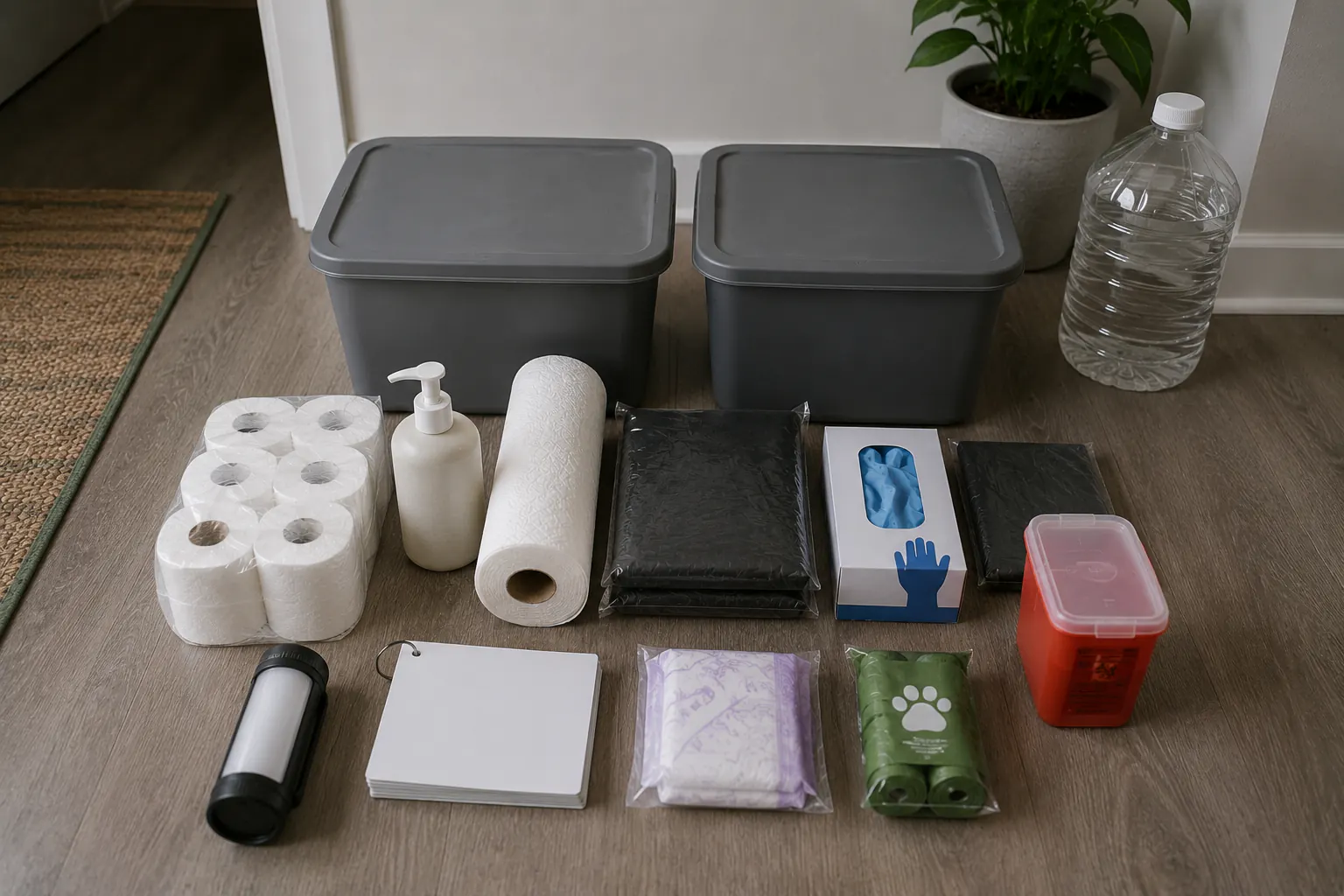
Start with the building dependencies
Ask management before an emergency:
- Does the building need power for water pressure, sewage, sump, ejector, or lift pumps?
- Who announces a water or wastewater restriction?
- Where are backup or accessible toilets?
- May temporary toilet waste be stored, and where?
- What bags or containers will the waste hauler accept?
- What happens when elevators, trash chutes, compactors, gates, or access systems stop?
- Who assists residents unable to carry water or waste on stairs?
- Which common areas are fire routes and never storage locations?
- How are sewage backup, pest, odor, or leak emergencies reported after hours?
Record the emergency number on paper. Do not assume the balcony, hall, stair, basement, garage, roof, trash room, or public bin is approved storage.
Choose a realistic planning duration
Ready.gov promotes several days of household supplies, while local disruptions and building repairs can last longer. Use three layers:
| Layer | Purpose | Storage approach |
|---|---|---|
| Immediate | first toilet failure, cleanup of a small authorized task, handwashing | one reachable module |
| Core | several days of household operation | compact bins sized to real users |
| Extended | resupply, collection delay, or two-week stress test | rotation plan plus relocation triggers |
Do not claim the apartment can shelter for a fixed number of days until waste capacity, water, heat, air, medical needs, and collection have all been checked. Use the two-week hygiene plan as a stress test rather than a promise to stay.
Module 1: information and control
Keep a waterproof or protected paper card with:
- water and wastewater utility contacts;
- property-management emergency contact;
- local health and solid-waste authority;
- household meeting and relocation destination;
- exact building address and unit;
- resident care and accessibility responsibilities;
- product instruction locations;
- inspection and replacement dates.
Do not put passwords, medical diagnoses, key locations, or unnecessary personal data on the outside. Keep digital copies available offline but do not make the phone the only source.
Module 2: toilet continuity
Use the toilet sanitation guide to choose the system permitted locally. A planning module may require:
- stable, load-appropriate collection container or use of the existing toilet bowl under official guidance;
- compatible seat or lid;
- heavy-duty liners and required secondary bags;
- locally approved dry absorbent material;
- toilet paper;
- disposable gloves for waste handling;
- rigid lidded secondary containment permitted for storage;
- a small task light that leaves the walking path clear.
Do not pack loose cleaning chemicals or unlabeled powders in this module. Do not test a liner with human waste before an emergency. Test the empty setup for fit, balance, transfer, lid closure, and user reach.
Count capacity by actual daily use, not by package marketing. Include guests, caregivers, diarrhea or vomiting contingency, and bag replacement before overfilling.
Module 3: handwashing
CDC recommends soap and clean running water for at least 20 seconds. Include:
- a stable clean-water container with a controlled spout;
- plain soap;
- clean drying material;
- a marked catch container when drains cannot be used;
- closed trash container;
- alcohol-based hand sanitizer containing at least 60 percent alcohol as a backup;
- skin-compatible moisturizer if needed.
The clean-water container and catch container must be unmistakably different. Use text, shape, and tactile cues rather than color alone. Prevent spills and keep both out of walkways.
Review the limited-water hand hygiene guide for sanitizer limits and advisory decisions.
Module 4: waste separation
Store empty bags and labels by category before the outage. Include only containers the household can close, lift, and move safely.
Prepare separate paths for:
- temporary human waste;
- diapers, incontinence, and menstrual products;
- spoiled food and wet garbage;
- ordinary dry trash;
- pet waste;
- sharps and medical waste;
- batteries and electronics;
- household hazardous products.
FDA-cleared sharps containers are preferred for used needles and lancets. Keep them upright, below the fill line, and inaccessible to children. Do not treat a sharps container as optional because collection is delayed.
The waste isolation guide covers category-specific controls.
Module 5: personal and caregiver hygiene
Build for the people actually present:
- diapers, wipes, changing liners, rash care, bags, and spare clothes;
- menstrual supplies and preferred disposal bags;
- incontinence products, skin protection, and bed or chair protection;
- toilet-training supplies;
- oral-care supplies and confirmed-safe water plan;
- no-rinse personal-care products appropriate to the user;
- tissues, clean cloths, towels, and laundry isolation bags;
- pet litter, waste bags, pads, and cleaning supplies;
- clinician-directed ostomy, catheter, wound, respiratory, or feeding supplies.
CDC notes that infant feeding items may be unsafe when they cannot be cleaned with safe water and soap. Ready-to-feed formula has specific emergency advantages for formula-fed infants; follow current CDC and clinician guidance rather than improvising dilution or bottle cleaning.
Do not substitute wipes for every hygiene task or use surface disinfectant on skin.
Module 6: cleaning and PPE
Use a small, understandable product set:
- plain detergent or soap appropriate to intended surfaces;
- one label-directed EPA-registered disinfectant only when a defined need exists;
- task-appropriate gloves;
- eye protection when required by the product or splash risk;
- disposable or washable cleaning cloths kept separate by task;
- absorbent material for ordinary nonhazardous spills;
- bags for used cleaning materials.
For small, known dry messes during ordinary household use, keep the brush and pan you already own. A compact countertop set is an alternative only if that particular task is missing. It is not a sanitation treatment or permission to collect hazardous dust, unknown residue or broken glass.
For a small familiar spill on a compatible surface, start with a suitable cloth you already own. Washable cotton cloths are another format when that ordinary wiping job is missing and you have a normal laundering routine. Keep each task separate, including used cloths; buying a set does not make waste handling or an unknown spill safe.
Keep every chemical in its original labeled container. Do not decant, combine, or pre-mix products for storage. Do not put bleach beside ammonia, acids, toilet cleaner, drain opener, vinegar, or unknown products as a suggested recipe.
Read the cleaning-products mixing warning. A critical sewage, chemical, flood, or mold cleanup is outside the purpose of a compact household kit.
Module 7: accessibility and safe movement
Check:
- toilet seat height and stability;
- transfer space and grab support already approved for the home;
- ability to open bags, lids, soap, sanitizer, and water controls;
- readable and tactile labels;
- lighting during an outage;
- clear routes for mobility equipment;
- maximum container weight each assigned person can safely carry;
- privacy for care and disposal;
- a backup caregiver and relocation plan.
Do not add an improvised grab bar or support that has not been structurally installed for the load. Do not require a resident to carry a heavy five-gallon container on stairs.
Pack by sequence, not by product type
Place the first-use items together:
- instruction card and light;
- toilet liner or facility directions;
- toilet paper and personal-care supplies;
- closure and secondary containment;
- gloves;
- soap, safe water, and drying material;
- waste log and next-action card.
If soap is in one closet, bags in another, and the light has no battery, the kit is not operational.
Keep total bin weight manageable. Two smaller bins are often safer than one deep bin, but each should have a complete inventory and clear purpose.
Avoid common apartment kit failures
- Buying a portable toilet without an approved waste route.
- Storing drinking water where a leak from waste or chemicals could reach it.
- Assuming trash pickup, elevators, or chutes will operate.
- Packing one glove size for every user and task.
- Keeping sanitizer but no soap or safe-water station.
- Decanting cleaners into travel bottles with unclear labels.
- Storing bags that do not fit the actual container.
- Ignoring diapers, incontinence, menstruation, medical care, or pets.
- Blocking the exit or accessible path with supply bins.
- Planning for two weeks without enough secondary containment or collection.
Inspect twice a year and after every use
Check:
- water and wastewater contacts;
- management rules;
- bag fit and material condition;
- container cracks, lid fit, and load stability;
- soap, sanitizer, gloves, paper, and personal-care quantities;
- disinfectant label, seal, and expiration;
- battery and light condition;
- infant and child sizes;
- medical and accessibility changes;
- waste and relocation plans.
Do not open sealed sterile or medical supplies merely to inspect them; follow their package and clinician instructions.
Check fit and instructions before buying
I have not tested or ranked emergency toilets, bags, gloves, or hygiene products here. For the exact items you are considering, check the intended use, supported user weight, liner fit, closure instructions, accessibility, storage dimensions, replacement availability, and compatibility with the waste method allowed locally.
Do not use human waste or improvised loading to test a product. Manufacturer instructions and the local waste authority control the setup; a household fit check does not grant lease, code, health, or waste-hauler approval. The testing methodology explains the evidence I require before calling a product tested.
Sources reviewed
- Ready.gov: Build a Kit
- CDC: Emergency Personal Hygiene; Infant and Young Child Emergency Checklist
- Washington State Department of Health: Toilet Use During Emergencies
- FDA: Sharps Disposal Containers
Sources reviewed July 14, 2026. Building management, local health and solid-waste authorities, clinician plans, and product labels control the actual apartment setup.
The Streamlight 66318 example uses the manufacturer and exact Amazon identity check recorded October 11, 2026; its dry indoor instruction-access placement was reviewed October 12. No product performance, chemical compatibility, cleaning, wet-use or sanitation system was tested.
OXO’s current 1334280 compact brush/pan documentation and exact Compact/One Size US listing were checked October 13, 2026. The brush snaps into the pan for covered-bristle storage; that feature does not establish retention, cleaning effectiveness or a sanitation result. Exact care follows the supplied instructions, not another OXO brush’s dishwasher or disinfectant guidance. The larger model and six-set packs are separate listings, not this selection.
Full Circle’s current selected Multi three-pack record and exact Original FC10206 US selection were checked October 13, 2026 against UPC 850166002406. Other barcode aliases, eight-packs and maker feature text saying three or five are not treated as this package. Current maker care calls for cold laundering, low tumble drying and no fabric softener; the listing’s ingredients text instead says warm water. Follow the supplied current label rather than combining these into a new procedure. Organic, non-toxic, absorption and durability marketing are not a chemical clearance or cleaning result established here.