
Measure one dry, secure storage space for your tools before buying a box. Then gather the usable tools you already own for permitted jobs, such as assembling your furniture. Leave room to take each tool out without reaching past an exposed blade or lifting a case you cannot control.
The renter also has a different authority boundary. A resident may assemble furniture, measure a space, inspect visible conditions, and make approved minor adjustments. Building plumbing, electrical distribution, fire doors, locks, windows, alarms, HVAC, common areas, and structural assemblies may belong to the landlord or building.
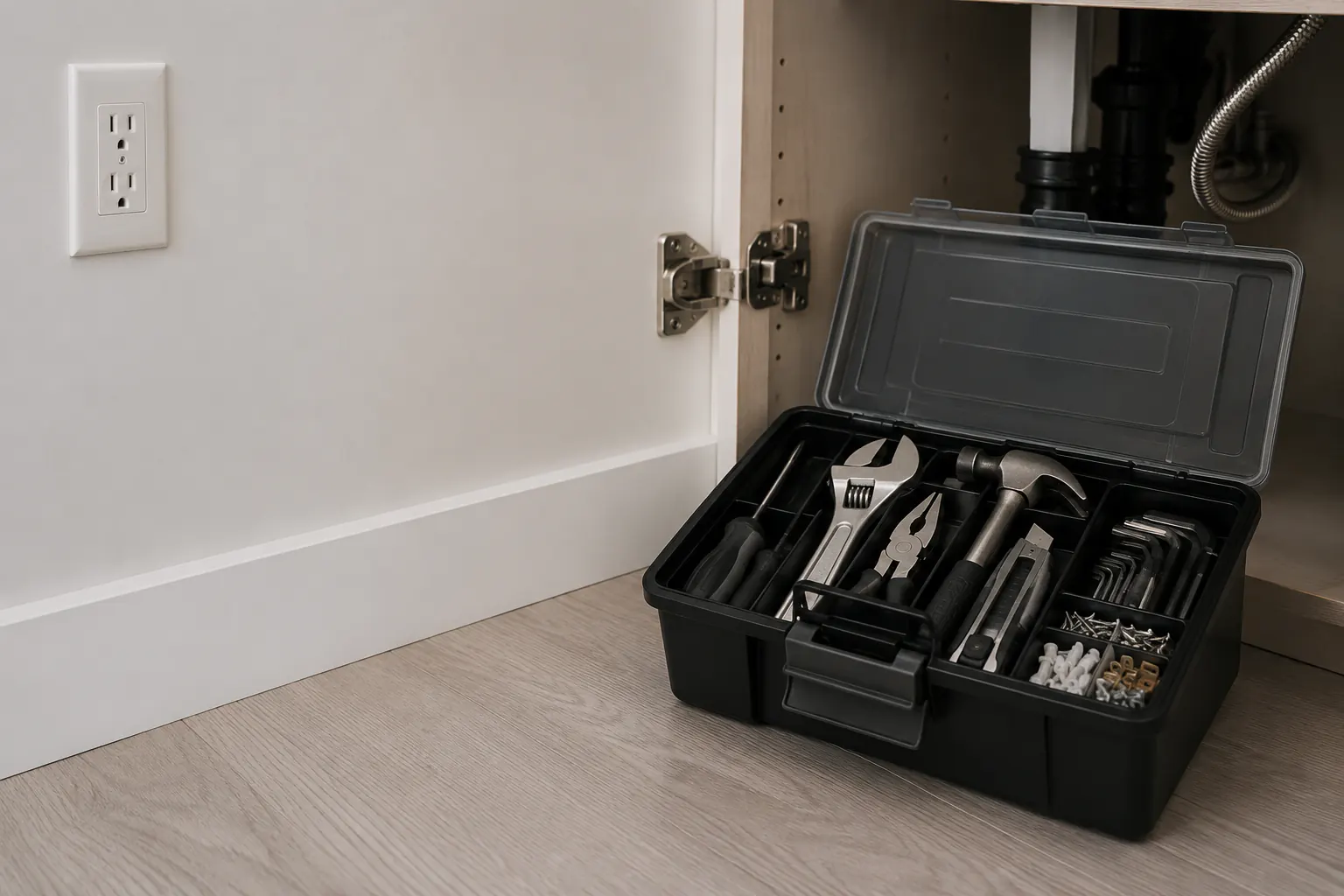
Choose the box before the tools
Use a box or bag you already own if it meets these storage needs:
- one rigid box or zippered tool bag the intended user can lift;
- a stable footprint that fits one known shelf or cabinet;
- internal dividers for sharp, heavy, small, and battery items;
- a closure that cannot spill when carried;
- a lock or secured cabinet when children or unauthorized users may reach it;
- enough visibility that missing tools are obvious;
- no placement in a fire exit, electrical-panel clearance, hallway, stair, or damp utility area.
Measure the storage location and the user’s comfortable lifting height. A box may be liftable from the floor but unsafe above shoulder level. Do not store a heavy metal case where it can fall onto a bed, child, pet, or foot.
One-box inventory by zone
Lid or quick-access zone
- compact flashlight or headlamp;
- paper building contacts and maintenance number;
- pencil, removable tape, and small notebook;
- tape measure;
- suitable eye protection in a clean case;
- work gloves appropriate only to known non-rotating tasks.
The emergency light should not be buried beneath sharp tools. Keep it in the same location and test it under the power outage plan.
Driver zone
- one comfortable multi-bit ratcheting driver;
- a few full-size drivers for the apartment’s common fasteners;
- labeled hex keys for resident-owned furniture;
- compact bit organizer with no loose pieces.
Do not carry security bits or unusual drivers merely because they are sold in a large set. Access to a fastener does not authorize opening an appliance, fire alarm, access-control panel, electrical enclosure, or building system.
Grip and turn zone
- general adjustable pliers;
- needle-nose pliers for non-energized small parts;
- one adjustable wrench;
- small verified wrench or socket set only if recurring resident-owned equipment uses it.
Separate a property-specific water shutoff key if the landlord has identified an authorized resident valve and procedure. Do not turn unmarked valves or building risers. The renter plumbing guide explains when to contact building management instead of working on the system.
Measure, mark, and hang zone
- compact level;
- tape measure;
- removable tape and pencils;
- small stud-sensing or wall-scanning device only if the lease allows work and the user understands its limitations;
- manufacturer-approved hanging hardware for known wall construction and allowed loads.
No detector proves that a wall is free of electrical, plumbing, gas, sprinkler, or communications services. Obtain building information and permission before drilling. Adhesive hooks can damage paint, fail under heat or humidity, and still violate a lease; follow exact surface and load instructions.
Controlled cutting zone
- household scissors;
- locking or retracting utility knife;
- spare blades in a rigid closed dispenser;
- small cutting mat if the household regularly opens packages or works on a table.
Store blades in the most secure compartment. Cut on a stable surface away from the body, and never cut toward a hidden hand, cable, wall cavity, flooring, countertop, or upholstered furniture.
Light striking and assembly zone
- one compact balanced hammer;
- small non-marring mallet only for manufacturer-directed assembly;
- a few labeled furniture spares and fasteners from known projects.
Keep supplied hardware bags and an existing divided box if they preserve those labels. A divided soft parts bag is another format when several known groups keep getting mixed. For two justified small-tool groups, separate zip pouches can avoid emptying one flat pouch to find them. Choose the missing function, not both formats automatically; neither replaces independently secured storage.
Avoid a pry bar, sledge, hatchet, large demolition hammer, or bolt cutter in the general apartment kit unless a specific lawful task and secure storage justify it. These items add weight and can damage finishes, fire assemblies, or security hardware.
Keep chemicals outside the box
Do not store adhesives, solvents, lubricants, cleaners, paints, fuels, pesticides, drain products, or pressurized cans loose with hand tools. They can leak, contaminate handles and eye protection, create incompatible mixtures, and increase child risk.
Keep products in original labeled containers under their temperature, ventilation, separation, and child-storage instructions. The cleaning products warning covers chemical boundaries; it does not authorize using a chemical as a tool-maintenance shortcut.
Decide whether a cordless drill fits apartment life
A drill/driver adds speed but may not fit the lease, neighbors, quiet hours, wall construction, hidden-service risk, storage temperature, or user skill. Before adding one:
- identify repeated authorized tasks;
- obtain required written permission;
- verify building quiet hours and dust controls;
- select a controllable model and compatible bits;
- plan eye protection and stable work support;
- store battery and charger under manufacturer conditions;
- keep it locked away from children;
- understand that wall scanners do not eliminate hidden-service risk;
- stop before drilling a fire-rated, tiled, wet, unknown, or shared assembly.
The compact kit works without a drill. Borrowing or renting may be more sensible for a rare authorized task, provided condition, instructions, compatibility, and liability are checked.
Add an outage pouch without overloading the box
Use a removable pouch containing:
- task light and spare approved batteries;
- charging cable for the light if rechargeable;
- work gloves for debris-free ordinary handling;
- removable labels and marker;
- compact tape measure;
- building contact card;
- copies of approved unit shutoff instructions;
- phone power bank stored and maintained separately if needed.
This pouch supports inspection and communication. It is not a storm-repair kit. During active wind, lightning, flooding, smoke, fire, civil disturbance, or building damage, stay away from windows, balconies, roofs, facades, utility rooms, and elevators as official instructions require.
Protect children and other residents
CPSC says cabinet latches and locks can help restrict access to knives and other sharp objects but no device is completely childproof. For tools:
- use a locked cabinet or box appropriate to the household;
- reengage the lock after every use;
- store keys or combinations away from children without blocking adult emergency access;
- keep blades closed and separately contained;
- remove batteries from tools for storage where the manual directs;
- do not rely on a high shelf alone for heavy or attractive objects;
- keep small bits and fasteners away from children and pets;
- never leave a tool staged on a bed, chair, floor, or windowsill;
- return tools before cleanup attention moves elsewhere.
Guests, caregivers, roommates, and maintenance workers also affect access. Agree on storage and return rules without sharing tools broadly.
Make missing tools easy to spot
One label or a short list is enough to begin; you do not need numbered pouches or a detailed inventory for every tool. If a layout card helps, show where each item belongs. Record actual condition and action, not a prefilled “pass”:
| Item | Slot | Owner | Condition | Last check | Replace or service |
|---|---|---|---|---|---|
| task light | accessible compartment | permitted user | record actual check | actual date | follow light instructions |
| driver and bits | contained organizer | permitted user | record actual check | actual date | record missing size |
| utility knife | secured compartment | permitted adult | record actual check | actual date | follow blade/lock instructions |
| drill battery, if owned | storage specified by manual | permitted adult | record actual check | actual date | manual/recall review |
Do not store apartment keys, alarm codes, identity papers, cash, or sensitive maintenance-access details inside an obvious tool case.
Check the fit when the kit changes
When adding a tool, check the box’s weight, space, and access again. Move an unnecessary duplicate to suitable secure storage if that helps, but do not remove a needed tool merely to keep the item count unchanged. Follow manufacturer inspection schedules and check again after a move, child-access change, leak, pest event, or hard use.
Use the multi-tool comparison to decide which compact tools truly replace others, the safe storage guide for placement, and the essential toolkit hub for wider household limits.
Sources reviewed
- U.S. Consumer Product Safety Commission: Childproofing Your Home; Recalls
- OSHA: Hand and Power Tools
- U.S. EPA: Used Household Batteries
Sources reviewed July 14, 2026. Lease, landlord, building, fire, utility, manufacturer, recall, and qualified trade instructions control actual apartment work and storage.
Klein’s 32500 datasheet and exact Amazon variant were checked October 12, 2026 for identity, tip sizes and the non-insulated limit. Manufacturer warnings require approved eye protection and prohibit prying or chiseling. No physical fit, carry, control, ASME conformity or recall-clearance result is established. Check the listing’s California chemical-exposure warning and current received-product instructions.
Bondhus’s current 20199 composition table, CLC’s 1539 specifications and warning, Plano’s Classic 3600 model record and their selected listings were reviewed October 12, 2026. These support configuration and ordinary organization features, not measured fit, child-access protection, chemical safety or a load rating. Follow the furniture and received-product instructions; no product was physically tested.
Bucket Boss’s 25001 documentation and linked chemical warning, Klein’s current 55470 specifications and older two-pouch brochure, and their exact US identities were checked October 13, 2026. The Bucket Boss listing’s area-valued Unit Count is not a quantity; the selection is one bag. Klein’s item/pack fields do not multiply the two-pouch set into four pouches. Dimension and weight differences remain unresolved for packed fit, and no wash recipe is borrowed from another bag. These formats do not certify secure storage or carrying performance.