
Choose the ordinary job first, then check reach, grip, and whether the tool fits without sideways pressure. For a known cabinet screw, for example, an existing full-size driver may be easier to control than a folding tool. Compact carry is useful, but it is not a reason to accept poor fit.
For a household, a compact multi-tool may help with a loose screw, package, small gripping task, or travel kit. It is a poor substitute for a full-size driver when a fastener needs alignment and controlled torque, for pliers when grip matters, or for any rated electrical, plumbing, security, or structural tool.
This compares tool categories with documented manual-driver and tabletop-clamp examples, not a tested model ranking. No folding-tool, grip, lock, fit, holding-force or durability test was performed for these examples.
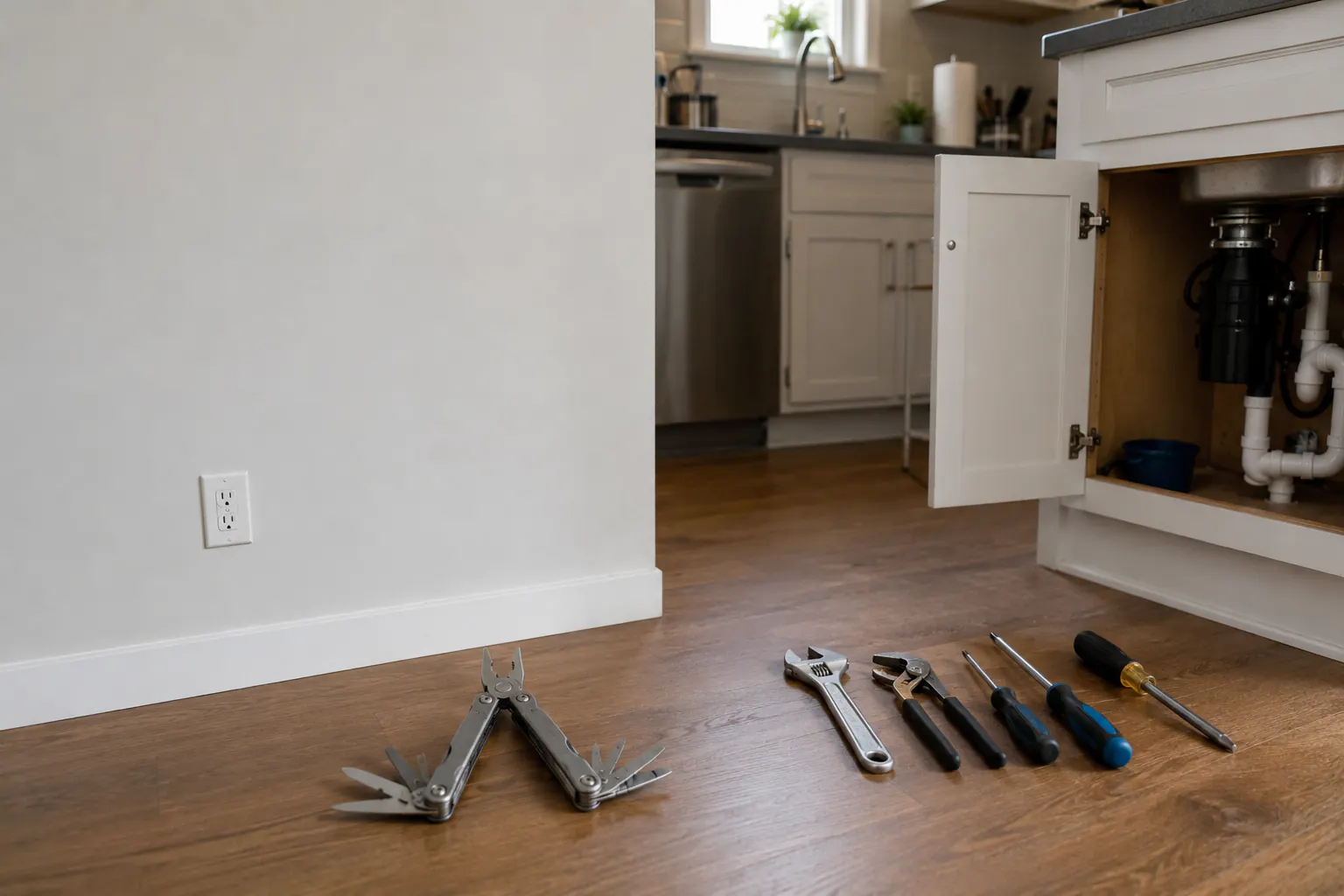
Compare the job geometry first
| Factor | Multi-tool tendency | Dedicated-tool tendency |
|---|---|---|
| Carry | several functions in one object | several separate objects |
| Handle | compact and shared among implements | shaped for one operation |
| Reach | may be limited by body and pivot | multiple lengths and profiles available |
| Alignment | folding geometry can complicate straight access | direct in-line control is often easier |
| Leverage | short handles limit or concentrate force | selected length can match intended force |
| Grip | narrower jaws and handle interference possible | jaw form and handle can match material |
| Replacement | one damaged pivot can affect the set | one tool can be replaced independently |
| Inspection | many joints and locks | fewer mechanisms per tool |
| Storage | compact | more volume but easier visual inventory |
The word “function” can be misleading. A two-inch bit holder and a full-size screwdriver may both turn a screw, but they do not provide the same reach, pressure, handle comfort, visibility, or control.
For a straight line on a paper draft, use a ruler or straightedge you already own. A transparent office ruler is another format when the tool hides the outline you need to align. Keep that task on disposable paper at a stable table; a visible scale does not establish calibrated precision or permission to cut or install anything.
For that disposable graphite draft, keep an eraser you already own, including the one on your pencil. A separate STAEDTLER Mars plastic 526 50 block is another handling format if you prefer to hold the eraser independently. The selected 526 50 BK4 packet contains four erasers, which may be more than you need. Follow supplied handling, care and warnings, and keep small items away from children and animals. No paper-damage, clean-erasure, grip or chemical-safety result is established here. Do not erase original records or evidence, safety measurements, or marks on a building; do not use it on switches, screens or skin.
View STAEDTLER erasers on Amazon(opens in a new tab)Use a multi-tool for low-consequence tasks
Reasonable household roles may include:
- opening ordinary packaging with a controlled blade or scissors;
- tightening a lightly loaded accessible fastener with a correctly fitting driver;
- gripping a small non-energized object without marring a critical surface;
- cutting cord or soft material within the implement’s instructions;
- serving as a compact secondary tool in a vehicle or evacuation kit;
- helping with simple manufacturer-directed assembly.
Even then, use a stable work surface, keep the free hand out of the path, fully engage the implement lock where provided, and stop when the geometry forces the wrist or tool sideways.
Do not use a blade in a moving vehicle, crowded shelter, dark stair, or unstable standing position. Local law and venue rules may restrict carry of blades or locking tools; verify before travel.
Choose a dedicated tool when failure matters
Prefer the correct dedicated tool when:
- the fastener is tight, damaged, recessed, valuable, or security-critical;
- straight alignment and downward pressure are important;
- the material can crack, deform, scratch, or leak;
- the work requires a rated insulated, torque, striking, cutting, or plumbing tool;
- the user needs a larger ergonomic handle;
- the task is repetitive or prolonged;
- the workpiece needs controlled clamping;
- a slipping tool could reach the body, glass, wire, pipe, finished surface, or bystander;
- the manufacturer specifies an exact tool or torque;
- the tool must be cleaned or decontaminated separately.
A multi-tool should not be used to defeat locks, pry doors, open utility equipment, turn unknown valves, or improvise emergency medical care.
Evaluate the pivot and lock
The multi-tool’s central mechanisms are failure points and inspection points. Before each use:
- check that handles, pivots, fasteners, and scales are intact;
- open each intended implement slowly;
- verify its lock or retention system engages under the manual’s normal check;
- look for looseness, binding, corrosion, cracking, bending, or incomplete closure;
- keep fingers away from folding paths and pinch points;
- confirm the implement cannot contact another tool during use;
- clean debris without dismantling beyond instructions.
Do not “test” a lock by forcing the blade or loading it against the hand. Do not use an implement whose lock is inconsistent. Manufacturer service or retirement is safer than an improvised pivot repair.
Compare drivers
For each driver:
- identify bit type and exact size;
- check bit retention and wobble;
- compare usable reach and body clearance;
- check whether the handle permits straight pressure;
- assess grip with dry hands and intended gloves;
- note whether the bit is replaceable;
- test only on a sacrificial ordinary fastener under controlled conditions.
A multi-tool driver can be useful for known light hardware. Dedicated drivers usually provide clearer size identity, better reach options, and more comfortable control. Neither should be used on energized equipment.
For known, lightly loaded non-electrical hardware, keep a correctly fitting driver you already own. Klein 32305 offers forward, fixed and reverse collar positions as a manual ratcheting alternative. Compare that handle action and body clearance with the plain driver; it is not evidence of lower effort, speed or better fit. One tool is supplied, but advertised function counts do not settle the physical bit inventory: verify the exact tips the screw needs. It is not insulated or a calibrated torque tool. Follow required eye protection and supplied care, never pry or chisel, secure small bits, and retain the lead, cancer and reproductive-harm warnings. No oiling, soaking or ratchet-repair recipe is provided here.
View Klein 32305 on Amazon(opens in a new tab)Compare pliers
Multi-tool pliers are compact and can handle small gripping tasks. Dedicated pliers offer jaw types selected for general grip, long reach, locking, cutting, plumbing, or other specific functions.
Compare:
- jaw alignment and opening;
- tooth or smooth-jaw suitability for the surface;
- wire cutter material and rating, if any;
- handle spacing and pinch risk;
- grip comfort under expected force;
- ability to see the contact point;
- corrosion and pivot condition;
- manufacturer prohibition on hardened wire or other materials.
Never assume a multi-tool plier is electrically insulated. Never cut a wire unless it is known, de-energized under an appropriate process, and the task is authorized; household electrical work has a separate qualified boundary.
Compare blades and scissors
Assess:
- opening and closing control;
- lock or retention;
- edge protection in storage;
- blade shape and permitted materials;
- replaceable versus sharpened design;
- cleaning method;
- corrosion resistance;
- local carry constraints.
A dedicated utility knife with controlled blade extension may be easier to manage on a cutting mat and cheaper to reblade. Dedicated scissors may keep both hands farther from the edge. A multi-tool blade is convenient but can place other folded implements and metal edges in the grip.
Use the tool that gives the clearest cut path and best hand position, not the one with the most features.
Apply a replacement test
If one function wears out, ask:
- Can that implement be replaced by the user under official instructions?
- Must the entire tool go to manufacturer service?
- Does sharpening alter geometry or heat treatment?
- Does looseness in one pivot affect every implement?
- Are spare bits or parts available for the exact model?
- Can the tool be inspected after a drop or contamination?
One compact object can create one compact single point of failure. Keep a basic dedicated driver, pliers, light, and cutting tool at home even when a multi-tool travels.
Look for evidence in a model comparison
A useful model comparison should report the following information. These are questions to ask of a review, not experiments to run at home:
| Evidence | Method |
|---|---|
| exact model | manufacturer, revision, country/region, included implements |
| dimensions and mass | calibrated scale and basic measurement |
| implement access | repeatable dry-hand and glove observations |
| lock consistency | manufacturer-approved operation, no overload |
| driver fit | known replaceable fasteners and correct bits |
| plier alignment | visual and low-force controlled material |
| cutting | specified sacrificial material, documented edge condition |
| corrosion care | manual, materials, controlled cleaning only |
| recall and support | CPSC and manufacturer check date |
| limitations | prohibited tasks and untested claims |
Do not perform electrical, lock-bypass, rescue, destructive, impact, drop, overload, or “torture” testing for content. ASME B107 standards and manufacturer evidence matter more than a dramatic informal demonstration.
A practical household decision
- Home core box: dedicated tape, light, drivers, pliers, wrench, hammer, scissors, and controlled knife.
- Apartment one-box kit: compact dedicated core; multi-tool optional if it truly replaces travel items.
- Vehicle kit: dedicated safety and vehicle-specific tools under the vehicle manual; multi-tool only for low-risk support.
- Evacuation bag: weight-sensitive, lawful, minimal, and not treated as rescue or forced-entry equipment.
Use the starter homeowner toolkit, apartment toolkit, and essential toolkit hub to place the tool by role. Maintain both categories with the hand-tool care guide.
Sources reviewed
- OSHA: Hand and Power Tools
- ASME: B107 Hand Tools and Accessories
- U.S. Consumer Product Safety Commission: Recalls and Product Safety Warnings
Sources reviewed July 14, 2026. This page contains no product ranking or field-test result. The linked options are disclosed documentary research, not tested endorsements. Exact manufacturer instructions, standards, recalls, and local carry rules control selection and use.
Klein’s 32500 datasheet and exact Amazon variant were checked October 12, 2026 for identity, tip sizes and the non-insulated limit. Manufacturer warnings require approved eye protection and prohibit prying or chiseling. No ASME conformity, recall clearance or measured comparison is established. Check the listing’s California chemical-exposure warning and the received product’s current instructions.
IRWIN’s current 1964758 page and selected four-clamp listing were reviewed October 12, 2026 for identity, pack contents, trigger release and jaw-pad presence. The source’s conflicting force figures do not support a holding-force claim. Follow supplied instructions and the actual assembly task; no clamp, finish-protection or usability test was performed.
Westcott’s current single 10562 record and exact US 10562/073577105621 selection were checked October 13, 2026. Box and case codes are different packages; other maker barcode aliases are not treated as interchangeable revisions. The page’s generic cutting badge is not permission to use a ruler for cutting. Transparent page view and raised edges describe its format, not calibrated precision, ink compatibility or tested surface protection.