
The first month in a home produces a particular kind of friction: a loose cabinet pull, an unlabeled shutoff, a picture that needs measuring, a delivery that requires assembly, a window that needs documenting, and a storm forecast that makes every missing flashlight obvious. The temptation is to buy a large case with a dramatic piece count.
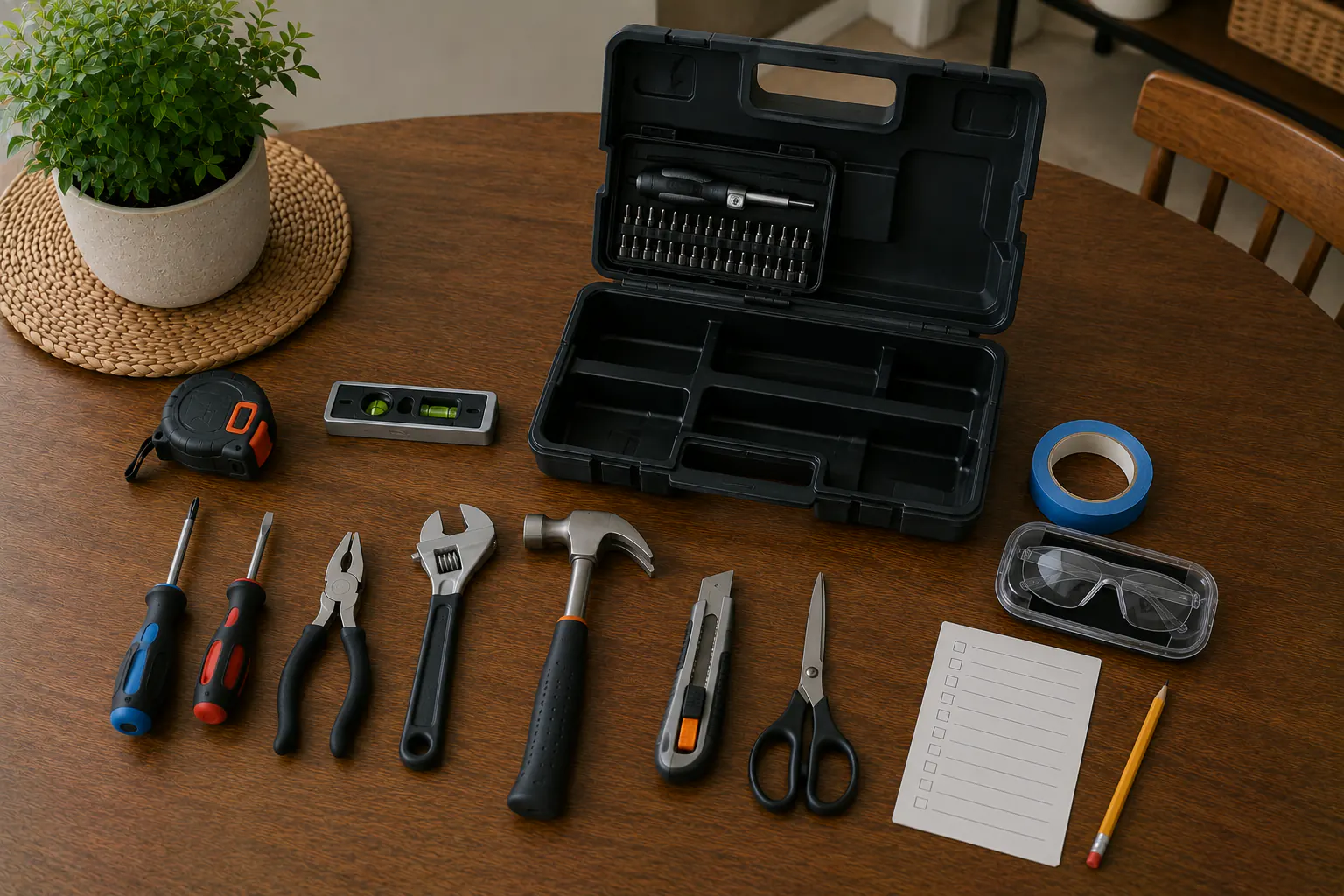
Resist the count. A starter toolkit should cover the home’s ordinary fasteners and inspection tasks, fit the people using it, and leave dangerous or specialist work to the right trade. Many large kits inflate their numbers with small bits, duplicate sizes, and accessories that do not improve household capability.
Begin with a two-week task log
Before buying beyond the minimum, record each task that appears:
| Task | Frequency | Exact material or fastener | Authority | Risk boundary | Tool needed |
|---|---|---|---|---|---|
| assemble approved furniture | occasional | manufacturer hardware | owner | no modification | supplied key plus correct driver |
| measure room or opening | recurring | finished surfaces | owner | no destructive access | tape and pencil |
| tighten loose handle | occasional | known screw head | owner | stop if stripped or rated opening | matching driver |
| locate water shutoff | seasonal | labeled valve | owner/utility | no forced or unidentified valve | light and documented key |
| inspect door operation | seasonal | complete opening | owner | no attack testing | light, level, notebook |
This log reveals the difference between a real need and imagined self-sufficiency. It also prevents buying a tool for work the household cannot legally or safely perform.
Core measuring and observation tools
Start with:
- a readable 16- to 25-foot tape measure suited to the home;
- a compact level with protected, readable vials;
- a durable ruler or combination square only if actual tasks justify it;
- pencils and removable painter’s tape appropriate to the surface;
- a bright handheld or head-mounted task light with common batteries;
- a small inspection mirror;
- notebook or private maintenance log;
- phone camera used without exposing access or security details publicly.
Inspect the tape blade and return action. Do not let a metal blade snap back uncontrolled or use a tape near exposed live parts. A phone level or measurement app can assist orientation, but it is not evidence of structural plumb, code compliance, or exact fabrication dimensions.
Drivers that fit the home
Instead of dozens of weak drivers, choose:
- two or three comfortable full-size screwdrivers matching the common fasteners;
- a compact ratcheting driver with a small, organized set of quality bits;
- the hex keys actually used by household furniture and fixtures;
- a bit holder or labeled organizer that makes missing pieces visible.
The tip should fill the fastener recess without wobble. Stop when the fastener cams out, the head deforms, the material moves, or force rises unexpectedly. Do not use a screwdriver as a chisel, pry bar, punch, electrical tester, or lever.
Keep manufacturer-supplied specialty keys with the product record rather than loose in the general box. Label by furniture or equipment without including a home-security key code.
Gripping and turning tools
A conservative starter set may include:
- adjustable pliers for general household gripping where appropriate;
- needle-nose pliers for controlled small-part handling, not energized work;
- an adjustable wrench for known ordinary hardware;
- a compact set of correctly sized combination wrenches or sockets only when the home and equipment require them;
- a documented shutoff key or wrench specific to the property, stored separately and labeled by function.
Pliers damage nuts when used instead of a fitting wrench. Adjustable tools can slip when poorly fitted or pulled in the wrong direction. Longer handles add force that can break a valve, fitting, fastener, or hand. Use smooth, controlled force and stop before the tool or workpiece deforms.
Never advertise ordinary pliers as insulated electrical tools. Even marked insulated tools require the correct rating, inspection, training, and electrical work controls.
Controlled cutting and striking
For common packaging and light household work:
- choose scissors suited to material;
- use a retracting or folding utility knife that locks securely and accepts available replacement blades;
- keep spare blades in a rigid closed dispenser;
- choose one balanced general-purpose hammer appropriate to intended work;
- add a small non-marring mallet only for a documented task.
Cut away from the body on a stable surface with the free hand out of the path. Never reach into a concealed space with a blade. Retract or sheath it immediately and lock it away. Retire a hammer with a loose head, cracked handle, damaged grip, or mushroomed striking surface; do not “make it last” with tape.
The basic kit should not include chisels, pry bars, axes, bolt cutters, large demolition tools, or striking accessories without a defined task, training, eye protection, and secure storage.
Fasteners and consumables
Do not create a mystery jar. Keep a small organizer with:
- manufacturer-supplied spare hardware;
- common picture-hanging hardware selected for the known wall and load;
- a few verified screws, washers, and anchors left from documented work;
- removable labels and small cable ties for non-electrical organization;
- clean cloths and a small brush for tool care.
Label source, size, material, and intended use. An anchor does not inherit a universal load rating when installed in unknown wall material. Do not reuse bent, corroded, stretched, stripped, or unidentified fasteners for critical work.
Keep adhesives, solvents, oils, paints, fuels, cleaners, and pressurized products outside the dry tool box in their original containers under their own storage rules.
Protective equipment is task-specific
Include safety eyewear that fits the intended user and applicable hazard. Add hearing, respiratory, hand, knee, or surface protection only after assessing the actual task. OSHA’s workplace standards are not a homeowner instruction manual, but their principle is useful: protection must match the specific mechanical, chemical, dust, or flying-object hazard.
Gloves can reduce some abrasion or chemical contact but can create entanglement near rotating equipment. A face shield may not replace primary eye protection for impact. A dust mask is not universal respiratory protection. If the hazard cannot be identified and controlled, stop the task.
Decide whether to add a drill/driver
A cordless drill/driver can speed assembly and pilot work for a competent user, but it is not essential on day one. Add it only when the task log shows recurring need and the user can select bits, control torque, identify hidden-service risk, secure the work, and store batteries safely.
Before purchase, compare exact model identity, weight, grip, chuck, clutch, trigger control, brake, lighting, battery ecosystem, charger certification, manual, warranty, support, and recalls. Do not buy on voltage or torque marketing alone. Use the essential hand tools comparison for the evidence sheet.
Use a staged purchase order
Day one
- task light;
- tape measure;
- driver set matched to visible household fasteners;
- general pliers and adjustable wrench;
- controlled utility knife and scissors;
- balanced hammer;
- pencil, removable tape, and small organizer;
- suitable eye protection;
- secure dry box.
After the home orientation
- exact main-water shutoff tool if required;
- fire and utility contact records;
- manufacturer-specific appliance and furniture tools;
- level and inspection mirror;
- fasteners for documented wall types and loads;
- project modules based on the task log.
After demonstrated need
- sockets or additional wrenches;
- drill/driver and battery system;
- specialty pliers, saws, or layout tools;
- work support, ladder, or trade equipment only with a separate safety plan.
Avoid false economy
A cheap tool that slips, bends, cannot hold a bit, has unreadable sizes, or cannot be replaced is expensive in damaged hardware and frustration. A premium tool used once may also be wasteful. Compare fit, control, documented standard, warranty, replacement parts, corrosion resistance, handle comfort, organization, and service.
ASME B107 standards establish safety and performance requirements for categories such as wrenches, pliers, screwdrivers, and striking tools. Verify a manufacturer’s exact conformity claim; a marketplace title mentioning “professional” or “industrial” is not a certification.
Store and inspect from the first day
Assign every sharp or heavy tool a slot. Keep the box dry, stable, locked or otherwise secured from children, and out of exit paths. Keep batteries out of extreme temperatures and follow manufacturer charging instructions. Register supported tools when useful, retain receipts and manuals, and check CPSC recalls by exact model.
Use the safe storage guide and annual inspection checklist. The essential toolkit hub links the kit to storm readiness and maintenance.
Sources reviewed
- OSHA and NIOSH: Hand and Power Tool Safety and Inspection
- U.S. Consumer Product Safety Commission: Home Power Tool Safety; Recalls
- ASME: B107 Hand Tools and Accessories
Sources reviewed July 14, 2026. This guide contains no current product ranking or model-level test claim. Follow exact manufacturer instructions, current recalls, property authority, code, and qualified trade guidance.