
Start with the task light and the tools you actually use. Can you find them, do you see damage, and are their instructions and recall status known? An annual review is a useful reminder, not a safety certificate or a reason to postpone a check after damage or before use.
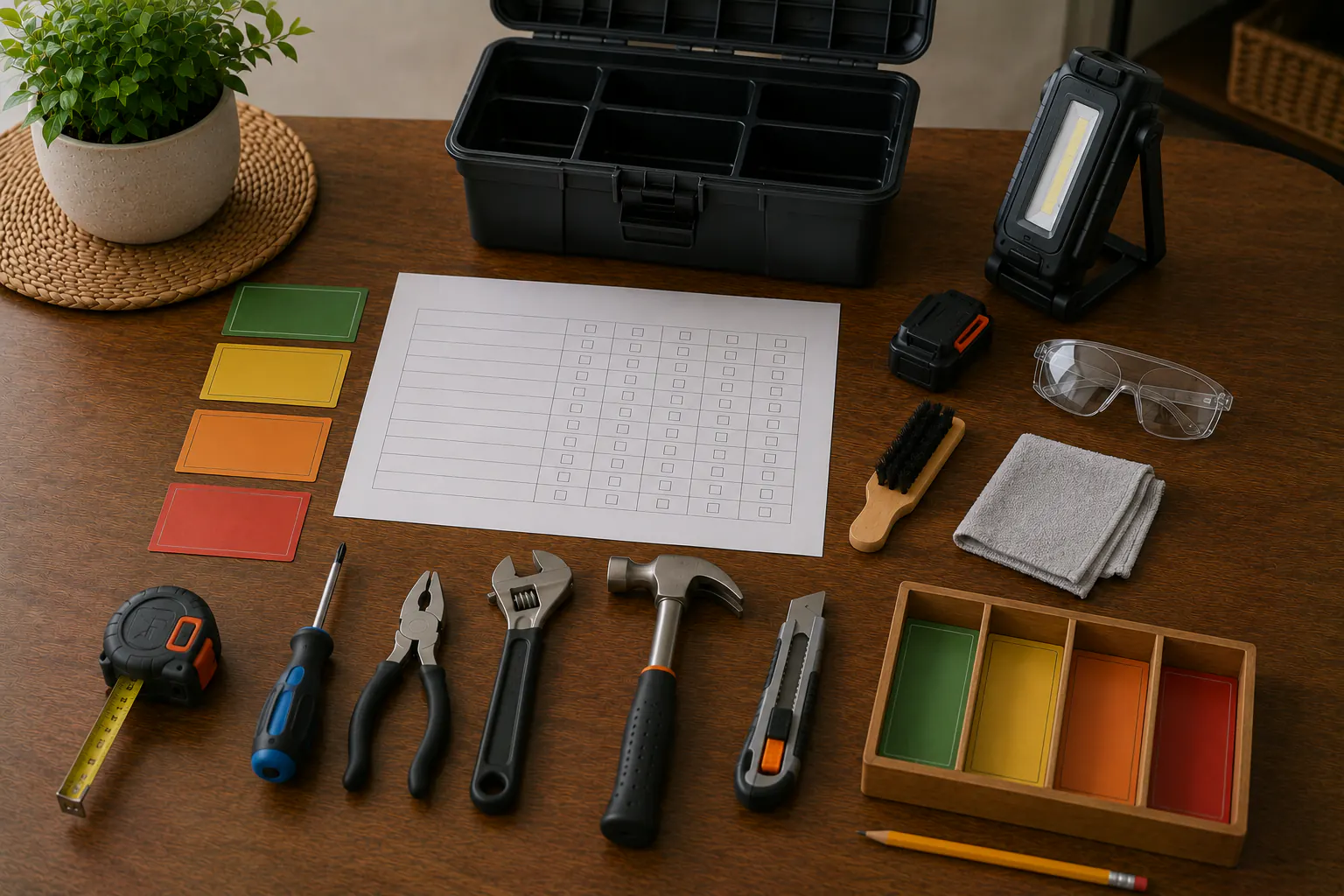
Check, separate, and put away
Use an annual reminder alongside the exact manual's checks. Damage, exposure, recalls, and access changes need attention when they occur.
Choose a starting point
Check one familiar group in calm conditions; work alone or ask a trusted person for help if useful.
Sort each item
Record whether every tool is ready, needs service, belongs in quarantine, or should be retired.
Close before storage
Return only ready tools, assign the replacement or service decision, and set the next review.
Schedule the review before the household’s main storm season and after a move, flood, fire, theft, child-access change, hard project, or major recall. Inspect in daylight on a stable surface without operating dangerous equipment.
Prepare the review
Gather:
- existing inventory and purchase records;
- manufacturer manuals and service contacts;
- exact model, serial, and date codes;
- clean trays for small parts;
- bright task light and magnifier;
- “ready,” “service,” “quarantine,” and “dispose” labels;
- phone or computer for official recall checks;
- current local battery and hazardous-waste guidance;
- a trusted helper if useful; a second reviewer is not required.
Keep children, pets, food, and unrelated household activity out of the area. Do not unpack sharp tools onto the floor or leave batteries near metal parts.
Use the readable manual, magnifier or enlarged reference you already have to record an exact model or part code. A handheld magnifier is another reading format only when that small-print job is still missing on a familiar, safely placed item. Leave uncertain characters unknown; a closer view does not establish condition or permission to return a tool to service.
Carson SureGrip SG-10 is one manual magnifier with a soft pouch for reading an ordinary small reference. Current maker and US spot-power and size fields differ, so no numerical performance or fitted-case promise is made here. The exact manual specifies a microfiber lens cloth and no abrasives, chemical cleaners or solvents. Follow supplied instructions and the California cancer and reproductive-harm warning; keep the lens out of direct sun and away from uncontrolled hazards. No optical, grip, medical, defect-detection or safety-inspection result is established.
View Carson SG-10 on Amazon(opens in a new tab)1. Inventory and ownership
For an item needing follow-up, use the fields that help you resolve it. A complete spreadsheet is optional; leave unknown details unknown:
| Field | Decision |
|---|---|
| exact tool | category, size, manufacturer, model |
| intended task | one or more documented household uses |
| owner or custodian | person responsible for condition and storage |
| authority | homeowner, renter, landlord, building, or trade boundary |
| location | slot or cabinet, not a public security map |
| condition | ready, service, quarantine, retire |
| last use | date or unknown |
| recall check | date and result |
| next action | replace part, service, train, move, dispose |
Remove mystery parts and unidentifiable electrical items from the ready kit. Do not throw them into a donation box until condition and recall status are understood.
2. Missing and duplicate tools
Check every molded slot, bit index, socket rail, hex-key set, blade dispenser, battery bay, and pouch. Missing pieces can remain in a wall, furniture, vehicle, yard, or child-accessible area.
For duplicates, ask:
- Do both fit different tasks or users?
- Is one a deliberate backup kept separately?
- Is one worn but never formally retired?
- Did a bundled set create low-quality duplicates?
- Can the better tool cover both roles safely?
- Would removing it make the kit lighter and easier to audit?
Keep deliberate redundancy such as an independent task light. Remove clutter that delays finding the correct size.
3. Hand-tool condition
Inspect clean, dry tools for:
- cracks, bends, twists, chips, pitting, and active corrosion;
- loose heads, handles, grips, pins, rivets, and scales;
- mushroomed struck surfaces;
- rounded driver tips, sockets, or wrench jaws;
- plier jaw misalignment and cutter damage;
- sticky ratchets, pivots, locks, and adjustments;
- missing size or rating markings;
- damaged sheaths, blade locks, and edge guards;
- contamination or unapproved tape, weld, grind, heat, or coating repairs.
Quarantine uncertainty. The cleaning and inspection guide covers the conservative process. A clean tool is not necessarily structurally sound.
4. Power tools and guards
Without energizing the tool, inspect:
- housing, handle, auxiliary handle, chuck or accessory interface;
- trigger, lock-off, brake, and controls by the manufacturer’s approved check;
- guards, shields, depth stops, shoes, and dust components;
- cord, plug, strain relief, and grounding features where applicable;
- battery contacts, latch, vents, and compartment;
- manufacturer labels, warnings, and manual;
- case and accessory retention.
Do not run a tool with a missing guard “just for a second.” Do not open the housing or bypass a control. Send faults to manufacturer-authorized or qualified service.
5. Batteries and chargers
Record chemistry, exact pack model, date, compatible tool and charger, storage condition, charge behavior, and recall check.
Stop for:
- swelling or changed case shape;
- impact, puncture, cracks, melted areas, or loose parts;
- unusual heat, odor, smoke, sound, or liquid;
- corroded or burned contacts;
- damaged cord, plug, charger bay, or ventilation;
- repeated charging error or unexpected shutdown;
- unverified aftermarket compatibility;
- active recall or safety warning.
Do not test a suspect battery by charging it again. Isolate under manufacturer/emergency guidance and contact the maker or local hazardous-waste authority. EPA says lithium-ion batteries should not enter household trash or curbside recycling and recommends terminal protection for end-of-life handling.
6. Blades, bits, sockets, and accessories
Check that every accessory:
- has a known identity and size;
- is compatible with the exact tool and intended speed or force;
- is not bent, cracked, chipped, burned, excessively worn, or corroded;
- fits its holder without dangerous looseness;
- has the required guard, flange, adapter, or fastener under the manual;
- is stored so edges and points cannot cut a hand;
- has not exceeded any manufacturer life or inspection limit.
Do not use a grinder wheel, saw blade, drill bit, socket, or adapter whose rating or history is unknown. This annual guide does not provide powered-accessory inspection authorization; use the exact manual and qualified service.
7. Measuring and detection tools
Inspect tape blades and hooks, level vials, squares, rulers, stud sensors, thermometers, moisture meters, voltage detectors, and other instruments for physical damage, battery condition, readable markings, and self-test features.
A successful self-test does not prove suitability or calibration. Compare ordinary measuring tools to a trusted reference where appropriate. Use manufacturer or qualified calibration when decisions depend on accuracy. Never use a detector as the sole proof that a wall, wire, circuit, gas system, or structure is safe.
8. Protective equipment
Review each item against the task rather than treating one set as universal:
- eye protection for scratches, clouding, cracks, markings, fit, and side protection;
- hearing protection for seal, cleanliness, age, and compatibility;
- gloves for tears, contamination, fit, and task limitations;
- respiratory equipment for correct type, seal needs, cartridge or filter life, and storage;
- knee pads, work clothing, and footwear for wear and contamination;
- first-aid supplies under their own medical review.
PPE does not authorize work on an uncontrolled hazard. Do not use expired or contaminated respiratory components or scratched eye protection that impairs vision.
9. Storage system
Inspect box, bag, cabinet, shelving, locks, latches, anchors, drawers, wheels, labels, and floor area.
- Is the load within rated capacity?
- Can the intended adult lift or reach it safely?
- Are heavy tools low and stable?
- Are blades and small parts contained?
- Are children and unauthorized people restricted?
- Are tools dry and away from heat, flood, chemicals, and combustion equipment?
- Are exits, panels, shutoffs, and fire equipment clear?
- Does every item have a slot?
- Can a task light be reached during an outage?
Use the safe tool storage guide for apartment, garage, child, and battery controls.
10. Recall and support review
Search the CPSC database using exact manufacturer and model. Check the manufacturer safety page, support status, manual revision, replacement parts, and service options. Record the date and result.
When a recall matches:
- stop use as directed;
- separate the item from the ready kit;
- follow the official remedy;
- do not sell, donate, or discard contrary to instructions;
- update related batteries, chargers, accessories, and household records;
- verify the replacement or repair before return to service.
Do not assume an online seller’s listing or review confirms recall status.
11. Task coverage
Compare the final ready inventory against actual household needs:
- light and observation;
- measurement and marking;
- common correct drivers;
- controlled grip and turning;
- safe cutting and light striking;
- known authorized shutoff access;
- storm documentation and communication;
- apartment or child storage;
- manufacturer-specific household equipment;
- cleaning and inspection supplies.
Do not fill every gap by buying. A task may belong to the landlord, utility, rental counter, tool library, or qualified trade. The starter toolkit and apartment toolkit prioritize the core.
Close the review
- Return only ready tools to assigned slots.
- Keep service and quarantine items physically separate.
- assign each missing or replacement decision to one owner;
- update manuals and records;
- reengage child and access controls;
- clear the work surface and floor;
- schedule the next seasonal or annual review;
- route purchase research through the hand-tool comparison.
The essential toolkit hub connects the audit to storm, storage, maintenance, and multi-tool decisions.
Sources reviewed
- OSHA and NIOSH: Hand and Power Tool Condition, Guards, and Inspection
- U.S. Consumer Product Safety Commission: Recalls
- U.S. EPA: Used Household Batteries
Sources reviewed July 14, 2026. Exact manufacturer, recall, service, calibration, disposal, lease, and qualified-trade instructions control the final decision.
Carson’s current SG-10 page, complete linked English guide and exact one-item US SG-10 listing were checked October 13, 2026 against UPC 750668001504. Other barcode aliases and sizes are not treated as interchangeable. The guide and current maker specify a different spot power from the listing, and their diameter fields differ from the selected style name; no magnification, clarity or fit result is inferred. This is a reading support only: the replacement decision above remains product-free until an actual failed-tool, recall or service need is known. Earlier practical experience is not a test of this magnifier.