
Before using the filter you already own, check what the water utility or health department says has happened. If the source or hazard is unknown, use a different supply identified as safe and contact that authority.
“Filter,” “purifier,” and “treatment” are not interchangeable promises. Better taste does not establish safety. Boiling can kill germs while leaving fuel or toxic chemicals in the water; a portable filter may remove parasites but not viruses. This guide explains the limits behind those labels, not a way to choose treatment without the official instruction.
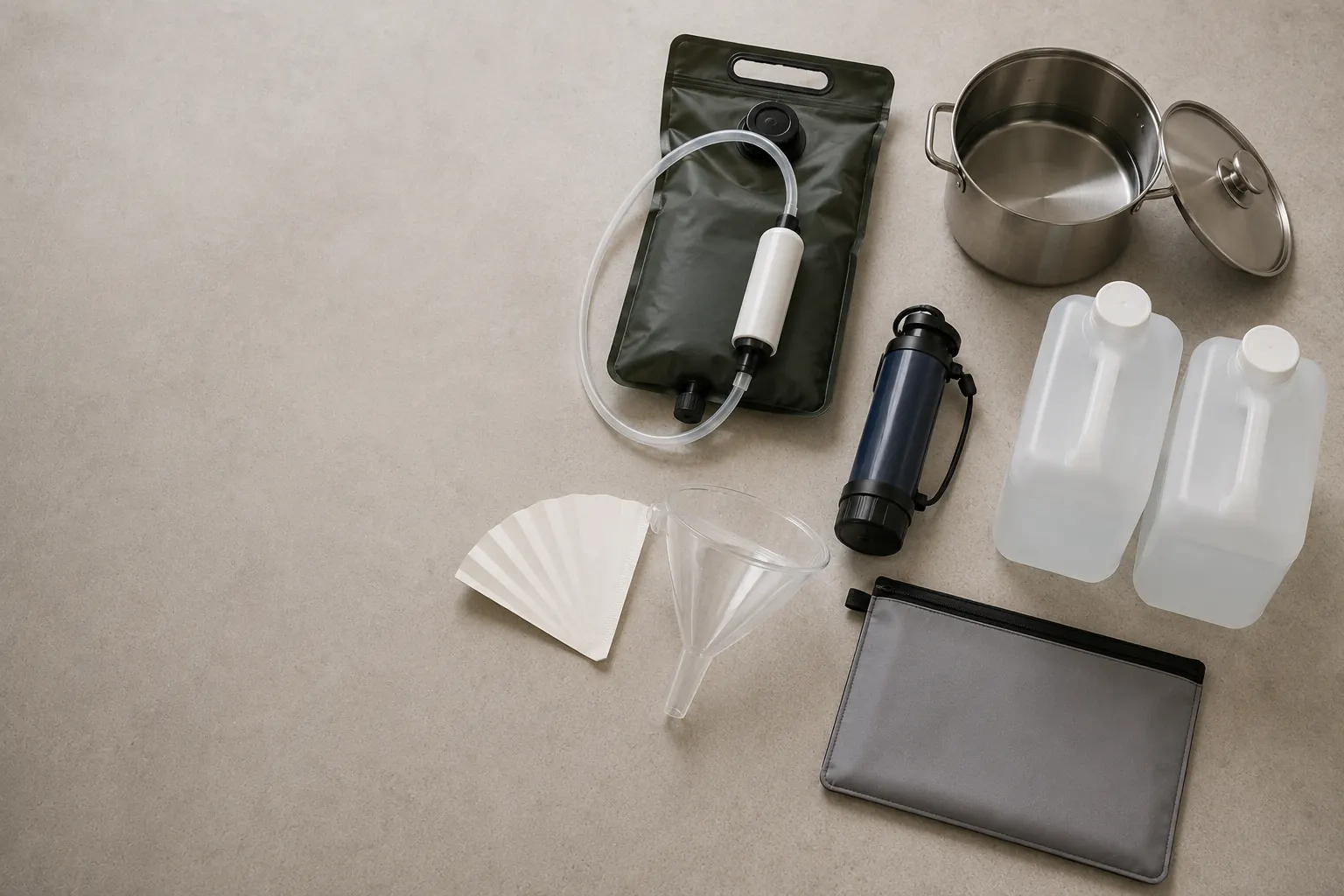
Use a source-first decision sequence
Before choosing a method, answer five questions:
- What is the source? Public tap, private well, stored water, cistern, collected rain, surface water, or flood-exposed water are not equivalent.
- What happened? Pressure loss, main break, flood, sewage release, wildfire, fuel spill, routine taste concern, and an ordinary backcountry trip create different hazards.
- What does the authority say? Copy the exact boil-water, do-not-drink, do-not-use, or other notice.
- What contaminant or class is identified? Bacteria, viruses, parasites, sediment, lead, volatile chemicals, pesticides, fuel, salt, or an unknown mixture require different decisions.
- What exact claim does the method have? Record the model, certification standard, contaminant-reduction claim, capacity, flow, maintenance, operating range, and emergency instructions.
If any answer is unresolved, do not fill the gap with a generic treatment. Use the Water Advisory Decision Tree and Action Log to preserve the official wording and assign a contact owner.
Understand the contaminant classes
Sediment and turbidity
Visible particles can clog equipment and shield germs from UV or chemical treatment. Letting cloudy water settle or passing it through a clean cloth may be a pre-treatment step under CDC guidance before an approved emergency method. It does not make the water safe by itself.
Clarity also does not prove safety. Many germs and dissolved chemicals are invisible. Never use appearance as a release test.
Parasites, bacteria, and viruses
These groups differ in size and treatment resistance. CDC emergency guidance says portable filters do not remove all types of germs. It notes that an absolute pore size of 1 micron or smaller is needed to remove parasites such as Giardia or Cryptosporidium, and 0.3 micron or smaller to remove bacteria; portable filters will not remove viruses. Product construction, integrity, use, and its exact claim still matter.
Chemical disinfectants can kill many viruses and bacteria, but CDC says they do not work as well as boiling against some parasites. A combined process may be required when the official guidance permits it. Do not design that sequence from memory during an emergency.
Dissolved chemicals, fuel, and radioactive material
Boiling, ordinary disinfection, and most portable filters cannot be assumed to remove dissolved chemical hazards. Boiling may concentrate contaminants as water evaporates. CDC explicitly says water containing fuel, toxic chemicals, or radioactive material cannot be made safe by boiling or disinfecting; use a different source and contact the health department.
No taste, odor, or countertop reading can identify every hazardous compound. Floodwater and spill-affected sources may contain mixtures that exceed a household system’s claim.
What boiling does and does not do
Boiling is the best method in CDC emergency guidance for killing germs. For clear water, the general CDC method is a rolling boil for one minute, or three minutes above 6,500 feet, followed by cooling and storage in clean sanitized containers with tight covers. Local instructions come first.
Boiling requires a safe energy source, vessel, cooling location, and clean container. During a power outage, never create a carbon monoxide or fire hazard to heat water. A grill, camp stove, charcoal appliance, or generator does not become safe indoors, in a garage, porch, tent, or partially enclosed space because water is urgent. Use the generator and combustion safety guide and the authority’s safe-water alternatives.
Boiling does not remove fuel or toxic chemicals. It also does not prevent recontamination from a dirty ladle, hand, cap, bottle, or dispensing surface.
What chemical disinfection can and cannot do
CDC publishes emergency steps for specified concentrations of unscented household chlorine bleach and directs users to follow drinking-water instructions on the product label when present. Concentration, water clarity, temperature, volume, measurement, mixing, and contact time matter. Tablets and drops must be used for the exact water quantity and according to the label.
This guide intentionally does not turn bleach into a universal recipe. Formulations differ, labels change, and chemical disinfection does not address every germ or any unknown chemical mixture. CDC also identifies limits and cautions for iodine, including pregnancy, thyroid conditions, hypersensitivity, and duration of use.
Never mix cleaning chemicals. Never use scented, splashless, color-safe, or additive-containing products unless the current authority and drinking-water label explicitly identify that product and method. If the correct concentration or measuring tool is unavailable, use another safe source rather than estimating.
What portable filters can and cannot do
A portable filter moves water through media or a membrane designed for specific reductions. Its pore claim may address parasites and, for some designs, bacteria. CDC warns that portable filters do not remove all germ types and will not remove viruses. Filtered water may need additional disinfection under official guidance.
Operational limits matter as much as the headline claim:
- source-water quality and turbidity;
- absolute versus nominal pore wording;
- flow rate at realistic pressure or gravity head;
- cartridge life and contaminant capacity;
- integrity after impact, freezing, drying, or incorrect backflushing;
- clean-side hose, cap, vessel, and hand separation;
- replacement indicators and storage method;
- whether the claim applies to treated public water, microbiologically unsafe water, or only aesthetic concerns.
A refrigerator or pitcher filter usually serves a routine household purpose. It should not be assumed to satisfy a boil-water or chemical advisory unless the issuing authority and the exact certified product claim say so.
What activated carbon, reverse osmosis, and distillation mean
Activated carbon can reduce certain tastes, odors, chlorine, or specific chemicals depending on the certified claim and capacity. Carbon is not a universal barrier. A saturated cartridge, excessive flow, channeling, or the wrong contaminant can defeat the intended reduction.
Reverse osmosis forces water through a semipermeable membrane and may reduce specified dissolved contaminants. A system depends on pressure, prefilters, membrane condition, plumbing, reject-water flow, sanitation, and the exact certification. A power or pressure disruption can change output. It is not automatically approved for microbiologically unsafe or flood-contaminated water.
Distillation boils water and collects condensed vapor. It may leave some contaminants behind, but volatile organic compounds can carry with the vapor unless the system is designed and certified for them. Distillation also requires energy, time, clean equipment, and protected storage.
What UV treatment means
UV equipment uses light to inactivate germs under defined operating conditions. CDC notes that portable UV units can treat small amounts of clear water and do not work well in cloudy water because particles can shield germs. Dose depends on lamp output, exposure, flow, water clarity, power, temperature, and device condition.
A glowing lamp is not proof of an adequate dose. Record lamp age, cleaning, battery or power dependency, flow restriction, alarm behavior, and the manufacturer’s validated claim. UV does not physically remove sediment or chemicals and provides no residual protection after treatment.
Read certifications at the contaminant-claim level
NSF explains that standard numbers are not rankings and that certification to a standard does not mean a system reduces every possible contaminant. Verify the exact product listing and the specific reduction claim.
Common examples include:
| Standard or protocol | General scope to verify, not a universal promise |
|---|---|
| NSF/ANSI 42 | Aesthetic effects such as specified chlorine, taste, odor, or particulate claims |
| NSF/ANSI 53 | Specific contaminants with health effects; claims vary by product |
| NSF/ANSI 55 | UV systems, with different Class A and Class B scopes |
| NSF/ANSI 58 | Reverse-osmosis systems and specified reduction claims |
| NSF/ANSI 62 | Distillation systems and specified performance requirements |
| NSF/ANSI 244 | Intermittent microbiological contamination of otherwise safe public water under its scope |
| NSF P231 | Microbiological purifier performance under the protocol |
| NSF/ANSI 401 | Specific emerging-compound claims; claims vary by product |
Confirm the model in the certifier’s current product database. A certification logo without the model and reduction claim is not enough. Also check the replacement cartridge: compatibility and certification can change when a different element is installed.
Questions to check before buying equipment
I have not tested these products and do not rank them here. Before considering an exact model, ask the supplier or qualified water-treatment professional about:
- intended source and contaminant class;
- exact certified model and reduction claims;
- test standard and current listing;
- documented flow under the conditions covered by the product’s claim;
- total capacity and replacement basis;
- power, pressure, gravity, priming, and pre-treatment needs;
- cartridge cost, availability, shelf life, and storage;
- freeze, drop, cross-contamination, and cleaning limits;
- accessible operation with wet or cold hands;
- manufacturer support, instructions, and recall check;
- whether the system can serve the calculated household volume in the available time.
Keep the answers with the product instructions. Specifications can narrow the questions, but they do not establish that the water in your current emergency is safe to treat. Do not conduct a contaminated-water, drop, or freezing trial at home to check a claim.
Connect treatment to stored water and volume
Treatment equipment is not a substitute for a protected stored supply. A known emergency reserve avoids uncertain source collection, energy use, clogging, treatment time, and contamination handling. Use the household water calculator and storage hub first.
Then compare the system’s realistic output with household demand. A tiny device may be useful for evacuation but impractical for a family sheltering at home. A high-flow home system may fail without pressure or power. The backup-power hub can document measured electrical loads, but it cannot convert an unapproved water source into a safe one.
Stop rules
Do not proceed with household treatment when:
- a do-not-use or do-not-drink notice prohibits it;
- fuel, solvent, pesticide, toxic chemical, radioactive material, or unknown chemical contamination is suspected;
- floodwater entered the source, well, cistern, equipment, or storage system and the authority has not released it;
- the exact model, cartridge, claim, instructions, or operating condition cannot be verified;
- freezing, impact, contamination, expired media, or a failed integrity check may have damaged the system;
- the required clean containers, measurement, safe energy, or contact time are unavailable;
- a clinical, infant-feeding, medication, or medical-device use requires a different water specification.
Use another source identified as safe and contact the applicable authority or qualified professional. After flooding, follow Safe Drinking Water After a Flood.
Sources reviewed
ReadyLience reviewed CDC emergency treatment guidance, EPA emergency disinfection guidance, and current NSF treatment-system standards summaries on July 15, 2026. Current authority notices, laboratory findings, exact certified product listings, labels, manufacturer instructions, and qualified water, well, plumbing, and clinical review control the method. This guide does not replace those controlling sources.