
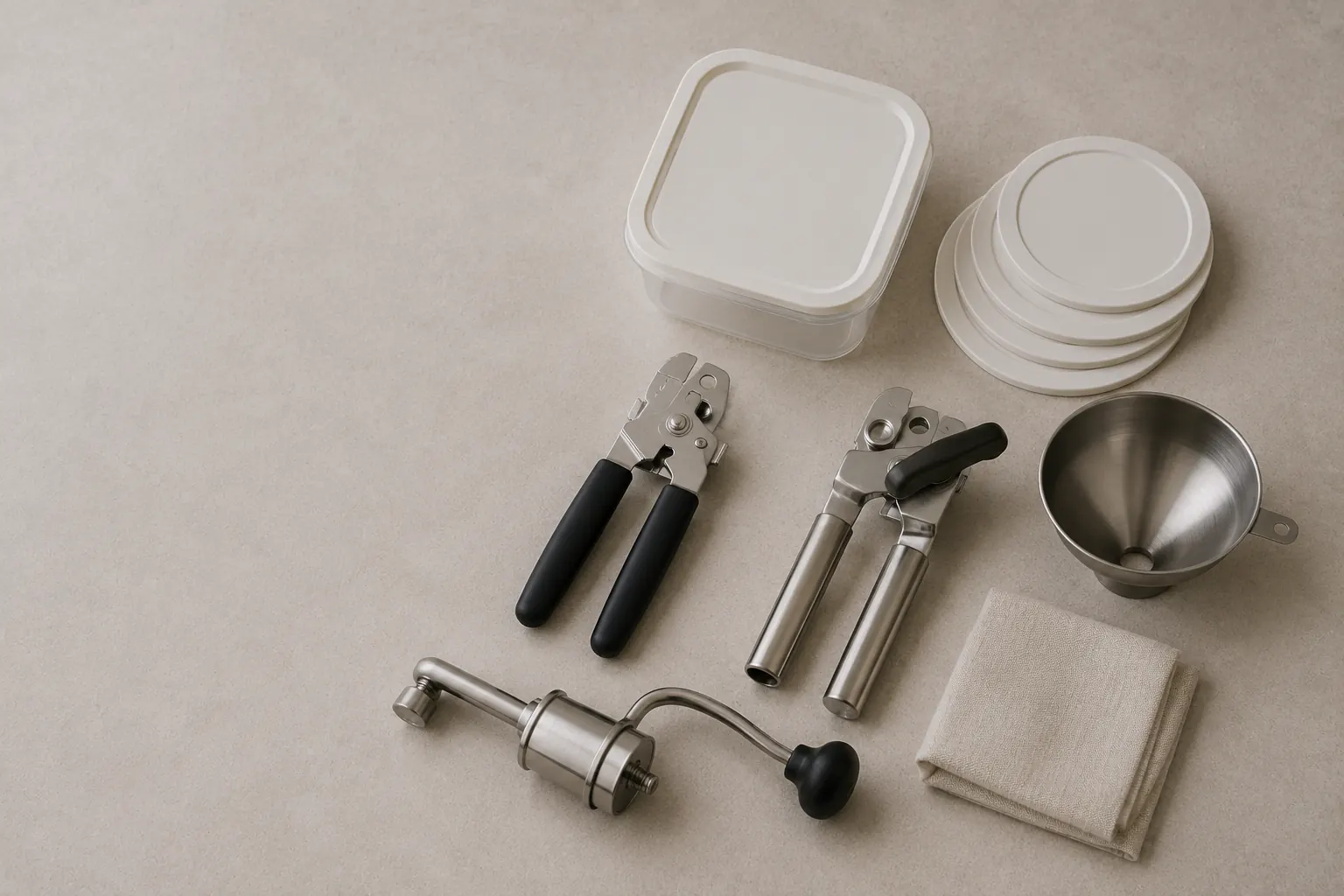
Pick one meal from your emergency pantry. Can the person who will prepare it find the package, open it, read its instructions, and clean the needed utensils? That ordinary check is a better starting point than buying another set of bins.
The emergency food storage hub covers food and quantities; here I compare the tools around them. I have not hands-on tested or ranked specific containers, openers, or organizers. The disclosed examples below address packaging, ordinary ingredient measurement or transfer, and serving from an opened jar, not tested winners or proof that they suit your hands.
The best tool is the one that makes the household’s existing food plan work without adding a hidden dependence on power, unclear food-contact materials, a difficult cleaning process, or inaccessible storage.
Check what the first meal needs to open
A manual can opener is useful when the planned food requires one. Keep the needed tool in a known, reachable place. During ordinary meal preparation with normal lighting and utilities, check whether the intended user can operate and clean it, or arrange the assistance they need. Consider grip, handedness, sharp edges, and the actual package; do not assign the same task to every child, adult, or caregiver.
Do not assume pull tabs solve access. Some packages still require scissors, a jar-opening aid, or a way to stabilize the container. The three-day and two-week food list asks households to record the actual access tool beside every meal.
If a familiar meal needs a measured ingredient, keep the measure its label calls for nearby. Match cups, teaspoons or tablespoons to those directions; a ready-to-eat meal may need no measuring tool at all. These ordinary kitchen measures are not calibrated instruments for medication, infant formula or water-treatment dosing.
Keep a suitable clean spoon or scraper you already own for serving from an opened jar. If the actual jar is too narrow or deep for that utensil, compare a narrow scraper for this one task. It does not change the food’s label, leftovers rule, or cleaning needs.
For a meal that uses a dry ingredient, check whether pouring from its package or using a clean utensil you own already works. A flexible scoop is a transfer option only when that actual task is awkward. It is not a marked recipe measure or a reason to decant the reserve, and an item used for soil, pet feed or chemicals should not become the household’s food utensil.
Compare containers by their job
| Tool category | Useful selection questions | Limits to remember |
|---|---|---|
| Food-storage container | Is it intended for food contact, sealable, visible, cleanable, and sized for the household? | A container cannot make unsafe food safe or override a label. |
| Pantry bin or shelf organizer | Does it keep labels visible, reduce topple risk, and support first-in, first-out rotation? | It must not hide food, overload shelving, or block exits. |
| Manual can opener | Can likely users operate, clean, and locate it without electricity? | It does not resolve safe storage after a package is opened. |
| Labeling system | Can it show rotation month, allergy protection, and preparation needs without confusing people? | Labels must not cover package safety instructions or replace them. |
| Measuring or dispensing tool | Does it reduce spills and contact with stored food or water? | It must be cleaned and stored safely. |
Read the manufacturer’s instructions and material claims. “BPA-free,” a marketing term, a color, or a reviewer’s comment is not by itself a complete food-contact or long-term storage assessment. Use the product’s intended purpose, cleaning instructions, temperature limits, and the food’s label directions.
Prioritize visibility over extra capacity
Another bin will not solve food that nobody can find or identify. Choose storage that lets the household inspect package condition and labels without unloading a tower. Check the existing shelf first: a clearer rotation order may solve the problem without new equipment.
The FIFO pantry rotation guide gives the operating system. The small-apartment storage guide adds egress, weight, moisture, and lease constraints.
Make cleaning and food safety part of the comparison
Any tool that touches food should be cleanable with the water and sanitation resources the household expects to have. Complex lids, narrow gaskets, sharp edges, and deep crevices can be inconvenient during routine use and harder to manage during a disruption. Keep cleaning, hand hygiene, and waste planning connected to Emergency Sanitation and Hygiene.
Start with a compatible container and the washing tool you already own. Under normal water and utility conditions, a soap-reservoir dish brush is one way to keep ordinary dish soap at hand; a bottle, straw and cap-detail brush set addresses different narrow shapes. Buy neither for a hypothetical container. A simpler vessel may be easier to maintain, and its own care instructions still control. These tools do not replace water, hand hygiene or emergency food-safety decisions.
Containers are not a fix for food that was refrigerated too long, frozen under unknown conditions, exposed to floodwater, or otherwise questionable. Those decisions remain in Power Outage Food Safety. Never taste food to decide whether it is safe.
Use a short research checklist before buying
- Is the product intended for the specific food-contact or storage task?
- Can the intended user reach, open, and clean it, with planned assistance for any task or load they cannot manage?
- Does it keep the package label, date, and rotation sequence visible?
- Does its footprint fit without blocking exits or creating unstable weight?
- Does it work without electricity?
- Does it create a new need for special cleaning, replacement parts, or a battery?
- Does it protect allergy-safe or diet-specific food without creating confusion?
- Can the household test it with ordinary pantry food before relying on it?
Separate product claims from household evidence
Manufacturer dimensions, capacity claims, material descriptions, and instructions are useful inputs, but they do not prove how a tool will behave in a particular pantry. The household still has to check shelf fit, opening force, label visibility, cleaning effort, and whether the item works for the people who will use it. A product can be well made and still be the wrong choice for a small apartment, low-grip user, or allergy-protected storage system.
When comparing reviews, distinguish manufacturer documentation from hands-on observations. A specification sheet does not prove ease of use for your hands, pantry, or cleaning routine.
Avoid false redundancy
A second manual opener can be reasonable when the household depends heavily on cans and has tested both tools. Buying multiple organizers, decanting every packaged item, or duplicating tools that only one person can use can add complexity without resilience. Add a backup only when it removes a documented single point of failure and can be stored, maintained, and found.
The best comparison result may be no purchase: a clearer shelf label, a better rotation order, or a simple check that the existing opener still works can solve the practical problem.
Reassess when the pantry changes
The right container or opener can change when the household moves, ages, changes diet, adds a caregiver role, or changes from a few ready-to-eat items to a two-week rotating reserve. Re-run the research checklist after that kind of change. A tool should serve the food plan, never dictate it.
Keep receipts, manuals, and warranty information with the ordinary household records, not inside the food container. They may be useful for a recall or replacement, while the food shelf should remain simple enough to operate under pressure.
Sources reviewed
ReadyLience reviewed FDA food and water emergency guidance, USDA FSIS shelf-stable-food guidance, and Ready.gov emergency-kit guidance. Product instructions, labels, recalls, local emergency direction, and public-health guidance control the individual decision.
OXO’s Soft-Handled Can Opener documentation (model 28081) and the exact manual Amazon listing were checked October 11, 2026 for identity, handle-and-knob mechanism and sharp cutting wheel. This documentary check establishes no household usability or food-safety result and does not renew historical safety-source reviews.
OXO’s Kitchen and Herb Scissors documentation, required materials disclosure and the exact single-item 1072121 listing were checked October 12, 2026. The separable blades are documented for cleaning, not proof of cleaning effectiveness or suitability for a particular user. The linked option is confined here to ordinary package access.
Kuhn Rikon’s 2262 instructions and care information, OXO’s 1173600 jar-opener documentation, the 11132000 and 11132100 measure specifications, and their exact Amazon identities were checked October 12, 2026. Selection is based on the stated mechanism or markings, not measured force, accuracy, accessibility, hygiene or food safety. Manufacturer warnings and care remain controlling; dimensional and generic merchant-field contradictions are not fit or performance evidence.
OXO’s 11279500 Jar Spatula documentation and exact single Oat listing were checked October 12, 2026 for identity, narrow scraper design and dishwasher-safe care. Its use here is limited to an ordinary opened jar. The maker’s incomplete dimensions and claims about grip, heat, powered appliances or removing every drop are not household evidence. No exact Jar Spatula row was found in the manufacturer’s materials-disclosure table; other spatulas’ entries are not substitutes or chemical-safety clearance. Check the received item’s current labeling before use.
OXO’s current 1067686 Scoop documentation and exact single-item listing were reviewed October 13, 2026. Flexible sides, ordinary ingredient transfer and dishwasher-safe care are documented, not measured spilling, grip or cleaning results. The approximate cup description is not a calibrated recipe or dosing measure. No physical product or supplied package was inspected; no chemical, temperature or food-preservation clearance is claimed.
OXO’s 12361700 and 1329080 documentation and exact US identities were checked October 13, 2026. The first has a manual dish-soap reservoir; the second is one set of three different brushes. The listing’s ambiguous “Number of Packs: 3” field is not a recommendation to buy three sets. Exact brush maintenance instructions were not established by the inspected product pages, so the supplied instructions control; the 1329080 listing also carries a cancer and reproductive-harm warning. No cleaning effectiveness, water saving or disinfection result is implied.