
A 72-hour household starter kit is not one bag full of random products. It is a modest baseline for the first period of an everyday disruption, built from ordinary functions a household can inspect and replenish. It should make the next decision easier, not encourage a family to ignore an evacuation order, unsafe temperature, smoke, flooding, medical interruption, or an official warning.
This page is a starting route, not a replacement for the library’s specialist guidance. Begin with what is already in use at home, then close one gap at a time.
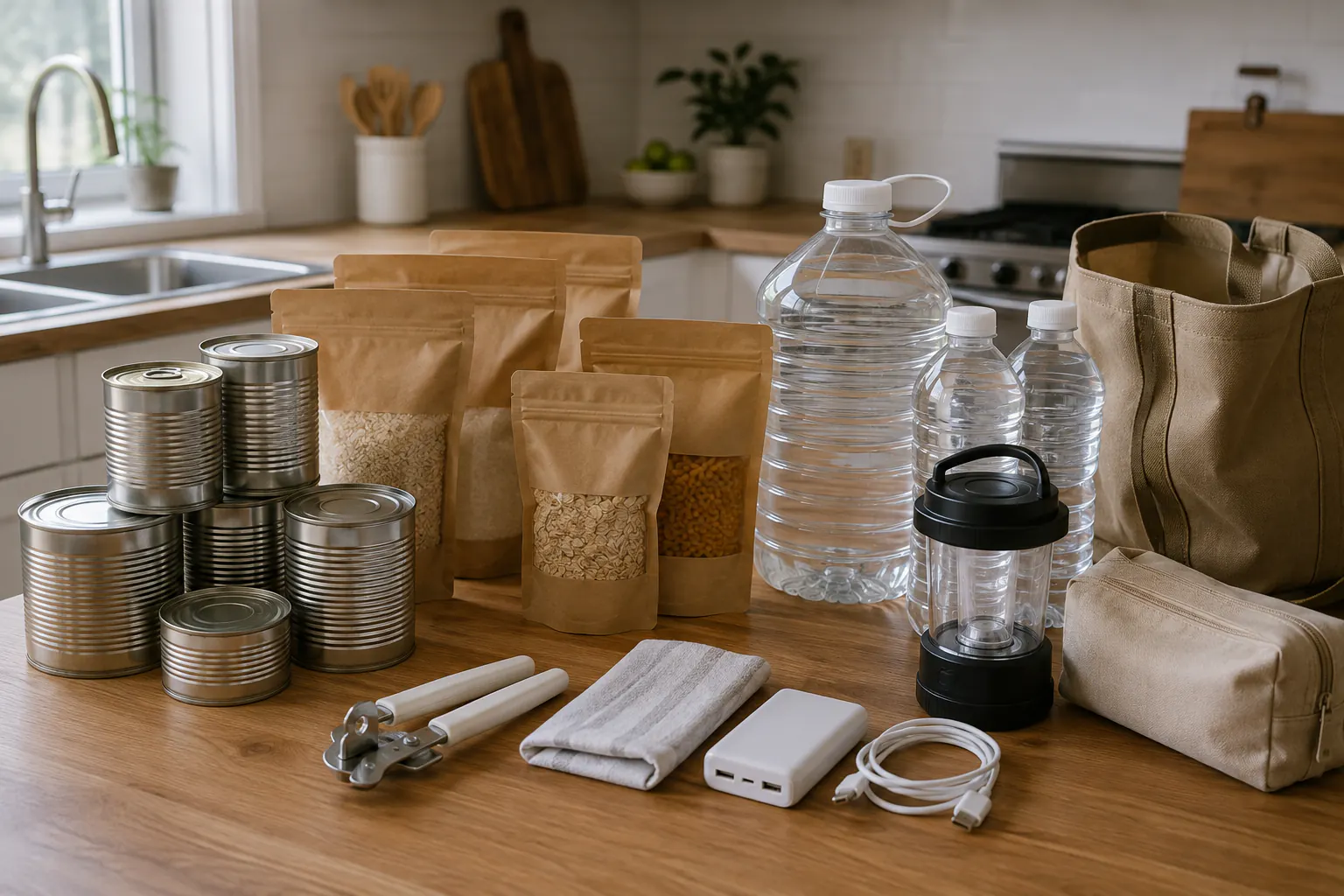
Start with the household you actually have
Before buying or packing anything, note who relies on the home: children, older adults, caregivers, people with mobility or communication needs, pets, regular medication, powered devices, special diets, and transport constraints. A generic three-day list cannot establish what any person needs or whether it can be safely carried, stored, or used.
Use the Emergency Food Storage hub to build food around ordinary meals and dietary requirements. Use the Family Communication Plan to establish contacts and meeting points before a live event. These foundations are usually more useful than adding a tenth version of the same flashlight.
Build seven connected functions
| Function | First baseline question | Specialist owner |
|---|---|---|
| Water | How will each person drink, use, and dispense safe water? | Emergency Water Storage |
| Food | Which familiar shelf-stable meals can the household make safely? | Power Outage Food List |
| Light and communication | Can people see, receive information, and conserve phone power? | Emergency Lighting and Family Communication Plan |
| Sanitation | What happens if normal toilet or handwashing access changes? | Emergency Sanitation |
| Care continuity | What is individualized, temperature-sensitive, or professionally directed? | Medical-device and medication continuity |
| Departure layer | What must leave with each person if staying is no longer appropriate? | Household Go-Bag Checklist |
| Household record | Where is the controlled route to contacts and essential documents? | Emergency document access |
The point is not to make every function portable. Food and water may be stay-at-home supplies; a document packet and personal care layer may travel. Keep the roles clear so a rushed departure does not turn into an attempt to empty a pantry.
For toilet, handwashing, waste, and clean-versus-dirty separation, use the Emergency Sanitation and Hygiene plan. It owns those decisions rather than treating a few wipes in a kit as a sanitation plan.
Make food and water work together
Choose meals the household already knows how to use, considering water, fuel, refrigeration, allergies, special diets, children, and utensils. Do not buy novelty food that nobody will rotate, and do not assume that a sealed package creates a complete plan.
The Household Emergency Food Quantity Calculator lets a household make its meal assumption visible. It cannot confirm nutrition, medical suitability, food safety, or whether the home is the safe place to stay. Pair it with current water storage guidance rather than assuming water is only for drinking.
Keep food and water away from chemicals, heat, pests, and damage. Store water in suitable containers according to current guidance. Do not use a first baseline as permission to use an unapproved water source or to extend unsafe food beyond the guidance that applies to the event.
Make the first-hour layer easy to reach
The first-hour layer should be small: a reliable household light, current contact route, means to receive information, essential daily items, and the instructions that apply to the actual event. Keep it accessible but not in an exit path. Check it after use.
Avoid using candles or indoor fuel-burning appliances as a casual substitute for a lighting or cooking plan. Follow equipment instructions, smoke and carbon-monoxide safety requirements, and public directions. A power outage can create a new fire or carbon-monoxide risk when a household improvises to feel prepared.
Keep a departure layer separate
Each person may need a small on-person or carryable layer, while shared supplies can stay with a responsible adult, vehicle, or support person. The Household Go-Bag Checklist covers those layers, destination, accessibility, pets, and documents without treating the bag as a wilderness kit.
Do not use a 72-hour label to delay leaving. Follow the current evacuation order, designated route, building plan, school or caregiver instruction, and emergency-service direction. Leaving early can be the correct use of preparation.
Set a modest order of operations
Trying to finish every category in one purchase can produce clutter and miss the household’s real constraints. Begin with the function that would fail first: drinking water, a familiar meal, basic lighting, an agreed contact route, an essential care plan, or a safe way to leave. Record what is already covered, choose one missing function, and put a review date on the calendar.
For a renter or apartment resident, the baseline may be distributed across a kitchen, closet, and departure layer rather than stored in a large bin. Keep shared exits, building equipment, stairs, and fire-safety features clear. A three-day target does not override a lease, a building rule, a current authority, or the physical limits of the home.
Avoid treating the kit as a stockpile score. The useful question is whether people can carry out the next action with the supplies, information, and contacts they can actually reach. A quiet update after a household change is more valuable than a dramatic once-a-year purchase.
Rehearse the ordinary parts
Once each season, retrieve the light, contact card, water method, meal supplies, sanitation module, and departure layer. Rotate food into normal meals where safe. Check batteries and equipment under their instructions. Update contact and care information when a number, provider, household role, or living arrangement changes.
Keep the routine modest. A working three-day baseline grows from repeated ordinary maintenance, not one intense shopping weekend.
Sources reviewed
- Ready.gov: Build a Kit, evacuations, and power outages
- Centers for Disease Control and Prevention: emergency water storage
Sources reviewed August 3, 2026. Current authorities, product labels, clinicians, pharmacists, device suppliers, veterinarians, building management, and qualified professionals control event-specific and individualized decisions.