
Before buying a cooler for an outage, list the food you would actually move into it. Then check whether the cooler you already own can close with that food, its cold source, and a suitable thermometer inside. More capacity is not automatically more useful if the filled cooler cannot be reached, moved, or kept cold.
I have not tested or ranked specific coolers here. This comparison helps you check the actual model and your household’s food, ice, space, and power constraints. It does not assign a safe holding time to a construction type or price bracket.
Use Power Outage Food Safety for each food decision and the cooler and ice guide for packing and observations. This page helps choose equipment, not decide whether yesterday’s milk is still usable.
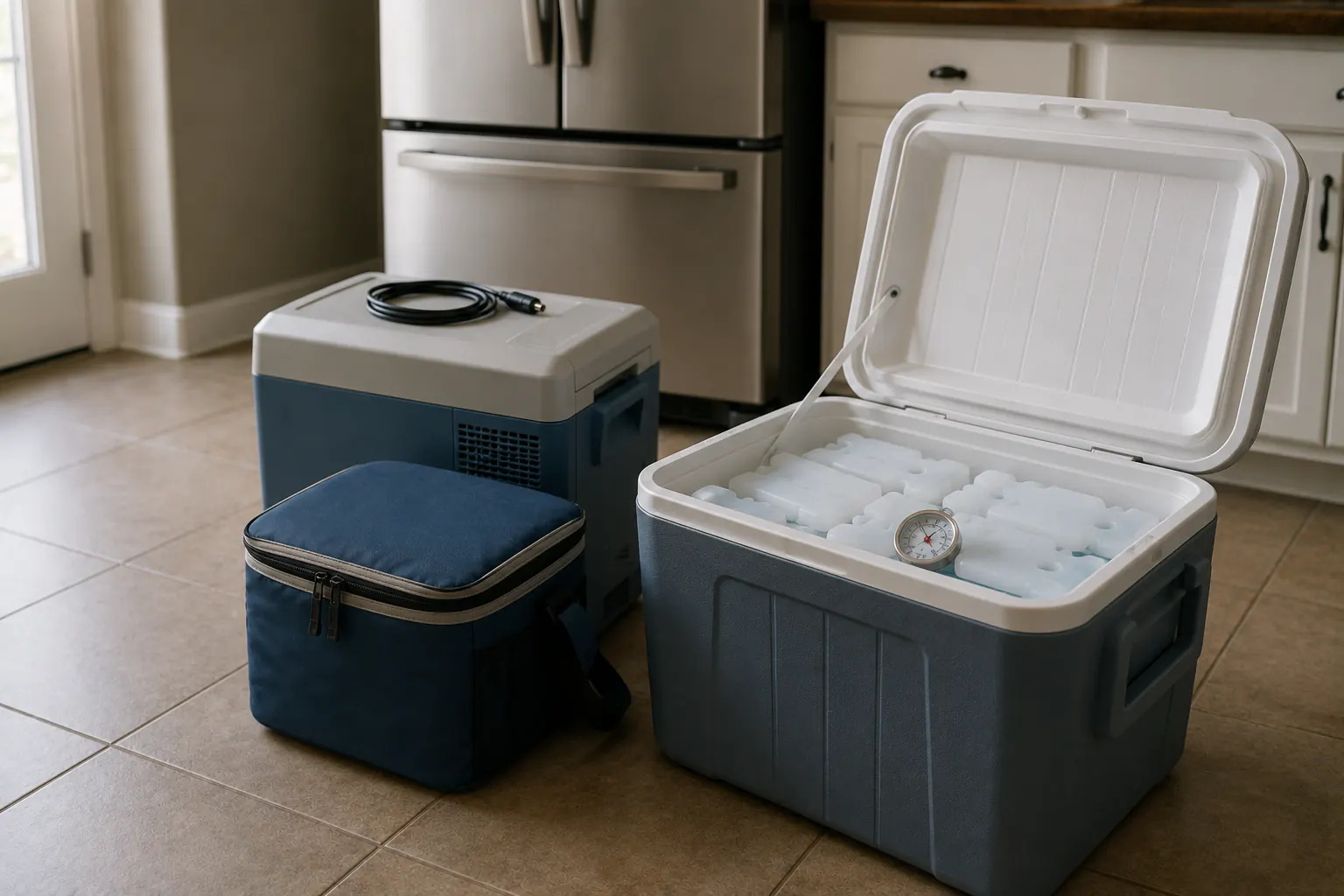
Moving food does not restart its safety clock
FoodSafety.gov advises keeping refrigerator doors closed and discarding refrigerated perishables after four hours without power. Its food-by-food chart also addresses time at or above 40 F. Plan cold holding before protection is lost; do not interpret four hours as a universal transfer deadline that rescues every item.
A colder reading after adding ice does not erase earlier warming or missing temperature history. Use the official chart and the food-safety guide, not a cooler’s advertised ice duration, for the actual decision.
Compare the job, not just the category
| Category | What to check on the exact model | What the category cannot tell you |
|---|---|---|
| Rotomolded hard cooler | Usable dimensions, empty and filled weight, latch access, drain, and stated test conditions | Construction alone does not establish multi-day food protection, a safe lifting load, or permission to stand on it. |
| Other hard-sided cooler | Food and cold-source fit, lid condition, handles, cleaning instructions, and available evidence | A hard shell does not promise one or two days of safe storage. |
| Soft-sided cooler | Intended load, closure, upright use, leak instructions, cleaning, and carrying route | A soft shell does not prove a holding duration or that it can replace your existing cooler. |
| Powered cooler or portable refrigerator | Intended temperature range, ambient limits, ventilation, electrical requirements, and measured energy use | A setpoint does not prove the food temperature, continuous operation, or compatibility with your battery. |
You do not need one of each. Compare only the models that might solve the particular gap: holding food at home, moving a manageable amount to another approved cold-storage location, or using refrigeration within an already suitable power plan.
Start with the cooler already at home
Inspect the lid, closure, handles, drain if present, and surfaces under the manufacturer’s instructions. Damage, contamination, a missing part, or a lid that will not close is not fixed by adding more ice. Find the model’s cleaning and loading instructions before relying on it.
Measure the actual usable space rather than relying on advertised quarts. Allow for the food containers, cold source, and thermometer placement specified by the equipment instructions. There is no universal rule that half the advertised volume will remain available for food.
Check where it will sit and whether the person responsible can open it, inspect a reading, and arrange assistance for any move. Children or someone with limited strength should not be assigned a heavy cooler just because it has handles. Keep exits and shared routes clear.
If the existing cooler fits the job, a clearer transfer plan or reliable cold-source supply may matter more than replacing the box.
Ask what an ice-retention claim actually measured
An advertised number of days may describe remaining ice rather than food temperature. Look for the test conditions instead of assuming every claim came from the same laboratory method:
- What was the ambient temperature, starting temperature, and cold-source load?
- How often was the lid opened, and what was inside?
- Was temperature measured, where, and over what period?
- Does the evidence cover this exact model and size?
- What does the manufacturer explicitly exclude or require?
If those details are unavailable, mark the duration unverified. A price, thicker-looking wall, retained ice, or camping certification is not evidence that your particular food stayed within the applicable conditions.
Do not run a spoilage, contaminated-food, drop, or standing-on-the-lid trial at home. Ordinary fit and access checks do not establish thermal performance or food safety.
Make the ice supply practical
Write down the cold source the model permits, where it will come from, and whether you can obtain replacements without an unsafe trip. A plan that depends on ice from a closed store has an unresolved supply gap, whatever the cooler costs.
Follow exact cooler and cold-pack instructions for placement and meltwater handling. Keep food packages protected from leaks and contamination. The cooler and ice guide covers that process alongside the factual record.
For a transfer, confirm the destination can receive the food and that the load and route are manageable. Moving food repeatedly without known conditions does not solve missing temperature history.
Powered cooling adds an equipment and energy check
Read the exact unit’s intended use, temperature range, ambient operating limits, required ventilation, and food-storage instructions. If a specification describes cooling relative to ambient temperature, that is not a guaranteed absolute food temperature. A compressor label or displayed setpoint is not a substitute for observations either.
Check the permitted supply, voltage, connectors, cables, startup requirements, and protection features with both equipment manuals. Energy use can vary with cycling, ambient conditions, loading, and settings. Use measured conditions where available, not a continuous-rated-watts assumption presented as exact runtime.
The refrigerator backup-power guide and power-station calculator help examine the power plan. A calculator estimate does not approve a connection or certify food storage. Do not improvise wiring, fuel use, or a hazardous cord route to avoid discarding food.
Decide what happens if cooling stops. Do not assume every powered unit can use ice, hold cold passively, or fail in the same way; follow the model’s instructions and the official food decision route.
Keep a short comparison note
For each realistic option, record the exact model, measured fit, intended food load, cold source or electrical dependency, access needs, cleaning instructions, and anything still unverified. You may finish with no purchase: the current cooler may be adequate for the intended job, or the household plan may rely more on familiar shelf-stable meals. The emergency food storage guide helps plan that pantry alongside the cold-storage needs.
No cooler comparison covers refrigerated medication, infant feeding, or medical nutrition. Use the product-specific instructions and clinician, pharmacist, or supplier plan for those needs.
Sources reviewed
FoodSafety.gov: food safety during power outages and temporary-outage planning. Centers for Disease Control and Prevention: keeping food safe after an emergency. Current public-health guidance controls food decisions; exact equipment instructions control loading, cleaning, temperature limits, and electrical use. This page reports no hands-on cooler results.
On October 13, 2026, I checked Igloo’s red Playmate Elite product details, care guidance, FAQ and safety notices. The linked model is identified by manufacturer part 00043362 and UPC 034223433635; confirm those identifiers rather than assuming every Playmate size or color has the same specifications. Igloo specifies mild-detergent cleaning, rinsing and complete drying, and excludes dishwasher cleaning and dry ice for this range. No ice-retention duration is used in this comparison.