
Keep the refrigerator door closed while you check the outage information and your cold-storage plan. If food needs to move, have the clean cooler, permitted cold source, and thermometer ready before opening the appliance. Note what moved and when; moving food into a cooler does not make an uncertain earlier history disappear.
The cooler cannot reconstruct a temperature history. It cannot make warm food safe again, prove that a bag of ice lasted long enough, or replace the official food-by-food decision chart. Keep the decision itself with Power Outage Food Safety: Refrigerator and Freezer Rules. Use this page to make the cooler setup calmer, cleaner, and easier to review.
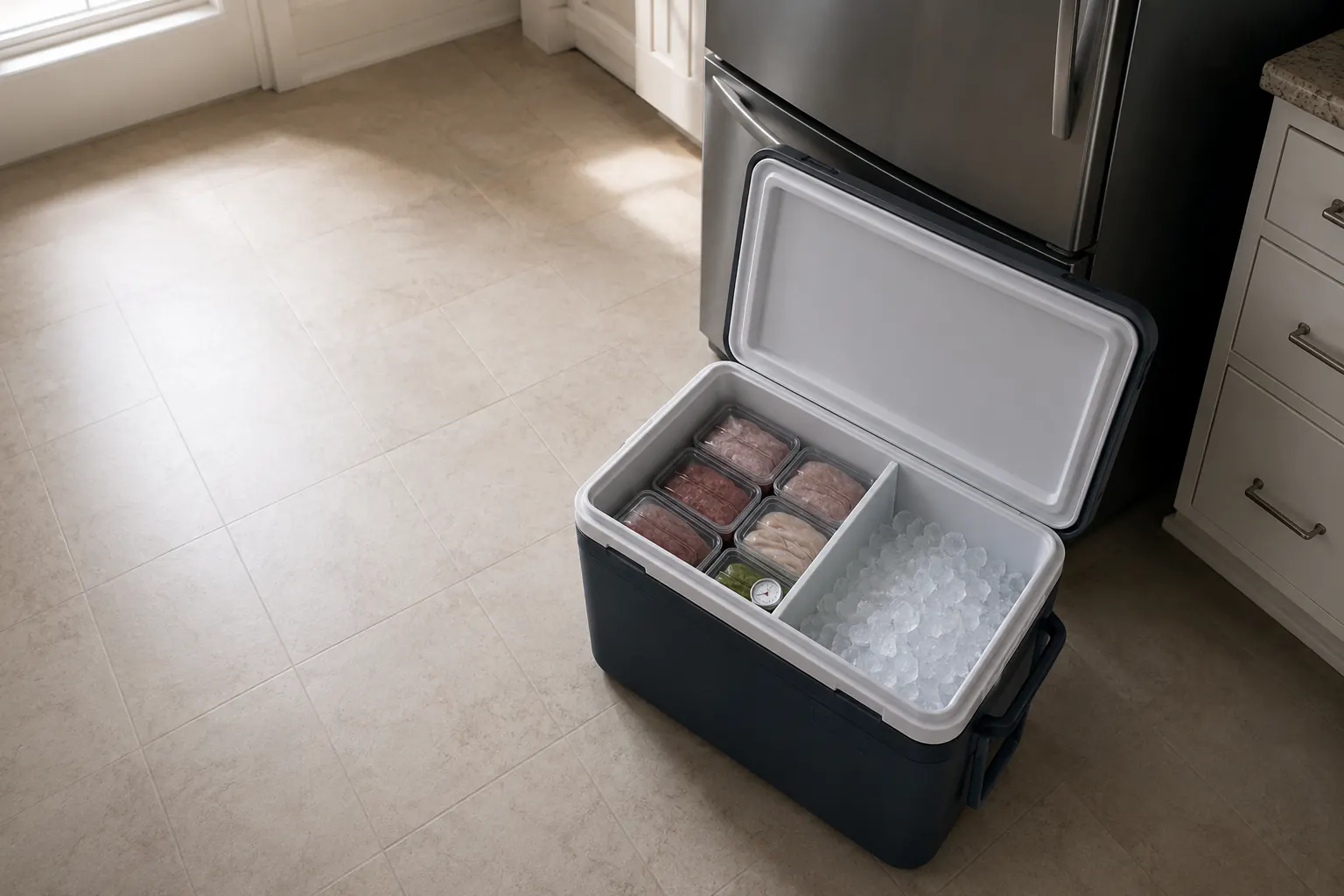
Choose the cooler before the outage
Use a clean cooler that closes fully and has room for food, ice or frozen gel packs, and a thermometer without crushing packages. A large cooler is not automatically better. Follow its loading instructions and keep raw-food leaks away from ready-to-eat food. Choose a manageable filled load and arrange help for any move, especially in an apartment or on stairs. If you are still choosing the box, the cooler category comparison helps check hard, soft, and powered options.
Keep the following together, but do not treat them as a kit that solves food safety:
- a cooler with an intact lid and drain;
- a refrigerator-safe thermometer or other reliable cold-temperature check;
- ice or frozen gel packs obtained and handled according to their instructions;
- leak-resistant containers or bags for raw meat, poultry, and seafood;
- a marker and plain timeline note; and
- cleaning supplies already appropriate for ordinary kitchen cleanup.
The CDC advises having a cooler and frozen gel packs ready, and keeping food at 40 F or below. That is a cold-holding condition, not a forecast. If the household cannot verify time or temperature, do not invent a reassuring explanation from how cold the cooler feels.
Decide what deserves the limited cold space
Move only food that has a realistic chance of being held cold and that the household can identify later. The first candidates are refrigerated perishables that would otherwise need a discard decision: meat, fish, eggs, milk, cut produce, and leftovers. Keep shelf-stable food in the pantry; it does not need valuable cooler capacity. Do not move refrigerated medication, infant feeding supplies, or a household member’s clinical item into the same improvised plan. Those require their own product-specific and professional route.
Before an intended transfer, note the observed outage time or the best known window; do not invent an exact time. Use the current food-safety chart to establish which food is still suitable for cold holding. Do not move food already subject to a discard instruction in the hope that ice will rescue it. Prepare the receiving cooler, make the necessary transfer, and close the refrigerator again. FoodSafety.gov and CDC emphasize keeping appliance doors closed as much as possible; there is no need to empty the refrigerator or open it just to complete a checklist.
Keep ownership and event records simple. A note such as “cooler A: milk, eggs, leftovers; moved at 3:20 p.m.; thermometer checked at 5:00 p.m.” is useful. Do not put a claim number, private address, medical information, or a complete household inventory on the note.
Pack for separation and temperature checks
Place the cold source around the food rather than relying on a small amount of ice on top. Follow the cooler and gel-pack instructions, and keep packages contained so meltwater or leaks do not spread from raw food to foods that are ready to eat. Put raw meat, poultry, and seafood in leak-resistant containers below or apart from other items whenever the cooler shape allows.
Keep the thermometer where it measures the cooler air or the location intended by its manufacturer, not pressed against an ice pack or a warm lid. Record the reading with the time. One late reading does not prove the food stayed cold before that moment; it is simply one observation.
Avoid putting the cooler in direct sun, a vehicle being used as storage, a generator area, a flood-prone location, or a place accessible to animals. Choose a clean, shaded, stable location that does not block an exit. In an upper-floor apartment, do not create an unsafe carrying load or block a stair or hall. The apartment water-movement guide has the same basic principle: a heavy emergency supply must not turn an exit path into a hazard.
Log facts, then use the official decision route
Record only facts the household actually knows:
| Record | Useful note | What it does not prove |
|---|---|---|
| Outage start | utility or household observation time | the exact temperature of every food item |
| Cooler transfer | item group and time moved | that the food was safe before transfer |
| Cold source | ice, gel pack, or other known source | how long it maintained a safe condition |
| Thermometer check | reading and time | the whole earlier temperature history |
| Door opening | reason and approximate time | that every item was unaffected |
When power returns or the cold source is depleted, do not decide by smell, appearance, or the fact that an item feels cool. Use the official chart linked from the food-safety hub, then follow a conservative discard decision when the conditions are unknown. The official chart is deliberately more specific than a cooler story because foods have different routes.
Keep cleanup separate from the food decision
Discarding unsafe or questionable food is not the same as cleaning the cooler. First bag and remove food according to local waste rules. Then clean any leak or residue with hot, soapy water and rinse; use only a sanitizing method appropriate to the product and current public-health guidance. Wash hands and any surface, bag, or container that contacted leaking food. Do not reuse a visibly contaminated bag or container without cleaning it properly.
USDA warns against solvent cleaners and abrasives inside a refrigerator because they can damage the finish or leave unwanted residues. The same restraint applies to a cooler: use the manufacturer’s care instructions, do not mix cleaners, and let the unit dry fully before storing it. Floodwater, sewage, chemical, or unknown contamination is a different event; use safe drinking water after a flood and current local public-health direction rather than treating ordinary cooler cleanup as sufficient.
Know when the cooler plan has ended
Stop using the cooler plan as soon as its cold source is no longer dependable, the thermometer cannot be checked, the cooler is contaminated, the food history becomes unknown, or the household must leave the location. Do not keep moving the same perishable food from refrigerator to cooler to vehicle to another cooler in the hope that one container will erase the earlier uncertainty. Record the last known observation, use the official decision chart, and discard conservatively when the facts do not support a keep decision.
This is also a useful point to separate food from other outage work. A generator, power station, or extension arrangement should never be started solely to avoid a food decision; Backup Power for Home owns measured electrical planning, and Emergency Sanitation and Hygiene owns waste and cleanup when normal services are disrupted. A household can protect itself from a second hazard by accepting the food loss rather than improvising power, fuel, transport, or cleaning methods under pressure.
Reset the plan after the event
Wash, dry, and store the cooler with its thermometer. Recharge or replace the cold source as appropriate, replace batteries, and write down the one change that would have reduced uncertainty next time: a smaller cooler, more frozen packs, a clearer transfer list, or a better storage location. For a broader lower-loss pantry plan, use Emergency Food Storage. For cooking limits during an outage, use How to Cook During a Power Outage Without Creating a New Emergency.
The durable habit is not owning a cooler. It is knowing that a cooler is a temporary, measurable holding space and that a food decision still belongs to current official guidance.