
Situational awareness is not a suspicion game. It is the ordinary habit of knowing where you are, who is with you, what has changed, and how you would leave without turning a minor concern into a confrontation.
That matters during a blackout, crowded event, transit delay, weather warning, or neighborhood disruption. It also matters on an ordinary afternoon. The aim is not to predict violence or identify “dangerous” people. It is to notice practical facts early enough to make a calm choice: stay, move to a less crowded place, call a trusted person, or leave by a normal safe route.
Start with the room, not the story
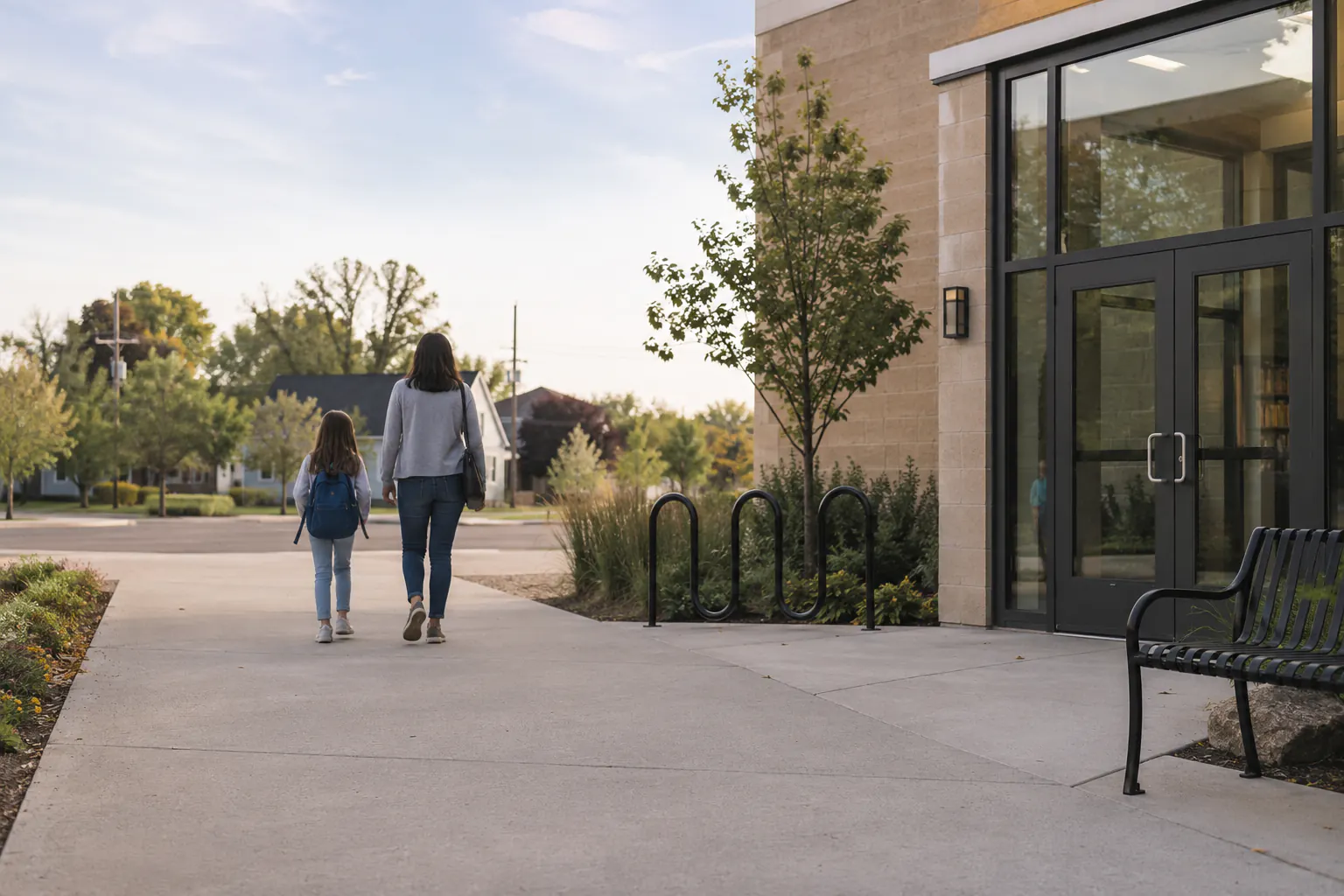
When you arrive somewhere unfamiliar, take ten quiet seconds to orient yourself. Notice the ordinary entrance, another exit when one is available, the staff or information point, the nearest well-lit public area, and the place where your group would reconnect if separated.
You do not need to scan faces, monitor strangers, or collect evidence. Look for conditions that affect everyone: a blocked doorway, an overcrowded corridor, a slippery surface, a smoke smell, an argument growing louder, a weather change, a transit cancellation, or an official instruction. A useful observation describes what is happening, not what you imagine it means.
For a family or group, say the plan before it is needed: “If we get separated, meet by the main entrance unless staff direct us elsewhere.” Children and guests need a simple instruction, not a complicated code or responsibility for adult decisions.
Keep your options open
The safest decision is often made before anyone feels trapped. Choose a parking spot, transit stop, seat, or waiting area that does not require pushing through a dense group to leave. Keep shoes, keys, phone, medication, mobility support, and a basic outer layer accessible rather than buried under purchases or luggage.
Do not block a doorway with bags, gather in a stairwell, or stand in a vehicle lane while trying to decide. In a building, preserve normal fire egress. At home, use the home security and safe-exit guide for doors, windows, and lawful hardware; do not improvise an obstacle that could trap your own household.
If someone in the group has a mobility, hearing, vision, language, cognitive, medication, or caregiving need, decide the slower person’s route first. The group can then choose a pace and location that actually works. A plan based on the fastest adult is not a group plan.
Treat crowds as a density problem
Crowds are not automatically dangerous. The useful question is whether movement, exits, staff direction, and personal space are still under control. CDC guidance for mass gatherings emphasizes knowing exits and first-aid locations, staying away from the densest areas when practical, and paying attention to trip hazards and changing conditions.
Move away early when the space becomes difficult to cross, people begin pressing together, an exit narrows, a disagreement pulls attention toward one point, or you can no longer keep your group together. Do not wait for certainty. Leaving a concert, station, store, or public event early is a normal option, not an accusation against anyone there.
If movement is already constrained, avoid forcing against people or trying to film from inside the densest area. Keep your group together where possible, protect children and anyone who needs support, follow venue-staff and public-safety directions, and move toward a less crowded edge only when that route is available. Call 911 for an immediate life threat when it is safe to do so.
Use distance instead of confrontation
Most situations do not require a clever response. They require space. If an argument, disturbance, or unknown person makes you uneasy, move toward a staffed public area, a normal exit, other people, or a place with a clear way out. Use a brief, ordinary boundary such as “I can’t help with that” or “Please give us space,” then disengage.
Do not follow someone, argue to prove a point, investigate a noise, block a person’s movement, make threats, show a weapon, or recruit bystanders into a dispute. Do not treat a phone video, clothing, politics, race, housing status, disability, or presence in public as evidence of intent. A household preparedness site has no business teaching readers to profile people or play security officer.
At home during an outage, a locked normal barrier, distance from the door, a usable exit, and a verified call for help are enough. The blackout security guide owns that household-specific sequence. When an encounter is already heating up and you cannot simply leave yet, the de-escalation basics guide covers lowering the temperature — space, tone, and an off-ramp — without feeding it.
Verify before you move
A social post, scanner clip, siren, crowd video, or group text can tell you that something changed. It cannot establish a safe route, a closure boundary, an evacuation order, or the condition of a building. Check local emergency management, transit, venue, school, building-management, weather, or public-safety channels through a known route.
The local alerts guide and family communication plan make that verification easier when service is unreliable. Keep a short status message ready: SAFE / LOCATION / NEED / NEXT CHECK-IN. Share destination details only with the people who need them.
If a route is closed, do not test a side street, cross a barrier, drive toward a crowd, or assume a navigation app knows the live condition. The car-free backup transportation guide owns travel alternatives and accessibility constraints; the civil unrest hub owns avoidance of an affected area and current-authority routing.
Practice the boring version
Practice when nothing is wrong. On an ordinary visit to a library, store, sports venue, school event, or transit station, identify the main exit, a meeting point, and the staff desk. Check whether a mobility device, stroller, child, pet carrier, or heavy bag changes the path. Then continue with the day.
At home, run a short drill: find shoes, keys, light, phone, and the household contact card; walk the normal exit route; notice the rug, cable, furniture, or storage item that makes it harder; fix that ordinary problem. This is preparedness at its most useful: less drama, fewer assumptions, more usable choices.
After an uneasy event
Once safe, account for the group and send the agreed check-in. Write down only factual information needed for a report or property manager: time, place, condition observed, who was contacted, and any current reference number. Do not post another person’s image, location, medical detail, or alleged motive online.
If the experience leaves someone persistently distressed or unable to resume ordinary activity, seek qualified support. CDC notes that stress and worry are common after emergencies and that practical preparation, trusted information, and support can help. The household stress-support plan offers non-clinical routines and escalation paths.
Personal safety is not about being on guard every minute. It is about leaving yourself enough room to choose a safer, quieter next step before a situation gets worse.
Sources reviewed
- Centers for Disease Control and Prevention: Mass Gatherings; Stay Calm
- Ready.gov: Make a Plan
- U.S. Department of State: Demonstrations
Sources reviewed July 16, 2026. Conditions, routes, venue procedures, and public-safety instructions change quickly. Follow current official instructions and do not use a general guide as a live threat assessment.