
Check the local fire and evacuation instructions first. If it is safe to remain, use the prepared cleaner-air room and the household’s approved backup plan. Confirm who needs help moving and which open, reachable destination can accommodate them; battery arithmetic comes after that decision.
An outage can take away filtration, cooling, elevators, and communication together. This guide helps you plan selected loads without treating a charged battery as permission to stay. Do not delay departure or emergency help to finish a checklist, find a rating, or preserve equipment.
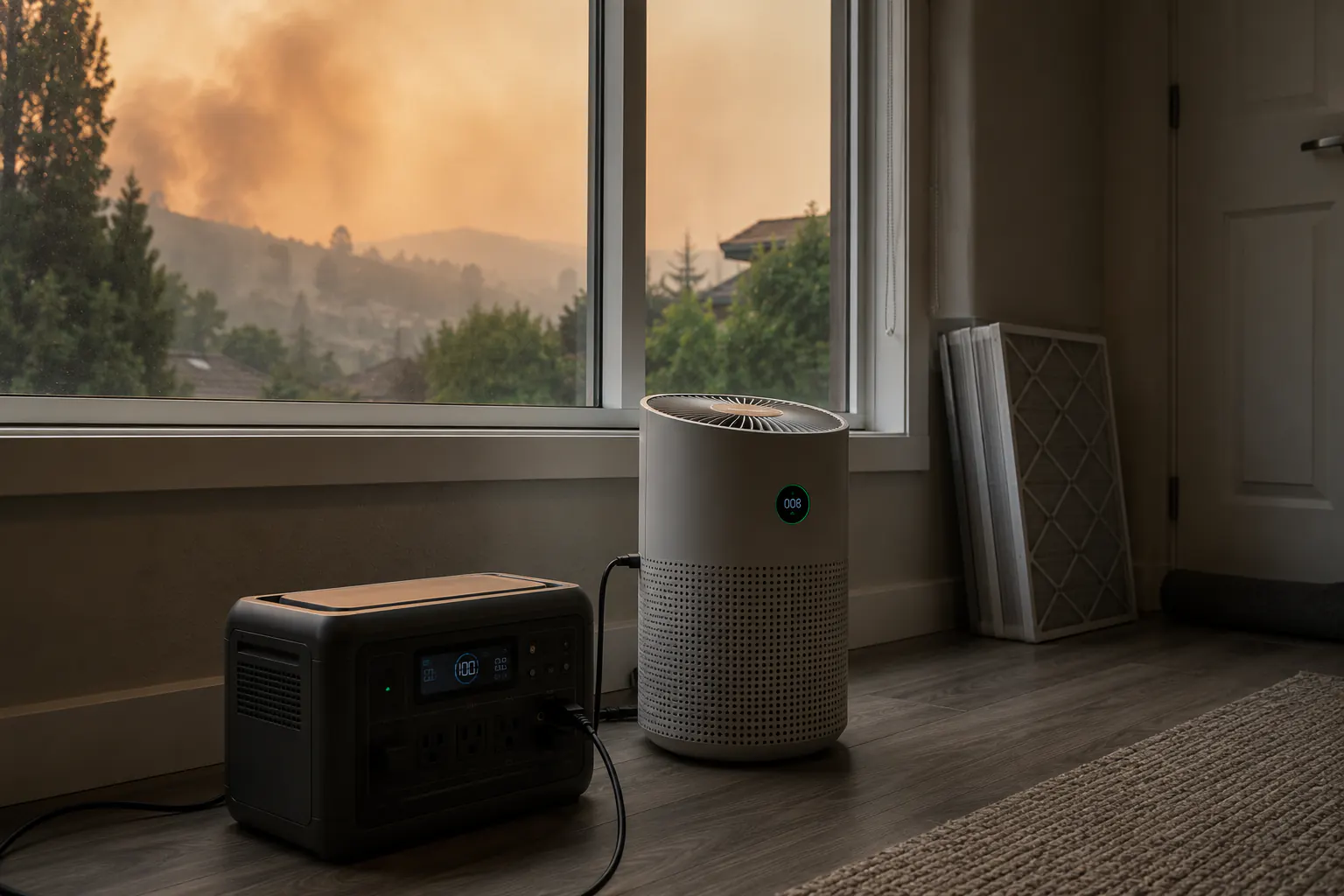
First five minutes: check fire before equipment
- Check local evacuation instructions and fire conditions.
- Confirm everyone is accounted for and able to move.
- Use flashlights rather than flames.
- Keep exterior windows and doors closed while outdoor smoke is worse, unless emergency egress or dangerous heat requires another action.
- Disconnect only safely accessible, nonessential equipment under its instructions; do not interrupt prescribed care or approach damaged, wet, hot, or sparking equipment.
- Start the household’s alert, communication, medical, and cleaner-air battery plan.
Leave promptly when ordered. If fire threatens, smoke becomes overwhelming indoors, heat becomes unsafe, or a medical plan requires reliable power, do not delay departure to optimize battery runtime.
Use the wildfire smoke hub for the full fire-versus-smoke decision and the power outage first-actions guide for electrical, food, water, and restoration checks.
Decide which condition ends sheltering
Write the stop conditions before an outage:
- local evacuation order or rapidly changing fire direction;
- cleaner-air room temperature above the household’s safe plan;
- filtration lost long enough that indoor smoke rises materially;
- essential medical equipment approaching its verified backup limit;
- inability to receive alerts or contact help;
- building fire alarm, carbon-monoxide alarm, gas odor, electrical fault, or unsafe structure;
- elevator loss or mobility constraint that requires earlier assisted movement;
- public cleaner-air or cooling location about to close or become unreachable.
The decision should be based on the whole system. A battery with hours remaining does not justify staying in an evacuation zone, and a low indoor particle reading does not resolve dangerous heat.
Preserve one occupied zone
Use the prepared room without overcrowding it or blocking exits and airflow. EPA’s How to Create a Cleaner Air Room at Home advises continuous air-cleaner operation at the highest fan setting during smoke. Plan power around that setting and the device instructions, not a quiet low setting with a longer advertised runtime. If the backup cannot maintain the required plan, arrange earlier movement to the confirmed suitable destination; do not trade away filtration simply to remain longer.
Do not seal required vents, combustion air, alarms, or exits. Do not light candles, cook with unvented fuel, smoke, vape, fry food, or vacuum. Particle sources inside the home consume the limited clean-air capacity.
The cleaner-air room guide covers room setup and heat limits. If the room was never prepared, choose the safest practical occupied room and move early rather than attempting extensive sealing during an active fire event.
Build the critical load list
List devices by function, not by ownership:
| Priority | Load | Decision question |
|---|---|---|
| 1 | Prescribed equipment | What does the clinician and supplier backup plan require? |
| 2 | Alerts and communication | Which phone, radio, router, and charger keep instructions available? |
| 3 | Particle filtration | What documented watts support the cleaner’s required operating setting? |
| 4 | Heat control | Can the approved cooling plan work without pulling smoke inside? |
| 5 | Safe lighting | Which light keeps exits and approved equipment access clear? |
| 6 | Food and comfort | What can wait without creating a health or safety problem? |
Use documented watts or existing normal-operation measurements at the required setting. Unknown loads remain questions for the equipment provider, not reasons to open a cabinet, move equipment, induce an outage, generate smoke, or interrupt essential operation. Compressor startup and cycling require their own documented limits. Medical equipment stays under the clinician and supplier’s plan.
Calculate usable runtime conservatively
Advertised watt-hours are not all delivered to loads. Account for battery availability, inverter loss, reserve, temperature, aging, standby draw, and other devices.
estimated hours = usable watt-hours ÷ average load watts
Example: a battery with 800 usable watt-hours supporting a 50-watt air cleaner, 10 watts of communication loads, and 5 watts of lighting has a 65-watt average load. The arithmetic estimate is about 12.3 hours before additional reserve or changing conditions. It is not a promise: device cycling, conversion loss, filter loading, heat, and battery behavior change the result.
The power-station runtime calculator estimates selected loads; it does not approve wiring, device compatibility, or medical continuity. Keep clinical and care details private. For ordinary planning, compare:
- filtration plus communication and safe lighting, keeping any prescribed equipment’s reserve separate under its approved care plan;
- filtration alone;
- communication-only reserve for departure.
Recalculate when a device, speed, battery, or room changes.
Choose backup power by the load
Small USB battery banks
Useful for phones, selected radios, and USB lights. They rarely support a household air cleaner directly. Confirm ports, cables, charging protocols, and actual device compatibility before smoke season.
Uninterruptible power supplies
A UPS can bridge short interruptions for routers, controls, or selected low-wattage equipment. Many are designed for minutes rather than overnight runtime, may alarm loudly, and may not support compressor or motor startup.
Portable power stations
For an ordinary load, check the exact device and power-source instructions, continuous and surge ratings, output, capacity, and operating conditions. A household calculation does not authorize powering a medical device: that requires the clinician, supplier, and manufacturer plan. Keep permitted equipment dry, ventilated as instructed, within its temperature limits, and clear of exits.
Vehicle charging
A vehicle may recharge small electronics where local orders, traffic, air quality, and vehicle safety allow. Never idle a vehicle in a garage, carport, near doors or windows, or another enclosed or partially enclosed area. Do not drain the starting battery or consume evacuation fuel casually.
Portable generators
Generators create carbon monoxide and fire risks. They are not an indoor air-cleaning accessory. Operate only outdoors at least 20 feet from buildings, doors, windows, and vents, with exhaust directed away, while following stricter manufacturer or local requirements.
Read generator carbon monoxide safety. If outdoor smoke, embers, evacuation, dry vegetation, fuel rules, theft, noise, or placement prevents safe operation, do not use the generator.
The backup power guide compares system roles and limits.
Do not assume solar recharge will match the plan
Smoke, cloud, ash, panel angle, shade, temperature, cable loss, and limited daylight can reduce solar input. Panels placed outdoors can also become an evacuation, ember, theft, or trip concern.
Use documented limits or existing normal-condition production records, not a recharge trial during the event. Do not climb a roof, deploy large arrays during an active warning, block a path, or leave equipment that delays departure.
Prioritize arriving at the destination with charged communication and medical reserves over pursuing a marginal recharge cycle.
Manage the smoke-versus-heat conflict
Without air conditioning, a closed home can overheat. Fans move air but do not lower room temperature and may add motor heat. They can improve comfort under selected conditions but cannot make dangerous heat safe.
Monitor temperature and people, not just the battery display. Use shading and reduce internal heat sources. If outdoor air temporarily improves enough for ventilation, follow local air-quality guidance and understand that the smoke plume can return quickly.
When the home cannot remain both cool and acceptably smoke-protected, move to a confirmed cleaner-air cooling location outside the fire threat. The extreme heat preparedness guide sets the heat decision framework.
Protect medical continuity
Before fire season, ask the clinician, device supplier, pharmacy, utility, and emergency-management program about:
- outage response and evacuation thresholds;
- battery type, capacity, maintenance, and replacement;
- safe alternative equipment or treatment location;
- oxygen and respiratory-device transport;
- refrigerated medication temperature control;
- accessible transportation and shelter;
- who to call before backup is exhausted.
Do not power a device from an unapproved source or change treatment based on this article. Call 911 for an emergency. Leave early when a person cannot tolerate smoke, heat, transport delay, or uncertain power.
Keep communication lean
Use one primary phone, low-power mode, downloaded contacts, and text messages when networks are congested. Assign an out-of-area contact and scheduled check-in. Keep a battery radio available for local instructions.
Reduce only nonessential background activity; keep required alerts, accessibility, medical connections, and the care plan operating. Preserve the needed cables and adapters. The family communication plan provides a reusable message format.
Apartments and shared buildings
An outage can stop elevators, access controls, garage doors, pumps, corridor ventilation, and shared HVAC. Ask management in advance which systems have emergency power and how residents receive evacuation instructions.
Do not enter an elevator during fire evacuation unless authorities specifically direct it. Keep mobility equipment charged and arrange assistance before smoke or fire reaches the building. Know how the garage gate opens during outage without blocking others or defeating security controls.
Portable generators are generally incompatible with apartment interiors, balconies, corridors, and shared outdoor spaces. Follow lease, fire code, building, and emergency restrictions.
Food and water remain secondary but real
Keep refrigerator and freezer doors closed. Use the power-outage food safety guide for time and temperature decisions. Do not spend cleaner-air battery capacity preserving low-value food while critical filtration, medication, or communication is at risk.
Monitor water-utility advisories because fire and power loss can affect pumps and pressure. Use stored water when directed. Do not assume an indoor filter intended for particles makes tap water safe.
Outage action card
- Check evacuation and fire instructions.
- Account for people, pets, medication, and mobility.
- Close the prepared cleaner-air room and stop indoor particle sources.
- Start only medical, communication, filtration, and safe-lighting priorities.
- Use documented loads to estimate runtime only if it does not delay help or departure.
- Reserve communication and departure energy.
- Monitor temperature, indoor smoke trend, symptoms, alerts, and battery state.
- Avoid indoor combustion and unsafe outdoor generator placement.
- Move before heat, smoke, medical, mobility, or route conditions exceed the written plan.
- Take charged devices, batteries, medication, respirators, documents, and animal supplies.
Before smoke season, confirm one suitable destination, the person arranging transport, and the equipment instructions needed for your selected loads. During the event, help and departure come first. Backup power does not buy permission to ignore fire, heat, health, or evacuation conditions.
Sources reviewed
- U.S. EPA: Wildfire Smoke: A Guide for Public Health Officials, 2026
- U.S. EPA: Create a Clean Room to Protect Indoor Air Quality During a Wildfire
- U.S. EPA: How to Create a Cleaner Air Room at Home
- CDC: Safety Guidelines for Wildfires and Wildfire Smoke
- CDC: What to Do to Protect Yourself During a Power Outage
- U.S. Consumer Product Safety Commission: Carbon Monoxide Information Center
Sources reviewed July 14, 2026. Event-specific fire, evacuation, utility, public-health, clinician, building, and equipment instructions control actual decisions.
October 3, 2026 update: checked EPA’s cleaner-air-room guidance for fan setting and movement limits, and CDC’s outage guidance for lighting, heat, and combustion boundaries. Other sources retain their historical review date.