
Before the next heating or cooling season, find the service number, check the filter instructions, and book any service that is due. Those three jobs are a useful starting point even if you know very little about the equipment.
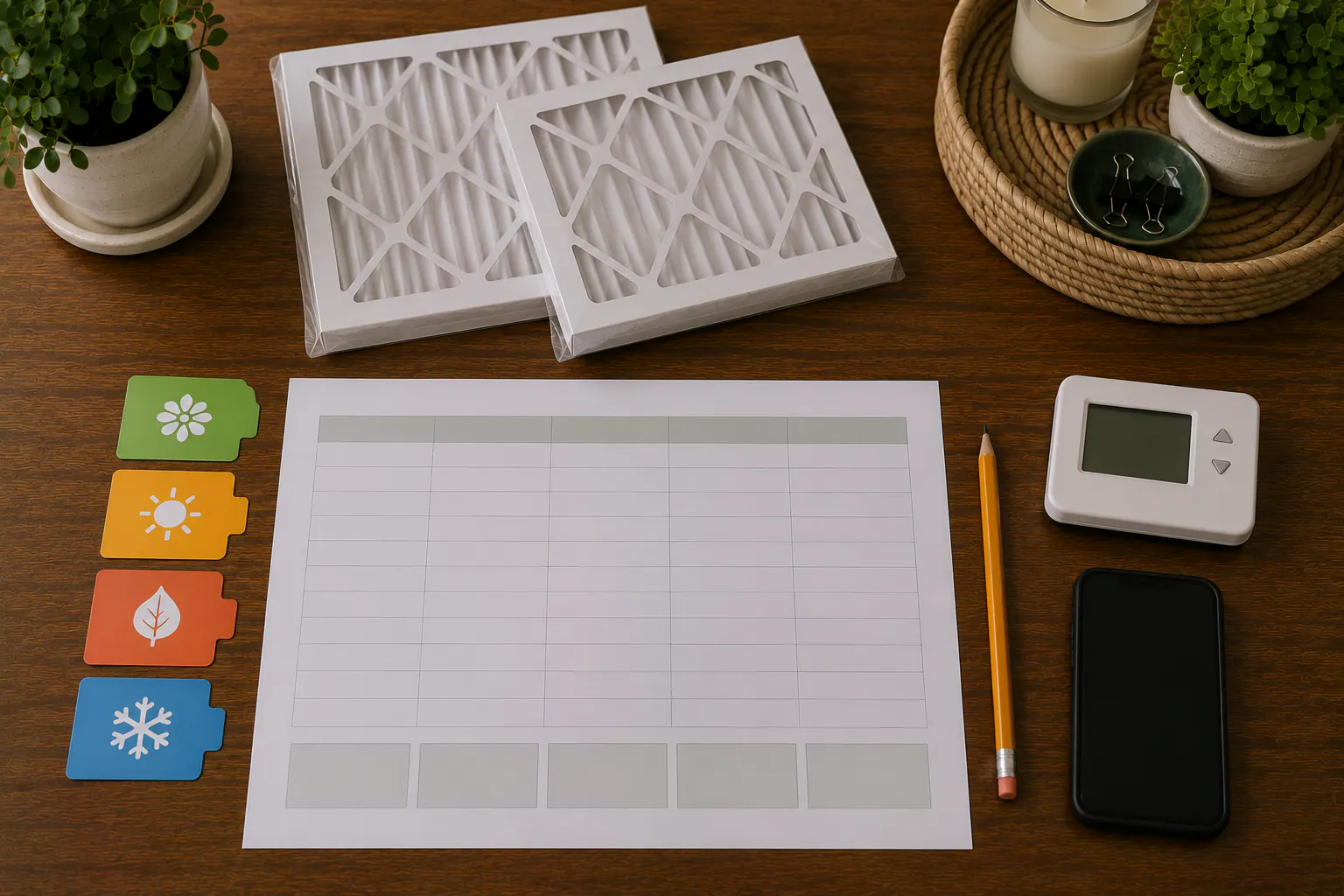
The checklist separates what the manual or building assigns to you from work for a qualified contractor. Normal controls, approved filter access and records may be household tasks. Electrical connections, refrigerant, combustion and internal service are not.
Return to the HVAC and climate-control hub when the question is equipment selection, outage planning, renters, smoke, or replacement rather than the seasonal routine itself.
Use two pre-season dates
ENERGY STAR recommends an annual pre-season checkup for cooling in spring and heating in fall, before contractors become busiest. (Source: ENERGY STAR, Maintenance Checklist.) If one system provides both heating and cooling, ask the contractor how its schedule should be organized.
Create two repeating calendar entries:
- Cooling readiness: before the local cooling season or smoke-and-heat season.
- Heating readiness: before freezing weather or the local heating season.
During heavy-use months, keep a brief record of changes noticed during ordinary use. Follow the equipment’s filter schedule rather than treating this reminder as a universal maintenance interval. Observation does not replace service.
Stop before routine maintenance
Do not proceed as a maintenance task if there is fire, smoke, active arcing, a carbon monoxide alarm, possible CO symptoms, gas odor, flooding, standing water near electrical equipment, structural damage, or immediate danger. Leave and call the responsible emergency or utility service.
Stop normal operation through an ordinary accessible control only if current instructions allow it and you can do so without approaching water, damaged equipment or another hazard. Otherwise, stay away and call the responsible service. Report:
- burning, fuel, chemical, electrical, or persistent musty odor;
- grinding, scraping, banging, repeated clicking, severe vibration, or a new impact sound;
- repeated breaker trips, visible wire or plug damage, melted material, or sparking;
- water, overflow, ice, oil-like residue, unknown liquid, or a stained ceiling near equipment;
- a fan or guarded part that is damaged, obstructed, or not operating normally;
- rapid cycling, failure to stop, repeated fault codes, or loss of climate control in dangerous weather;
- known or suspected mold contamination in the HVAC system.
Do not open a cabinet to investigate. Do not reset a protection repeatedly, bypass a switch, break ice, handle refrigerant, test combustion, or touch wet equipment.
Create the equipment record once
From safely visible labels, the manual, lease packet, or service invoice, record:
| Record | Why it matters |
|---|---|
| System type and fuel | Separates heat pump, furnace, boiler, room unit, and shared-building procedures |
| Make, model, serial number | Supports manuals, warranty, parts, service, and recall checks |
| Filter dimensions and approved rating | Prevents improvised fit and unsupported filter upgrades |
| Normal thermostat modes | Helps identify a changed setting after an outage or service visit |
| Service company or property contact | Saves time when weather becomes dangerous |
| Last service and repair | Gives the next technician useful history |
| Normal sound, cycle, and room pattern | Makes a new change easier to describe |
Photograph labels only from a normal standing position. Do not remove a cover, enter a mechanical room, climb, reach behind equipment, or expose wiring to find a number.
Spring cooling checklist
Household-authorized observations
- Confirm the thermostat display, date, time, mode, schedule, and batteries through its normal interface.
- Inspect the accessible filter and use the HVAC filter schedule for replacement decisions.
- Make sure ordinary furniture, curtains, rugs, boxes, and pet items do not block accessible supply registers or returns.
- From ground level and without reaching through a guard, look for leaves, storage, vegetation, impact damage, or roof runoff around exterior equipment.
- Look in occupied areas for water stains, damp material, musty odor, or recurring high humidity.
- Confirm that any accessible condensate alarm or normal status indicator follows its manual.
- Check that smoke and carbon monoxide alarms are within their separate manufacturer maintenance schedules.
- Review the household extreme-heat and outage plan, including where people can go if cooling fails. Follow any existing clinician or medical-device plan.
Do not hose electrical equipment, straighten fins, clean an internal coil, open an air handler, add a chemical tablet, clear an internal drain, or remove a guard unless the exact manufacturer instructions explicitly assign that task to the user and the work can be done without electrical, fall, contamination, refrigerant, or moving-part exposure. ReadyLience does not provide those model-specific procedures.
Ask the cooling contractor to document
ENERGY STAR’s professional checklist includes checking controls and the starting cycle, cleaning evaporator and condenser coils, verifying refrigerant charge, adjusting blower components, checking electrical connections, measuring voltage and motor current, and inspecting the condensate drain. Those are service tasks, not an occupant checklist.
Ask for a written result that identifies:
- what was inspected and measured;
- any fault or deferred repair;
- filter specification and airflow limit;
- condensate condition and discharge path;
- the equipment’s safe operating status;
- the next service date;
- any instruction that changes the outage restart plan.
Fall heating checklist
Household-authorized observations
- Review the normal heat mode and schedule without forcing a test outside the manufacturer’s allowed conditions.
- Inspect the approved accessible filter.
- Keep accessible registers, returns, radiators, baseboards, and ordinary clearances free of storage and textiles.
- Confirm exterior intake and exhaust locations are known so snow, vegetation, or household storage is not placed against them. Do not alter or clear a vent during active operation if access is unsafe.
- Check for prior water, rust, soot-like residue, or changed odor from a normal occupied position.
- Review carbon monoxide alarm locations and manufacturer replacement dates.
- Update the winter outage, pipe protection, medical, pet, and relocation plans.
Never use an oven, grill, camp stove, generator, or unvented improvised fuel-burning device for home heating. The winter outage heat guide and carbon monoxide safety hub define the emergency boundaries.
Ask the heating contractor to document
For fuel-burning equipment, ENERGY STAR places gas or oil connections, gas pressure, burner combustion, and heat exchanger inspection in the professional checkup. Electrical measurements, controls, lubrication, blower work, and internal cleaning also belong there.
Ask whether the system has a documented response for:
- utility outage and restoration;
- a thermostat that loses time, schedule, or network access;
- a condensate or freeze-protection fault;
- backup or auxiliary heat indication;
- an alarm, lockout, or repeated trip;
- extended vacancy during freezing weather.
Do not ask a general article to replace the equipment manual or local code.
Monthly heavy-use observation
During the busiest cooling and heating months:
- Check the filter through its approved access.
- Note changes during ordinary operation; do not force or wait through a cycle to complete the checklist.
- Walk the occupied rooms and note persistent hot, cold, humid, or low-airflow areas.
- Look for new water, staining, ice, odor, sound, or vibration.
- Confirm exterior equipment remains visibly clear from a safe location.
- Record the date, weather, setting, and observation.
One unusual cycle during extreme weather is not a diagnosis. A repeated or worsening pattern is useful evidence for the HVAC warning-sign guide and the service call.
After a storm or power outage
Do not treat utility restoration as automatic equipment clearance. Do not operate wet, flooded, impacted, contaminated, recalled, repeatedly tripping, hot, odorous, or visibly damaged HVAC. Respect any professional isolation; do not attempt to isolate or restore equipment yourself. Follow the HVAC outage restart guide and the exact manufacturer, utility, property, and service instructions.
Document:
- outage start and restoration time;
- lightning, flooding, wind, smoke, snow, ice, or debris exposure;
- thermostat and equipment status before and after;
- any utility message, error code, sound, odor, water, or breaker event;
- who authorized restart.
Do not reproduce a fault to make a video for service.
Renter version
The lease and building procedure decide who changes filters and how loss of heat or cooling is reported. A renter can usually keep accessible vents clear, operate normal controls, document indoor conditions, and report a problem. Do not enter a locked mechanical area, touch shared equipment, drill, wire, open a drain, or hire work on the owner’s system without authorization.
Use the renter HVAC guide to prepare a clear maintenance request and an extreme-temperature fallback.
Keep a one-page service log
For every observation, filter change, service call, repair, outage, or equipment change, record the date, outdoor conditions, thermostat setting, symptom, action, responsible person, and result. Attach invoices and photos that do not expose private account data.
The log does not prove safety. It prevents the next decision from starting with missing history.
When a seasonal check keeps finding the same fault, the question stops being maintenance and becomes whether to keep repairing at all; the repair-or-replace decision framework sets that out without guessing at a system’s remaining life.
Sources reviewed
ReadyLience reviewed current HVAC maintenance, cooling, moisture, mold, and recall guidance from ENERGY STAR, the U.S. Department of Energy, the U.S. Environmental Protection Agency, and the U.S. Consumer Product Safety Commission on July 14, 2026. The manufacturer, property authority, utility, emergency services, current recalls, local code, and qualified trades control the actual equipment and work scope.
The professional-versus-household maintenance scope was checked again against ENERGY STAR’s Maintenance Checklist on October 3, 2026.