
Start with the service visit: ask for a written diagnosis, the proposed repair, and whether the system may safely operate while you decide. Bring the last repair invoice and any bills you already have. Those few facts give you a useful starting point; you do not need a complete equipment history before calling.
One repair estimate, one high bill, or the system’s age does not settle the choice. Compare what the repair would restore with what a complete replacement project would change, including downtime and the work outside the equipment itself.
If the home cannot remain safe during extreme heat, cold, smoke, or an equipment fault, arrange help and a suitable place to go first. Confirm that the destination is open, reachable, and able to meet the household’s needs, including transport or assistance. Do not delay that move to gather invoices or compare proposals.
This page is research-only. ReadyLience has not tested HVAC brands, contractors, or replacement systems and does not rank them. Use it to compare qualified proposals on the same facts.
Return to the HVAC and climate-control hub for maintenance, filters, room cooling, mini-split planning, outages, renters, and smoke-specific guidance that may resolve a narrower question first.
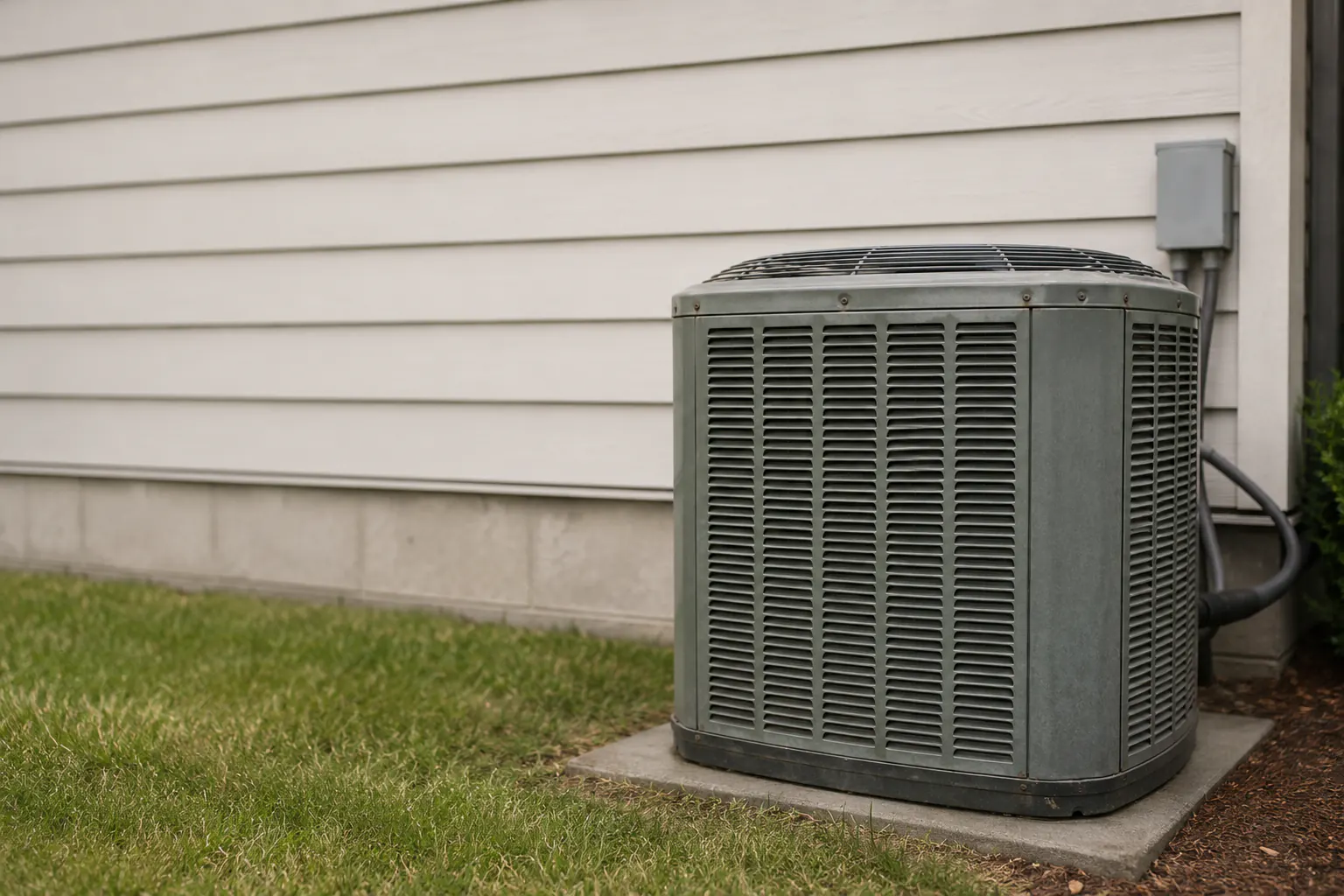
Keep the HVAC decision grounded in evidence
A repair or replacement decision is a qualified-project sequence, not a universal age rule or an online product choice.
Start with the service visit
Ask a qualified professional for a written diagnosis, repair scope, and whether operation is allowed. Help comes before paperwork.
Bring the records you have
Use existing invoices, manuals, bills, and ordinary observations. Leave missing details as questions for the professional.
Choose a documented path
Compare complete repair and replacement scopes only after the important unknowns have an owner and evidence.
Begin with a written diagnosis
Ask the service professional to identify:
- the failed or degraded component;
- observations and measurements supporting the diagnosis;
- immediate safety status;
- repair scope and parts availability;
- other known defects or deferred maintenance;
- whether the fault damaged another component;
- whether operation is allowed before repair;
- repair warranty and expected service impact;
- any recall, manufacturer bulletin, or warranty coverage.
Do not approve a replacement because “the system is old” without a diagnosis. Do not demand operation to prove a fault when the technician has isolated unsafe equipment.
Use the HVAC warning-sign guide to organize symptoms before the visit, but do not convert household observations into a technical diagnosis.
Use age as context, not a verdict
ENERGY STAR says an air conditioner or heat pump more than ten years old, or equipment that does not keep the home comfortable, merits professional evaluation. It also identifies frequent repairs, rising bills, uneven rooms, humidity problems, excessive dust, and noise as reasons to consider system improvement or replacement. (Source: ENERGY STAR, When is it time to replace?.)
Those indicators do not create an expiration date. A younger system can have a poor installation or major failure. An older system can still have a reasonable repair if it is safe, supported, correctly sized, and otherwise performing well.
Record age with:
- installation and commissioning records;
- repair and maintenance history;
- parts and refrigerant availability;
- warranty status;
- measured energy use under comparable weather;
- comfort and humidity pattern;
- current condition of ducts, envelope, electrical service, drainage, and controls.
Use records and observations available from a safe position. Leave unknown condition, model, or refrigerant details for the technician; do not open a cabinet, climb, or move equipment to fill a blank. Do not restart or run faulty equipment to collect comparison data.
Compare the complete repair cost
The repair column should include:
- diagnosis and labor;
- parts, refrigerant, permits, and disposal as applicable;
- related component work required for a valid repair;
- warranty on parts and labor;
- expected downtime and temporary climate plan;
- any known near-term maintenance or second repair;
- effect on existing equipment and system warranty;
- efficiency and comfort expected after repair;
- service availability for the remaining system.
Do not assume a repair returns the system to new condition. Ask what it restores and what remains unchanged.
Compare the complete replacement project
The replacement column is much larger than equipment price:
- room-by-room or whole-home load calculation;
- matched indoor and outdoor equipment;
- duct evaluation or ductless zone design;
- electrical service, circuit, disconnect, grounding, and surge scope;
- fuel, venting, combustion, or heat-pump backup integration;
- refrigerant, line set, condensate, drainage, and commissioning;
- structural mounting, penetrations, weather sealing, and exterior location;
- thermostat, controls, communication, and accessibility;
- permits, inspections, removal, disposal, and cleanup;
- installer labor, warranty, maintenance, and local service;
- temporary heat or cooling during installation;
- training, manuals, model/serial records, and closeout results.
ENERGY STAR warns that improper installation can reduce system efficiency by up to 30 percent and says sizing, airflow, refrigerant charge, and ducts are core installation issues. (Sources: ENERGY STAR, Heat & Cool Efficiently and HVAC Quality Installation.) A high-efficiency label cannot correct poor design or commissioning.
Fix the building problem before buying around it
Uneven rooms, long cycles, high bills, moisture, and discomfort can involve air leakage, insulation, solar gain, ducts, airflow, thermostat location, occupancy, or equipment. ENERGY STAR recommends addressing major air leaks and duct problems before investing in new HVAC because they can be the real source of poor performance.
Use:
- the DIY energy audit to organize bills and visible waste;
- the weatherization priorities guide for envelope sequencing;
- the home weatherproofing hub for building-envelope boundaries;
- a qualified load calculation for actual replacement sizing.
Ask the appropriate professional to investigate moisture, duct, or envelope defects before treating a larger system as the answer. Organizing observations is not permission to inspect hazardous or inaccessible parts of the building.
Ask about refrigerant without attempting service
Older equipment may use a refrigerant with changing supply, cost, or service implications. EPA says the equipment nameplate or manual can identify refrigerant and explains that there is no universal “drop-in” replacement for HCFC-22. Refrigerant conversion can require system changes, and covered work belongs with Section 608-certified technicians. (Source: EPA, Homeowners and Consumers FAQ.)
Ask each contractor:
- what refrigerant the current and proposed equipment use;
- whether the repair requires leak repair, recovery, recharge, or conversion;
- whether parts and refrigerant are locally supportable;
- what federal handling rules and technician certifications apply;
- how future service and end-of-life recovery will work;
- whether a proposed indoor/outdoor combination is officially matched.
Never buy, add, vent, mix, or substitute refrigerant based on an online chart.
Compare comfort and indoor-air outcomes
Write the current problem in observable terms:
- room temperatures and time pattern;
- humidity trend and condensation;
- noise and vibration location;
- airflow differences;
- filter loading and indoor particle concern;
- smoke, allergen, or ventilation need;
- accessibility and control limitations.
Ask how repair or replacement changes each item. A new system is not automatically an air-quality solution. EPA emphasizes source control and ventilation with clean outdoor air, with filtration as a supplement. (Source: EPA, Guide to Air Cleaners in the Home.) The HVAC filter guide and smoke-specific air purifier guide keep those claims bounded. Record only ordinary observations; do not create smoke, repeat a fault, or interrupt essential equipment to test a proposal.
Compare energy with normalized evidence
One high bill can reflect weather, rates, occupancy, a new appliance, or a billing period. Compare monthly energy use, not only dollars, across similar seasons and record major household changes.
Ask proposals to show:
- the efficiency metric applicable to the equipment type;
- rated performance at local design conditions;
- load and runtime assumptions behind savings estimates;
- utility rate assumptions;
- whether ducts, backup heat, defrost, auxiliary loads, or controls are included;
- what portion of any estimate is a national average rather than a home-specific calculation.
Do not treat a percentage from a label or national program as a guaranteed household saving.
Add resilience to the comparison
Replacement is an opportunity to document how the home behaves when HVAC is unavailable. Ask:
- What electricity does the system need for heating, cooling, controls, and accessories?
- Can it restart automatically, and what is the approved post-outage process?
- What surge-protection design is compatible?
- How does low-temperature heat-pump capacity affect backup heat?
- What parts of the system depend on internet, app, or cloud service?
- What local service and replacement parts are available during peak events?
- What is the safe household plan during outage or repair downtime?
Do not choose a central HVAC system based on a claim that a portable power station can run it. Use the backup power planning hub and a qualified electrical design for any intended backup connection.
Compare contractors on the same evidence
ENERGY STAR recommends verifying state license and insurance requirements, obtaining referrals and references, expecting a home evaluation, comparing written itemized estimates, and getting the proposal in writing. It specifically warns that bigger is not always better. (Source: ENERGY STAR, 10 Tips for Hiring a Heating and Cooling Contractor.)
Give every bidder the same problem statement and request:
- diagnosis and option set;
- load calculation and design assumptions;
- exact matched model numbers;
- complete scope, exclusions, and responsible trades;
- permits, inspections, and commissioning;
- timeline and temporary climate plan;
- labor, parts, equipment, and workmanship warranties;
- maintenance requirements and service response;
- payment schedule and change-order process;
- proof of current license, insurance, refrigerant certification, and references where applicable.
Avoid a bid that cannot explain its sizing, leaves critical work to an unnamed third party, or promises a universal savings figure.
Use a decision table
Safety is a stop condition, not something to trade against price. Any unresolved combustion, electrical, fire, refrigerant, structural, contamination, or recall issue needs the appropriate professional or emergency response before this comparison can continue.
Once the safety questions are resolved, put both written proposals alongside this table:
| Decision area | Repair evidence | Replacement evidence |
|---|---|---|
| Diagnosed fault | Written scope and measurements | Why replacement solves the documented fault |
| Safety | Conditions for safe return | Code, permits, commissioning, matched system |
| Cost | Full repair and known follow-on work | Complete installed project and exclusions |
| Comfort | Expected change and unchanged limits | Load, zones, airflow, humidity, sound |
| Energy | Normalized current trend | Assumptions and applicable ratings |
| Service | Parts, refrigerant, warranty | Installer, parts, warranty, maintenance |
| Resilience | Downtime and restart plan | Outage, surge, backup, controls, cold/heat plan |
Choose only after the important unknowns have owners and evidence.
Sources reviewed
ReadyLience reviewed current HVAC replacement, installation, contractor, refrigerant, and recall guidance from ENERGY STAR, the U.S. Environmental Protection Agency, and the U.S. Consumer Product Safety Commission on July 14, 2026. This research-based comparison does not diagnose a system or predict its remaining life; local diagnosis, code, permits, incentives, warranties, product availability, and written contractor proposals control the actual decision.
On October 3, 2026, I rechecked ENERGY STAR’s When is it time to replace? for the age and comfort indicators above, and EPA’s Guide to Air Cleaners in the Home for the source-control, ventilation, and filtration distinction. This was a focused source check, not a new inspection of household equipment or a product test.
The narrow maintenance example was checked on October 13, 2026 against Resideo’s F100 professional guide (68-0239EF-14) and media-cleaner quick guide (33-00240EF-05). Both identify FC100A1029 for the F100 16-by-25 size. The cartridge is not a proposal for system replacement, a universal fit claim or evidence that the diagnosed fault has been repaired.