
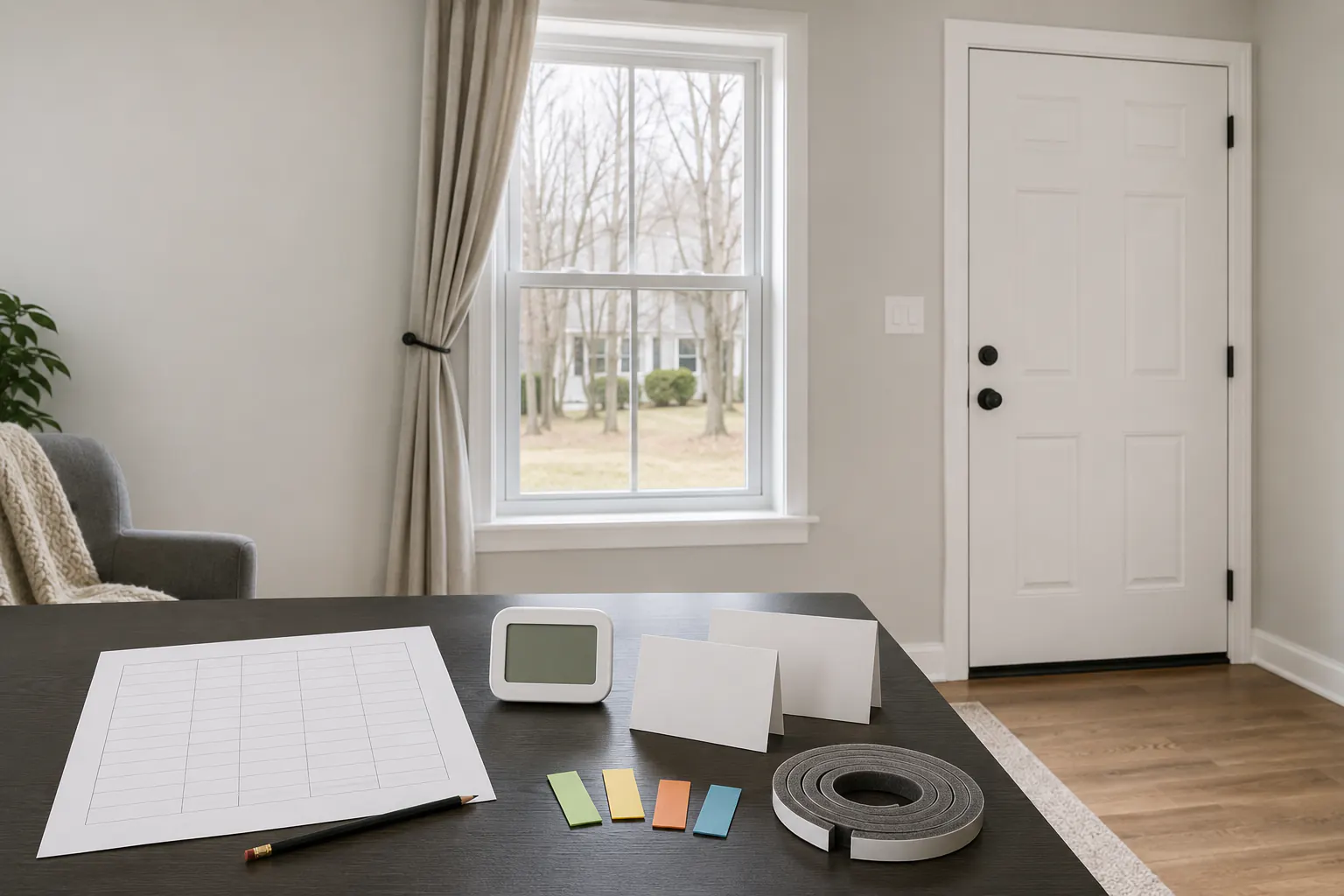
Start with one problem you can describe: a draft at an intact door, recurring condensation, or a stain after rain. Do not seal it yet. Water, failed opening operation, gas or CO concerns, and uncertain ventilation need the appropriate help before comfort work; an authorized removable seal is only an option for a suitable dry, normally operating opening.
My renovation background includes my apartment, my wife’s professional office, and my parents’ home. It is household experience, not an energy-auditor, HVAC, remediation, or building-science qualification. Building-wide work needs the responsible owner and qualified professionals, not a larger version of a door-seal project.
Start with the symptom rather than the product
| What you notice | First decision |
|---|---|
| A cold or hot air path near a door or window | Record it in the room-by-room draft audit |
| A door has a visible perimeter gap but closes and latches normally | Use the egress-safe weatherstripping guide |
| A window needs a reversible seasonal layer | Compare temporary window insulation for heat and cold |
| Water stain, swelling, soft material, peeling finish, or musty odor | Use the early water-intrusion warning guide before sealing |
| Repeated window or wall condensation | Record timing with the condensation-or-leak framework |
| Dampness or growth keeps returning | Build a source-first household moisture plan |
| Stormwater collects beside the foundation or an opening | Use the pre-storm drainage inspection from stable ground |
| A room is hard to heat or cool | Compare causes before using the weatherproofing-kit framework |
| Gas odor, CO alarm, soot, backdrafting, or combustion concern | Leave, call the appropriate emergency or utility contact, and do not weatherize |
The same symptom can have several causes. A cold window area may be air leakage, cold glass, missing insulation, HVAC imbalance, or normal radiant heat exchange. A brown mark may be a roof leak, plumbing leak, window entry, condensation, or an old repaired event. Product-first repair hides that uncertainty.
Protect life safety before comfort
USFA advises households to include all doors and windows in a fire escape plan, identify two ways out of each room where possible, and keep exits unblocked. Every weatherization measure must preserve that plan.
Do not add film, tape, a draft blocker, storm panel, curtain, threshold, sweep, security device, or furniture arrangement that:
- prevents an exit door from opening, closing, latching, or unlocking normally;
- increases the force, dexterity, reach, or vision needed for escape;
- covers an operable bedroom escape window or hides its release;
- interferes with a fire door, rated assembly, sprinkler, detector, or building alarm;
- creates a trip edge at a threshold or narrows an accessible route;
- blocks a required vent, transfer grille, combustion-air opening, exhaust, or drain;
- traps a cord, portable heater, battery, or heat-producing appliance against fabric or foam.
After any reversible change, every resident who may use the opening should be able to operate it under normal conditions. Restore the opening immediately if it binds, fails to latch, or makes the escape route less reliable.
Treat air, heat, liquid water, and vapor as different problems
Four forms of movement are easy to collapse into the word “leak”:
- Air leakage moves through cracks under pressure differences and can carry heat, moisture, smoke, and pollutants.
- Heat flow moves through materials even when there is no obvious draft. Insulation and glazing affect this path.
- Liquid water follows gravity, wind pressure, capillary paths, flashing defects, drainage failures, and plumbing routes.
- Water vapor moves with air and through materials, then can condense when a surface is cold enough.
DOE explains that air sealing and insulation interact with moisture control and that the correct strategy depends on climate and construction. EPA likewise warns that energy upgrades can harm indoor air quality when assessment, moisture control, ventilation, or combustion safety is ignored. To decide which of these projects pays back first, see weatherization priorities for energy savings, which ranks sealing and insulation work by cost and return.
This is why a tube of caulk is not a universal answer. Caulking a visible interior crack may not repair exterior flashing. Adding impermeable material can slow drying. Covering a damp surface can conceal change without removing the water source.
Build a baseline before changing anything
Create a dated record during ordinary weather and again during a useful contrast such as a windy day, cold morning, hot afternoon, or steady rain. Stay inside or on stable ground.
For each room, record:
- indoor temperature and relative humidity from one identified instrument;
- outdoor conditions and whether sun, wind, rain, or snow is affecting that side;
- door and window operation, latch condition, visible gaps, movement, and damaged seals;
- staining, paint failure, swelling, corrosion, odor, dampness, or condensation;
- supply and return grilles, exhaust fans, transfer paths, and any combustion equipment;
- which openings are part of the household fire escape plan;
- renter, condominium, historic-property, warranty, and permit restrictions;
- photos from the same safe position with a simple location label.
Do not use candles, incense, smoke, flame, depressurization, or unguarded fans to hunt for leaks. Do not remove outlet covers, trim, siding, insulation, drywall, access panels, or appliance covers. A qualified energy assessment can use controlled instruments and evaluate the whole building instead of turning one room into an experiment.
Rank work by consequence
A practical queue is more useful than a shopping list.
Stop conditions
Fire, gas odor, CO alarm, electrical hazard, active flooding, structural movement, broken glass, sewage, chemical contamination, significant mold, or an unsafe exit takes priority over weatherization. Leave or isolate the area as directed and use qualified help.
Water source and drying
Active liquid water and wet materials come before insulation or cosmetic sealing. Document the event, stop the source through an approved normal control if it is safe, protect people and electricity, and begin the appropriate drying or professional response. The plumbing emergency hub covers supply-water boundaries; storm and envelope entry may require a building-envelope professional.
Operation and escape
Correct a binding, damaged, or inaccessible door or window through the responsible owner or qualified trade before adding resistance. A seal cannot compensate for a failed frame, latch, hinge, sill, flashing system, or drainage path.
Small reversible comfort measures
Only after those checks should a household consider removable weatherstripping, manufacturer-approved window inserts, seasonal coverings, or draft management. Reversible does not mean consequence-free: adhesives can damage finishes, foam can trap moisture, and film can obstruct an exit.
Building-envelope work
Attics, crawlspaces, concealed cavities, roofs, exterior walls, vapor-control layers, whole-house air sealing, combustion zones, and major insulation changes require climate- and assembly-specific design. They are not scaled-up versions of a door-seal project.
Preserve ventilation and combustion safety
DOE recommends reducing uncontrolled leakage while providing controlled ventilation as needed. A tighter home still produces moisture and pollutants from people, cooking, bathing, cleaning, hobbies, stored products, pets, and combustion.
Before broad air sealing, identify:
- all fuel-burning appliances, fireplaces, chimneys, flues, and combustion-air provisions;
- kitchen, bathroom, dryer, and other exhaust paths;
- whole-house or balanced ventilation equipment;
- attached-garage and crawlspace boundaries;
- known radon system and test history;
- smoke and carbon monoxide alarm locations and current test instructions;
- any room where condensation, odor, stuffiness, or moisture already occurs.
Do not conduct a homemade pressure test or alter appliance operation to locate drafts. A qualified assessor can coordinate envelope testing with combustion safety and ventilation evaluation. If a CO alarm sounds or anyone has possible CO symptoms, move to fresh air and call 911 according to the alarm and emergency guidance; do not search for a leak.
Plan for seasonal reversals
Weatherproofing must work across changing conditions. Winter air sealing can reduce cold drafts, while summer shading may matter more than another layer of interior film. During wildfire smoke, uncontrolled leakage matters, but a very tight room can still overheat. During a power outage, mechanical ventilation, dehumidification, or sump equipment may stop.
Record which measure depends on:
- grid power or batteries;
- a dehumidifier, exhaust fan, HVAC system, or sump pump;
- a resident opening or removing it each season;
- outdoor air being cooler, drier, or cleaner than indoor air;
- access to an exit, window, valve, panel, alarm, or maintenance point.
The extreme-heat hub and winter-storm hub place the envelope inside a full household plan rather than treating it as active heating or cooling.
Give renters a permission-first route
Renters should document drafts, water, condensation, damaged seals, and operating problems with dates and photos, then use the lease and written maintenance process. Do not drill, remove trim, alter a rated corridor door, seal a shared ventilation path, change a window required for escape, or apply permanent adhesive without authority.
Ask the property manager to identify:
- which doors and windows are required exits or fire-rated assemblies;
- who owns weatherstripping, glazing, screens, flashing, gutters, and drainage;
- which removable products are permitted and how residue or damage is handled;
- the emergency moisture and after-hours reporting process;
- how ventilation, heating, cooling, and humidity are intended to operate.
Keep every report, response, photo, receipt, and permission together. That record supports maintenance and prevents the next resident from inheriting an unexplained layer over a recurring defect.
Review outcomes rather than promises
After a change, compare the same location under similar conditions. Confirm that the opening still operates, the surface remains dry, indoor humidity has not worsened, ventilation paths are intact, and no new odor, condensation, noise, pressure effect, or finish damage appears.
Do not claim an energy saving from touch, comfort, or one utility bill. Weather, rates, occupancy, thermostat settings, equipment, and behavior all change consumption. A documented assessment and normalized data are needed for a defensible performance claim.
Sources reviewed
- U.S. Department of Energy: Air Sealing Your Home; Detecting Air Leaks; Moisture Control
- U.S. Environmental Protection Agency: Indoor Environmental Concerns During Remodeling
- U.S. Fire Administration: Home Fire Escape Plans
Sources reviewed July 14, 2026. Current emergency services, utility and appliance instructions, property authority, local code and permits, climate-specific building guidance, and qualified building, HVAC, environmental, and remediation professionals control actual work.