
Report new or recurring water around a window or door before trying to seal it. Keep people away if water is near electricity, glass is unstable, or a wall or ceiling is changing shape. Use emergency help for immediate danger; otherwise start with the landlord, building manager or appropriate qualified professional.
Rain, condensation and plumbing can wet the same area, and water can travel behind finishes before appearing. Your useful role is to describe what you noticed from a safe, dry position, not diagnose the nearest joint.
Start with observation, not caulk. A cosmetic seal can trap water, block a drainage path, hide progression, or move the visible symptom without repairing the source.
Leave the area for urgent conditions
Call 911 or the appropriate emergency authority for collapse risk, fire, arcing, severe injury, or immediate danger. Do not approach or touch the opening when there is:
- water reaching a receptacle, switch, cord, appliance, panel, light, or electrical equipment;
- a sagging ceiling, bulging wall, moving frame, falling material, or cracking that is changing;
- loose, cracked, bowed, or wind-damaged glass;
- rapid flooding, rising water, exterior floodwater, sewage, fuel, or unknown contamination;
- a gas odor, carbon monoxide alarm, smoke, or damaged utility service;
- storm conditions that make the window, door, balcony, roof, yard, or exterior unsafe.
Move people away, close an interior door if safe and appropriate, and follow emergency, utility, and building instructions. Do not reach through water to unplug equipment or operate a panel. The electrical safety hub explains the stop boundary.
Recognize the early changes
One mark is not a diagnosis, but repeated or changing evidence deserves a record.
At the glass and sash
- droplets or a wet line that appears during or after rain rather than ordinary cold-weather condensation;
- water between glazing layers or fog that does not wipe from either accessible surface;
- loose gasket, cracked sealant, failed glazing compound, damaged corner, or shifted sash;
- corrosion, mineral deposit, darkened wood, peeling finish, or recurring debris trail;
- water entering around a window-mounted appliance or its side panels.
At the sill and threshold
- staining that expands after wind-driven rain;
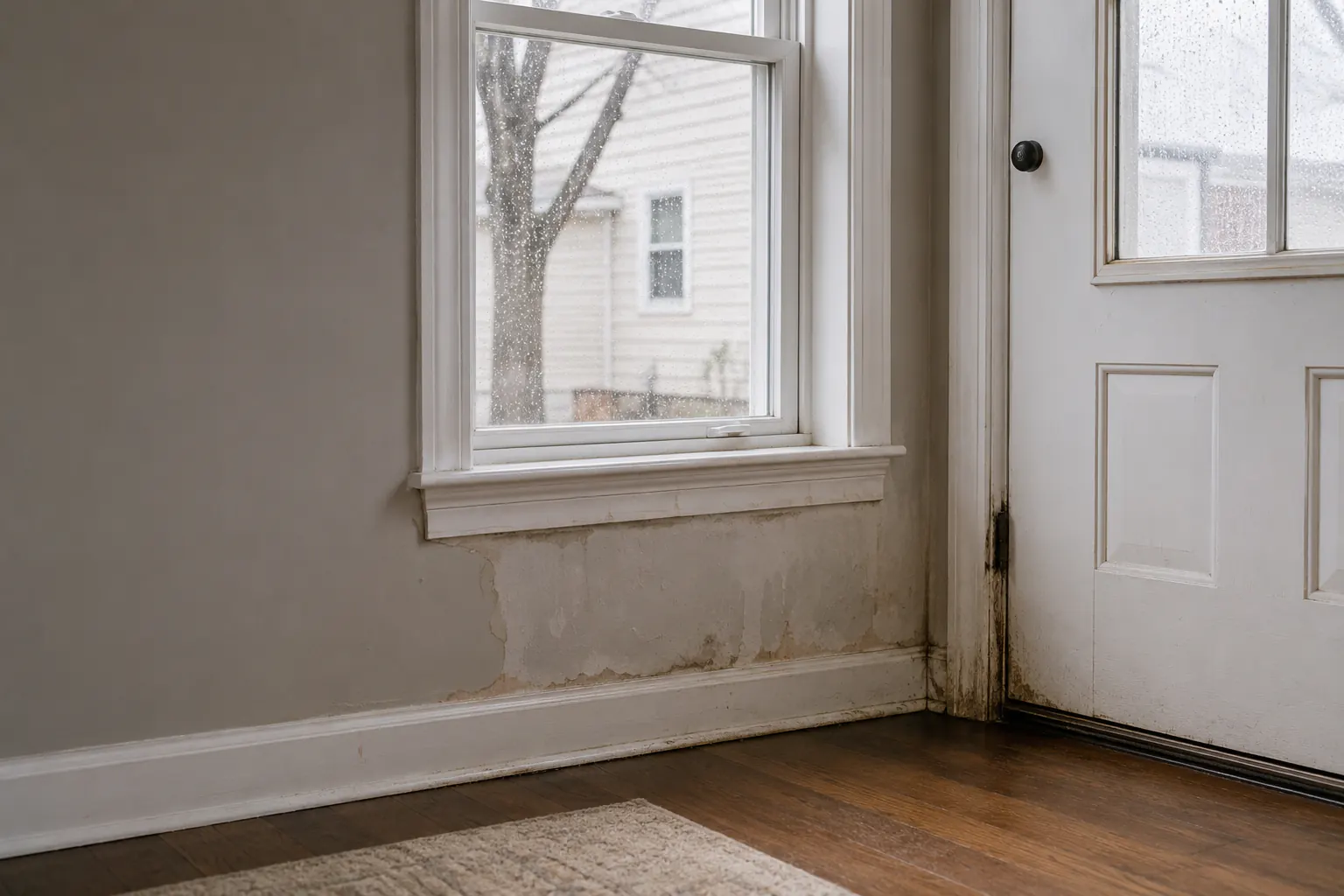
- swelling, soft material, lifted finish, delamination, rust, or a musty odor;
- water that pools rather than following the opening’s intended exterior drainage;
- blocked, damaged, or altered weep features visible from the occupied side;
- repeated wetness beneath a removable insert, film, curtain, mat, or draft blocker.
At the trim and adjacent wall
- hairline finish cracks that widen or return after repair;
- paint bubbling, peeling, powdering, or changing color;
- dampness, soft drywall, loose trim, staining, or odor above or beside the opening;
- a mark below an upper-story opening, roof edge, balcony, facade joint, or exterior penetration;
- visible growth or repeated condensation beyond the glass surface.
At the exterior from stable ground
- missing or displaced flashing, sealant, siding, trim, roof edge, or storm component;
- gutter overflow, disconnected downspout, blocked drain, ponding, or runoff toward the building;
- damaged screen, shutter, awning, window well cover, or door canopy;
- soil washout, splash marks, foundation wetting, or debris line.
Do not use binocular observations to declare a roof or facade safe. Do not climb for a closer look during or after a storm.
Distinguish clues from conclusions
| Observation | Possible routes | What it does not prove |
|---|---|---|
| Water at lower window corner during wind-driven rain | glazing, sash, frame joint, flashing, wall path | that the nearest visible joint needs caulk |
| Wet interior sill on cold mornings | condensation, air leakage, indoor humidity, glazing temperature | that rain entered |
| Stain above an opening | roof, wall, pipe, upper window, prior event | the exact source location |
| Soft trim below a door | threshold, flashing, drainage, splashback, plumbing, cleaning water | that trim replacement alone is enough |
| Musty odor with no visible water | hidden moisture, HVAC, contents, prior event | mold species, extent, or source |
| Fog between panes | glazing-unit seal condition | active wall leakage or indoor humidity alone |
Use the condensation-or-leak framework to organize timing and conditions. Avoid sampling or destructive searching.
Document the event safely
Make the required report first. From a dry, stable occupied position, add whatever information is readily available:
- Record date, time, rain intensity, wind direction, temperature, and recent snow or freeze-thaw conditions.
- Note whether the mark appeared during rain, after rain, during indoor humidity, or after an appliance or plumbing use.
- Photograph the full wall and then the local detail without touching unstable material.
- Place a dated paper reference beside, not over, the stain when the surface is dry and safe.
- Record indoor temperature and relative humidity with an identified instrument.
- Note nearby electrical equipment, plumbing, HVAC, facade, balcony, roof, and upper-unit context.
- Preserve previous photos, maintenance requests, repairs, invoices, and weather alerts.
- Keep a copy of the report and any instructions from the owner, insurer, building manager or qualified professional.
Photos and readings are optional support, not a reason to delay help. Do not draw on the wet surface, press a meter into damaged material, pierce a wall, remove trim, or open a cavity. Consumer moisture readings vary with material, depth, salts, temperature, contact, and calibration; a number without a method and baseline is not a source diagnosis.
Limit temporary protection
During an active event, life safety and evacuation instructions control. If the area is dry enough to approach and the responsible authority allows it, move vulnerable belongings away from the symptom without touching damaged structure or electricity. Use a stable container to catch a slow clean-water drip only when it cannot overflow, create a trip, add weight to a damaged surface, or delay professional response.
Do not:
- climb outside, lean through an opening, or work from a ladder in wind or rain;
- tape plastic across a required exit or ventilation opening;
- drill a ceiling or wall to release trapped water;
- puncture a bulge;
- apply roof cement, spray foam, caulk, expanding sealant, or waterproof coating during active entry;
- aim a fan through suspected mold, contaminated water, or damaged electrical areas;
- use a portable heater, hair dryer, or open flame to dry material.
The goal is to avoid additional exposure while qualified help determines source, extent, and drying method.
Preserve drainage paths
Windows, doors, walls, roofs, and foundations often include intentional layers and drainage routes. Weep holes, flashing laps, sill pans, cladding cavities, window wells, gutters, downspouts, swales, drains, and flood openings perform different jobs.
DOE and EPA moisture guidance emphasize managing liquid water, drainage, air movement, temperature, and vapor together. FEMA guidance tells homeowners and renters to observe runoff and maintain drainage while recognizing that structural cracks, grading, flood openings, and building alterations may require permits and qualified design.
Do not seal, fill, tape, paint, or screen an unfamiliar opening. Do not redirect downspouts or runoff onto a neighboring property, public way, slope, foundation, or sewer without current authority and a property-specific plan.
Use rain timing to narrow the question
A qualified investigator benefits from patterns such as:
- only during wind from one direction;
- only after prolonged rain rather than the first shower;
- immediately when a gutter overflows;
- during snow melt or freeze-thaw;
- after an upper balcony, roof, or facade receives water;
- independent of weather but associated with plumbing or HVAC use;
- on cold clear mornings with high indoor humidity;
- after a previous seal or window replacement.
These patterns guide inspection; they do not authorize a repair. Water can travel behind finishes and emerge far from entry.
Escalate recurring and concealed evidence
Use a qualified building-envelope, window, roofing, plumbing, structural, electrical, restoration, or remediation professional as the evidence requires. Ask the scope to identify:
- likely source and alternative sources;
- extent of wet materials and concealed cavities;
- electrical, structural, contamination, and occupant hazards;
- drying and monitoring plan;
- compatibility of flashing, sealant, drainage, air, vapor, and insulation layers;
- permit, warranty, lease, association, and insurance requirements;
- objective completion evidence and follow-up conditions.
For a rental or shared building, report immediately through the emergency maintenance process and keep copies. Do not enter another unit, roof, facade, utility room, or locked space to trace the route.
Prevent mold by controlling water
EPA states that moisture control is the key to mold control and emphasizes prompt drying, commonly within 24 to 48 hours where conditions and material allow. That time target is not permission to enter an unsafe area, energize wet equipment, or conduct contaminated cleanup.
The household moisture-control guide separates small routine condensation from extensive, contaminated, concealed, HVAC, or health-sensitive conditions. Painting or caulking over growth does not remove the water source.
Review after repair
Keep before, work-in-progress, and completion records. During later comparable weather, inspect the same safe positions for new staining, odor, swelling, condensation, drainage, operation, and indoor humidity. Confirm that the door or window still opens, closes, locks, and serves its exit role.
Do not describe a repair as successful only because the surface was painted or one storm was dry. Source control, dry materials, intact operation, and no recurrence under relevant conditions are stronger evidence.
The weatherproofing hub keeps water control ahead of draft products and insulation. A dry assembly is a prerequisite, not a cosmetic finish.
Sources reviewed
- U.S. Department of Energy: Moisture Control
- U.S. Environmental Protection Agency: Moisture Control Guidance; A Brief Guide to Mold, Moisture and Your Home
- Federal Emergency Management Agency: Urban Flooding Guidance for Homeowners and Renters
- Ready.gov: Floods
Sources reviewed July 14, 2026. Current emergency instructions, property authority, weather conditions, permits, insurance requirements, and qualified building-envelope, electrical, structural, plumbing, restoration, and remediation professionals control actual response.