
For moisture you have noticed, start with where it appears and when it returns. If there is water near electricity, unstable material, flooding or an unknown source, keep away and contact the responsible authority or qualified professional before investigating.
Condensation and leaks can wet the same surface, and more than one source may be involved. A short observation can help the investigator: a wet sill after rain, for example, or droplets on glass on cold mornings. It is a clue, not a diagnosis or permission to open the wall.
Stop for hazards before observing
Leave or isolate the area and use emergency or qualified help for:
- water touching or approaching electrical equipment, wiring, receptacles, lights, cords, or appliances;
- a sagging ceiling, bulging wall, moving frame, soft floor, falling finish, or structural cracking;
- active flooding, rising water, sewage, fuel, chemicals, or unknown contamination;
- gas odor, carbon monoxide alarm, smoke, fire, arcing, or burning odor;
- unstable glass, storm-damaged facade, roof hazards, or inaccessible heights;
- severe respiratory symptoms, fainting, confusion, chest pain, or another medical emergency;
- extensive visible growth, strong persistent odor, or suspected HVAC contamination.
Do not touch a wet switch or operate a panel from a wet area. Do not puncture a bulge or stand beneath it. A rapid source and structural response matters more than identifying whether the first droplet was condensation.
Understand the moisture routes
DOE describes several ways moisture moves in a building:
- liquid water through leaks, drainage failures, capillary paths, and flooding;
- water vapor carried rapidly by moving air through gaps and cavities;
- slower vapor diffusion through materials;
- condensation when air reaches a cold enough surface;
- moisture generated by occupants, cooking, bathing, drying, plants, and equipment.
Insulation, air sealing, temperature, ventilation, drainage, and vapor-control layers interact. A measure that helps one climate or assembly can create trouble in another. This is why a surface photograph cannot specify a vapor barrier or concealed repair.
Build a timing record
Timing can help without opening material. Start with the pattern you actually noticed; the table is a menu of useful questions, not a form you must complete before reporting the problem.
| Moisture appears | Questions to record |
|---|---|
| During wind-driven rain | Which wall faces the wind; when did it begin; is runoff or a gutter overflowing |
| Hours after rain | How long did rain last; are roof, balcony, facade, or upper openings above the mark |
| On cold clear mornings | Indoor humidity; surface location; curtains or inserts; room temperature; overnight occupancy |
| During showers or cooking | Exhaust operation; door position; indoor humidity; nearby cold surfaces |
| When HVAC runs | Cooling, heating, or dehumidification mode; drain history; filter and service status; exact location |
| After plumbing or appliance use | Fixture or appliance used; duration; upper or neighboring unit context |
| During snow melt or freeze-thaw | Roof edge, wall, window, foundation, pipe, and outdoor temperature history |
| Without a clear event | Prior incidents, concealed source, groundwater, humidity, vacancy, or intermittent equipment |
Record observations; do not run appliances repeatedly to reproduce a leak. Do not create high humidity, spray water, block drainage, or use a hose test.
Map location and pattern
From a dry stable position, note:
- exact room and surface;
- whether moisture is on the room-facing surface, between glazing, behind a removable covering, or emerging from a joint;
- high, low, corner, center, or linear pattern;
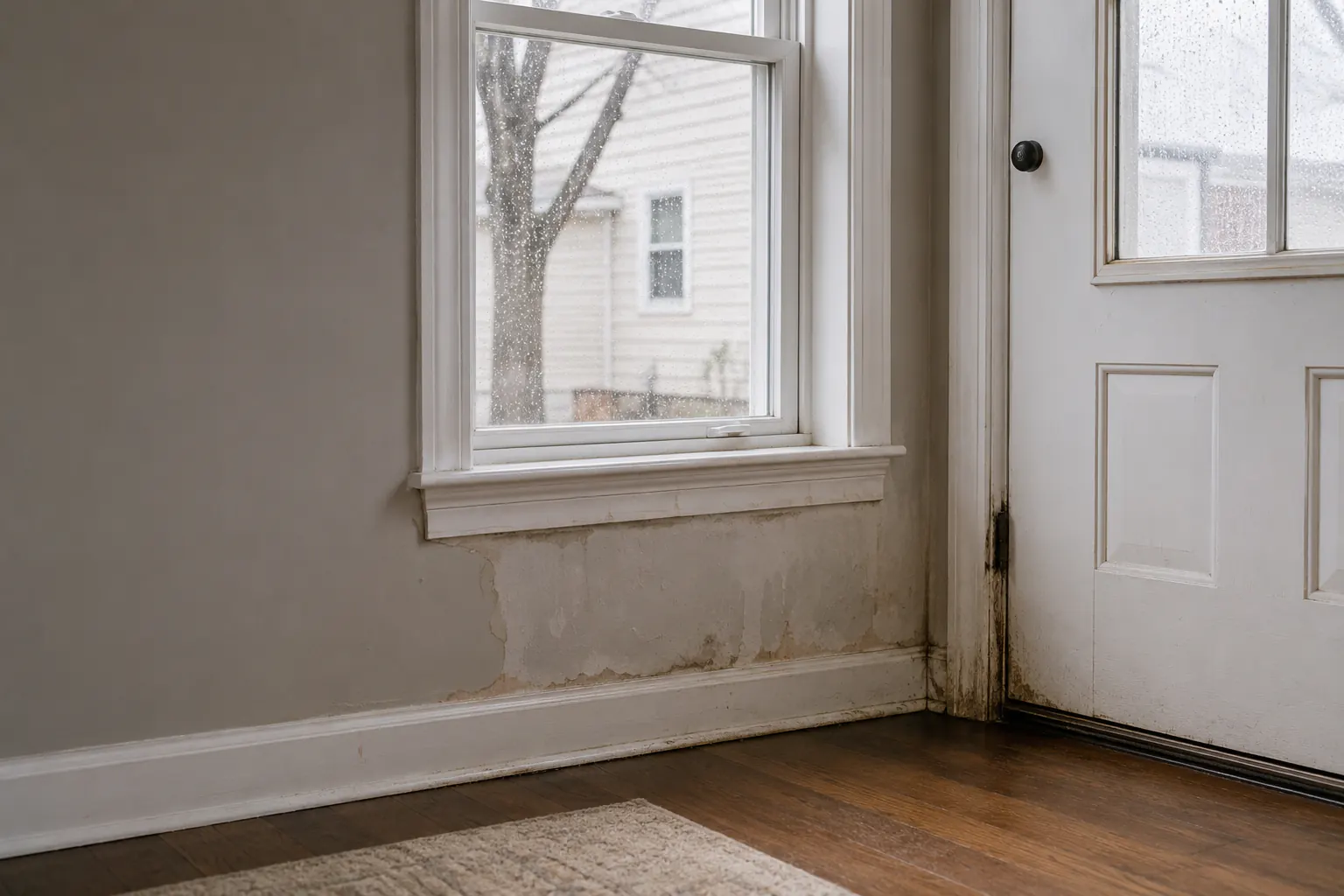
- droplets, diffuse dampness, ring stain, tide line, mineral deposit, rust, swelling, peeling, soft material, or odor;
- nearby plumbing, HVAC, exterior opening, roof, balcony, foundation, or neighboring unit;
- surface temperature only if measured without touching unsafe or damaged material;
- indoor temperature and relative humidity from an identified instrument;
- outdoor temperature, rain, wind, snow, and sun.
Use wide and detail photographs from the same position. Do not push on drywall, lift flooring, remove baseboards, open an HVAC cabinet, or peel a covering from a damaged surface.
Look for condensation patterns
Condensation becomes more plausible when moisture:
- forms broadly on a cold exposed surface rather than emerging from one joint;
- tracks cold mornings, high indoor humidity, bathing, cooking, or many occupants;
- appears behind a closed curtain or on cold metal and glass;
- reduces when indoor moisture generation drops and intended ventilation operates;
- affects several similar cold surfaces under the same conditions.
These clues are not proof. Air leakage can deliver moist air into one cold cavity, and rain or glazing failure can coexist with interior condensation.
If the area is otherwise safe and the water is ordinary surface condensation, dry it promptly with a clean absorbent material, protect the floor, and use intended kitchen, bathroom, or whole-house ventilation according to current instructions. Do not open windows when outdoor air is smoky, dangerously hot or cold, more humid, or unsafe.
Look for liquid-entry patterns
A leak or drainage route becomes more plausible when moisture:
- begins during or after rain, wind, snow melt, plumbing use, or HVAC operation;
- grows from a joint, penetration, ceiling, wall edge, sill, cabinet, or floor;
- leaves a directional trail, ring, mineral residue, or repeated localized stain;
- continues when indoor humidity is moderate;
- affects material away from an exposed cold surface;
- changes after exterior damage, window work, roof work, plumbing work, or a freeze;
- appears in more than one floor or unit along a possible vertical path.
Do not assume the source is directly above. Water can follow framing, fasteners, membranes, pipes, and sloped surfaces. The window-and-door intrusion guide and hidden plumbing leak guide provide source-specific documentation routes.
Use humidity readings carefully
Relative humidity depends on temperature. The same amount of water vapor produces a different relative humidity as air warms or cools. A single reading from a bathroom after a shower or beside cold glass does not represent the whole home.
If a gauge is already available and safe to use, these details make readings more useful:
- use one identified gauge and let it stabilize away from direct sun, vents, wet surfaces, and exterior doors;
- record room temperature with relative humidity;
- compare the same location and time over several days;
- note cooking, bathing, laundry, occupancy, humidifier, dehumidifier, and ventilation operation;
- compare with outdoor conditions;
- retire a damaged, recalled, or implausible instrument.
EPA commonly advises keeping indoor humidity below 60 percent and ideally around 30 to 50 percent where practical. That range is a general moisture-control reference, not a guarantee against condensation or a substitute for climate-, building-, health-, and equipment-specific guidance.
Avoid misleading moisture tests
Consumer pin and pinless meters can respond to material type, density, depth, salts, metal, temperature, contact, calibration, and reference conditions. Infrared cameras show surface temperature patterns, not water itself. Mold test kits do not locate the water source or define a safe cleanup.
Do not:
- drive pins into a wall, floor, wire, pipe, membrane, or suspect hazardous material;
- use a meter on energized, wet, contaminated, or unstable material;
- interpret color alone as mold species or moisture source;
- drill inspection holes or remove trim to validate a consumer reading;
- rely on one number without a dry comparison and documented method;
- buy sampling as a substitute for fixing visible moisture.
EPA emphasizes finding and correcting the moisture problem. A qualified investigation can select instruments and interpret them for the specific assembly.
Reduce normal moisture without hiding a leak
When no stop condition is present, use intended controls:
- operate kitchen and bathroom exhaust according to the equipment and building instructions;
- vent clothes dryers to the approved exterior route and report blocked or damaged exhaust;
- keep HVAC condensate and dehumidifier systems maintained by the responsible party;
- avoid uncontrolled humidifier use and follow cleaning instructions;
- keep furniture and stored contents from trapping dampness against known cold or wet surfaces where practical;
- dry small clean-water spills promptly;
- maintain safe indoor temperature and follow heat, cold, and air-quality guidance.
Do not seal a room, block a vent, overheat a surface, or run electrical drying equipment in a wet or contaminated area. Do not use ozone generators or mix cleaning chemicals.
Escalate by consequence and recurrence
Seek qualified investigation when moisture is recurring, concealed, widespread, affecting insulation or structure, near electricity, associated with HVAC, from contaminated water, or affecting a person with health concerns. For renters and shared buildings, use the written emergency maintenance process and preserve every report.
Ask the investigator to document:
- observed source evidence and remaining alternatives;
- affected materials and hidden extent;
- electrical, structural, contamination, and occupant controls;
- drying goal, monitoring method, and completion evidence;
- repair interaction with drainage, flashing, air sealing, insulation, vapor control, and ventilation;
- follow-up conditions and responsibility.
The moisture-control guide explains why cleanup without source control is incomplete.
Verify over relevant conditions
After repair or a ventilation change, compare the same location during similar weather and use. Confirm that material is dry by the documented method, odor and visible change do not recur, indoor humidity remains appropriate, ventilation works as intended, and doors or windows still operate safely.
Do not call a problem resolved because paint covered the mark, a dehumidifier lowered one reading, or dry weather followed the work. Keep the record through the next relevant rain, cold spell, cooling season, or appliance cycle.
The weatherproofing hub keeps diagnosis ahead of product choice. The safest seal is sometimes no seal until the water path is understood.
Sources reviewed
- U.S. Department of Energy: Moisture Control
- U.S. Environmental Protection Agency: A Brief Guide to Mold, Moisture and Your Home; Finding Mold and Moisture; Protect Indoor Air Quality in Your Home
- Centers for Disease Control and Prevention: Mold and Health
Sources reviewed July 14, 2026. Current emergency services, clinicians, property authority, weather, code, and qualified building-envelope, HVAC, plumbing, electrical, structural, restoration, and remediation professionals control actual response.