
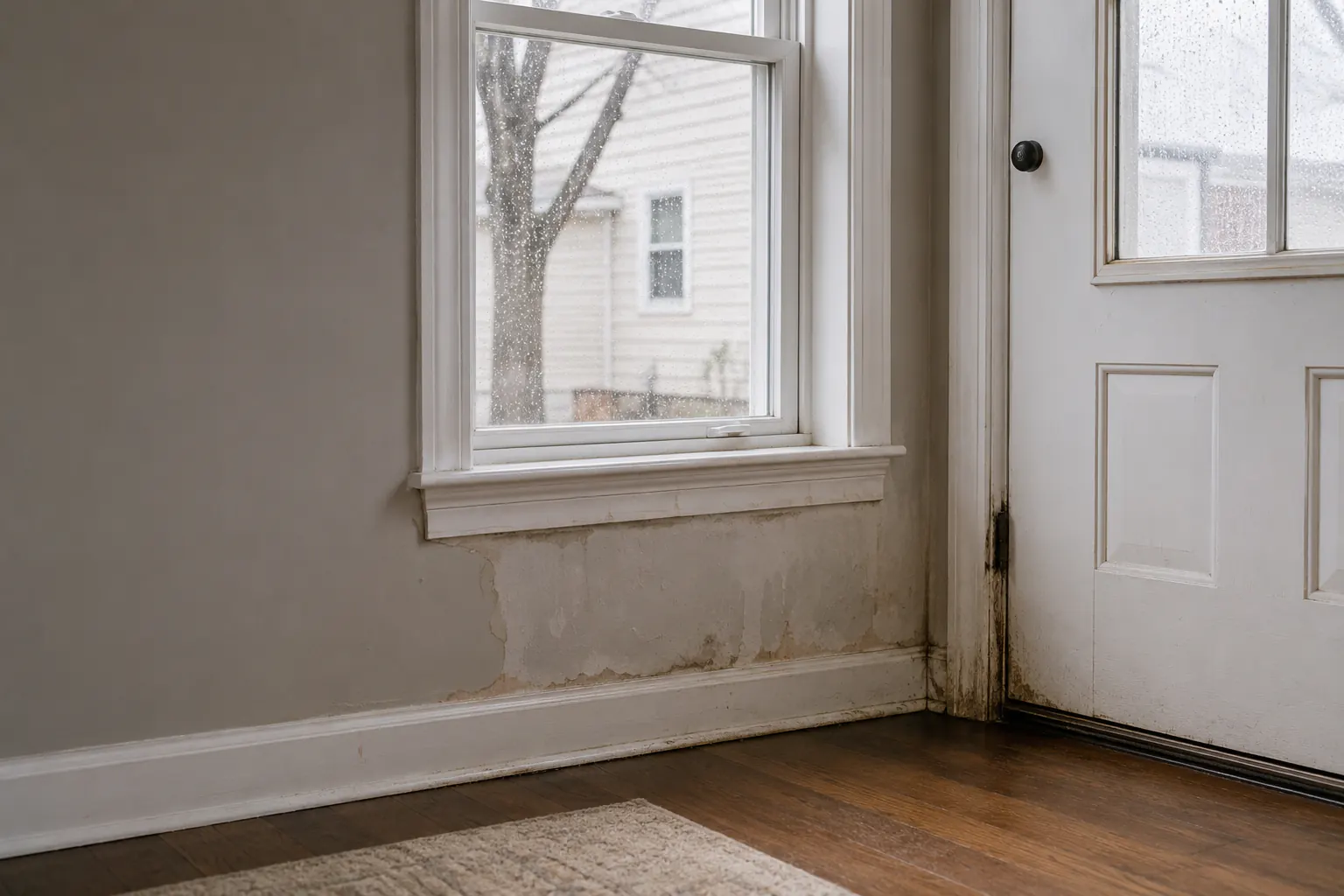
Start with the damp spot that keeps returning. Report a leak or failed exhaust to the responsible property owner or qualified professional; do not cover it with paint or another storage bin. For an ordinary clean-water spill on a safe, intact surface, prompt drying matters. Floodwater, sewage, electricity, hidden damage or mold changes the scope and may require professional help.
EPA’s central rule is moisture control. A spray, fragrance or test kit cannot replace fixing the water source, appropriate cleanup and complete drying. The aim is to stop persistent dampness, not make indoor air sterile.
Leave cleanup for urgent and complex conditions
Do not begin household cleaning when there is:
- sewage, floodwater, fuel, pesticide, chemical, or unknown contamination;
- water near electrical equipment, wiring, appliances, panels, outlets, or lights;
- fire damage, unstable structure, sagging material, falling debris, or broken glass;
- extensive, recurring, or concealed growth;
- suspected HVAC contamination or growth near an intake;
- damaged insulation, large porous assemblies, wall cavities, ceilings, crawlspaces, or inaccessible areas;
- suspected asbestos, lead-painted material, hazardous dust, or disaster residue;
- a resident with health concerns who needs clinical guidance before exposure;
- symptoms requiring urgent medical care.
Call 911 for immediate danger or severe symptoms. Use the responsible property authority and qualified remediation, building, HVAC, plumbing, electrical, structural, environmental, and health professionals for the actual scope.
EPA notes that a small area, often described as less than about 10 square feet, may in many cases be handled by an occupant under its current guidance. That number is not a universal permission. Water category, material, recurrence, hidden extent, HVAC involvement, health, PPE, property rules, and the ability to fix the source can all make a smaller area unsuitable for household work.
Control the source before the surface
Common moisture sources include:
- plumbing, appliance, roof, window, door, facade, foundation, or neighboring-unit leaks;
- rain, snow melt, groundwater, floodwater, and drainage failures;
- cooking, bathing, laundry, humidifiers, occupants, plants, and stored wet items;
- blocked or failed exhaust, HVAC condensate, dehumidifier, or dryer systems;
- cold surfaces, thermal bridges, air leakage, and unsuitable insulation or vapor-control details;
- wet materials that were covered, stored, or enclosed before drying.
Use the condensation-or-leak guide to record timing without destructive investigation. Use the plumbing emergency hub for supply-water boundaries and the water-intrusion guide for rain around openings.
Painting, caulking, or placing a panel over growth does not fix the source. A dehumidifier can reduce room humidity while a concealed leak continues. Cleaning without drying allows recurrence.
Build a moisture inventory
Check the problem location first. A seasonal look at other normally accessible areas can help, especially after storms, leaks, plumbing work or a long vacancy. Use the table to choose what applies, not to postpone an active repair:
| Zone | Normal source to manage | Warning evidence |
|---|---|---|
| Kitchen | cooking vapor, sink and appliance water | cabinet swelling, recurring odor, wet supply or drain area |
| Bathroom | shower vapor, supply and drain water | failed exhaust, persistent condensation, soft finishes |
| Laundry | washer hoses and drain, dryer exhaust | dampness, lint, blocked exhaust, floor change |
| Windows and doors | cold surfaces, rain, air leakage | repeated condensation, stains, swelling, peeling |
| Basement or crawlspace boundary | ground and foundation moisture | odor, efflorescence, standing water, material decay |
| Attic and top floor | roof entry, indoor air leakage, cold surfaces | ceiling stain, frost history, musty odor, insulation concern |
| HVAC and plumbing equipment | condensate, drains, pans, supply water | overflow, corrosion, blocked line, recurring wetness |
| Stored contents | trapped dampness and poor airflow | damp cardboard, textiles, furniture, odor |
Observe only normally accessible, stable, dry areas. Do not enter a crawlspace, walk an attic, climb a roof, remove a grille, or open equipment for this inventory.
Use humidity as a trend
EPA commonly recommends keeping indoor relative humidity below 60 percent and ideally around 30 to 50 percent where practical. Climate, temperature, health, building design, and equipment still matter.
For a useful trend:
- use an identified gauge in a representative location away from direct sun, vents, wet surfaces, and exterior doors;
- record temperature with relative humidity;
- allow the instrument to stabilize;
- compare the same place and time across several days;
- note cooking, bathing, laundry, humidifier, dehumidifier, HVAC, and outdoor conditions;
- compare problem rooms with a normal room rather than treating one reading as a diagnosis.
Retire damaged, recalled, corroded, or implausible instruments. A low-cost gauge can support a pattern; it does not certify an assembly as dry or identify concealed mold.
Maintain intended ventilation
Source control and ventilation work together. Use kitchen, bathroom, laundry, and whole-house ventilation according to current equipment and building instructions. Report an exhaust that is weak, noisy, blocked, recirculating unexpectedly, or discharging moisture into an attic, wall, corridor, or other unsuitable area.
Do not block supply, return, transfer, combustion-air, dryer, or required ventilation openings to stop a draft. Do not add a stronger fan or depressurize a home with fuel-burning appliances without qualified assessment. Air sealing can change pressure and indoor pollutant behavior.
During wildfire smoke, extreme heat, severe cold, and outages, outdoor-air decisions require event-specific guidance. The best moisture action is not always opening a window. Coordinate air quality, temperature, security, and power continuity.
Dry clean water promptly and safely
EPA and CDC commonly emphasize drying wet materials within 24 to 48 hours where conditions allow. Treat that as an urgency signal, not permission to enter a hazard.
For a small ordinary clean-water spill on an intact safe surface:
- Stop the source through a normal approved control.
- Keep electricity and vulnerable occupants away.
- Remove movable dry contents from contact with the wet area.
- Absorb and contain water using methods suitable for the material.
- Use intended ventilation or dehumidification only when electrical and contamination conditions are safe.
- Record the event and recheck for odor, staining, swelling, and recurrence.
Do not use fans after visible growth has begun if airflow could spread material. Do not aim portable heaters or hair dryers at wet assemblies. Do not energize wet equipment. Porous material, insulation, cavities, flooring systems, and contaminated water require material-specific decisions.
Avoid product shortcuts
Bleach, biocide, antimicrobial paint, ozone, fragrance, fogging, and consumer sampling are often marketed as complete answers. They do not replace source control, physical cleanup where appropriate, drying, material decisions, and verification.
Never mix cleaning products. The cleaning-products warning explains toxic-gas and exposure boundaries. Follow current EPA, CDC, product, property, and local waste guidance for any permitted small cleanup.
Do not use a mold test result to declare a home safe, identify health effects, or postpone visible moisture repair. EPA generally emphasizes that visible mold and moisture call for action rather than routine sampling.
Protect vulnerable residents
People with asthma, allergies, chronic lung disease, immune suppression, or other health concerns may need clinician guidance and should not perform or remain in cleanup. Children, older adults, pregnant people, pets, and people who cannot use PPE or exit independently also need an exposure and relocation plan.
Confirm the immediate care, access or relocation need first. Keep useful contact details privately if they help:
- clinician and medication continuity contacts;
- an alternate room or temporary location with safe temperature and air;
- accessible transport and support;
- which person communicates with property management and contractors;
- how the affected area will remain isolated without blocking an exit or required ventilation.
Do not create an improvised containment that traps a resident, blocks alarms, or uses a fan to move contaminated air through the home.
Give renters a documented route
Report moisture and growth promptly using the lease and emergency maintenance process. Include date, location, weather or activity context, wide and detail photos, odor or symptom report without medical diagnosis, and any prior event.
Ask in writing:
- how the source will be identified and stopped;
- which materials are wet and how extent will be assessed;
- whether electricity, HVAC, structure, or contaminated water is involved;
- what drying and remediation standard will be used;
- where residents should stay during work;
- what completion evidence and follow-up inspection will be provided.
Do not remove landlord property, open walls, sample growth, or apply permanent coatings without authority.
Verify that control persists
A completed response should address source, affected material, drying, cleaning or removal scope, ventilation, and recurrence monitoring. Keep records through the next comparable rain, cold spell, cooling season, appliance cycle, or occupancy pattern.
Reopen the issue for returning odor, staining, swelling, condensation, visible growth, high humidity, HVAC symptoms, or occupant health concerns. The weatherproofing hub keeps moisture control ahead of insulation and finish work.
Sources reviewed
- U.S. Environmental Protection Agency: A Brief Guide to Mold, Moisture and Your Home; Mold Cleanup in Your Home; Moisture Control Is the Key to Mold Control
- Centers for Disease Control and Prevention: Mold Cleanup and Health Guidance
- U.S. Environmental Protection Agency: Indoor Environmental Concerns During Remodeling
Sources reviewed July 14, 2026. Current clinicians, emergency services, property authority, local health and waste rules, and qualified remediation, HVAC, building, plumbing, electrical, structural, and environmental professionals control actual response.