
Before buying a weatherproofing kit, name one problem at one opening. A draft, direct sun, rain entry and condensation need different responses. Start with what you already have and what the property permits; a leak or operating defect needs investigation rather than another roll of tape.
Compare only materials that preserve escape, drainage, ventilation, combustion air, hardware and drying. The most useful kit may be a single approved item, or no purchase at all.
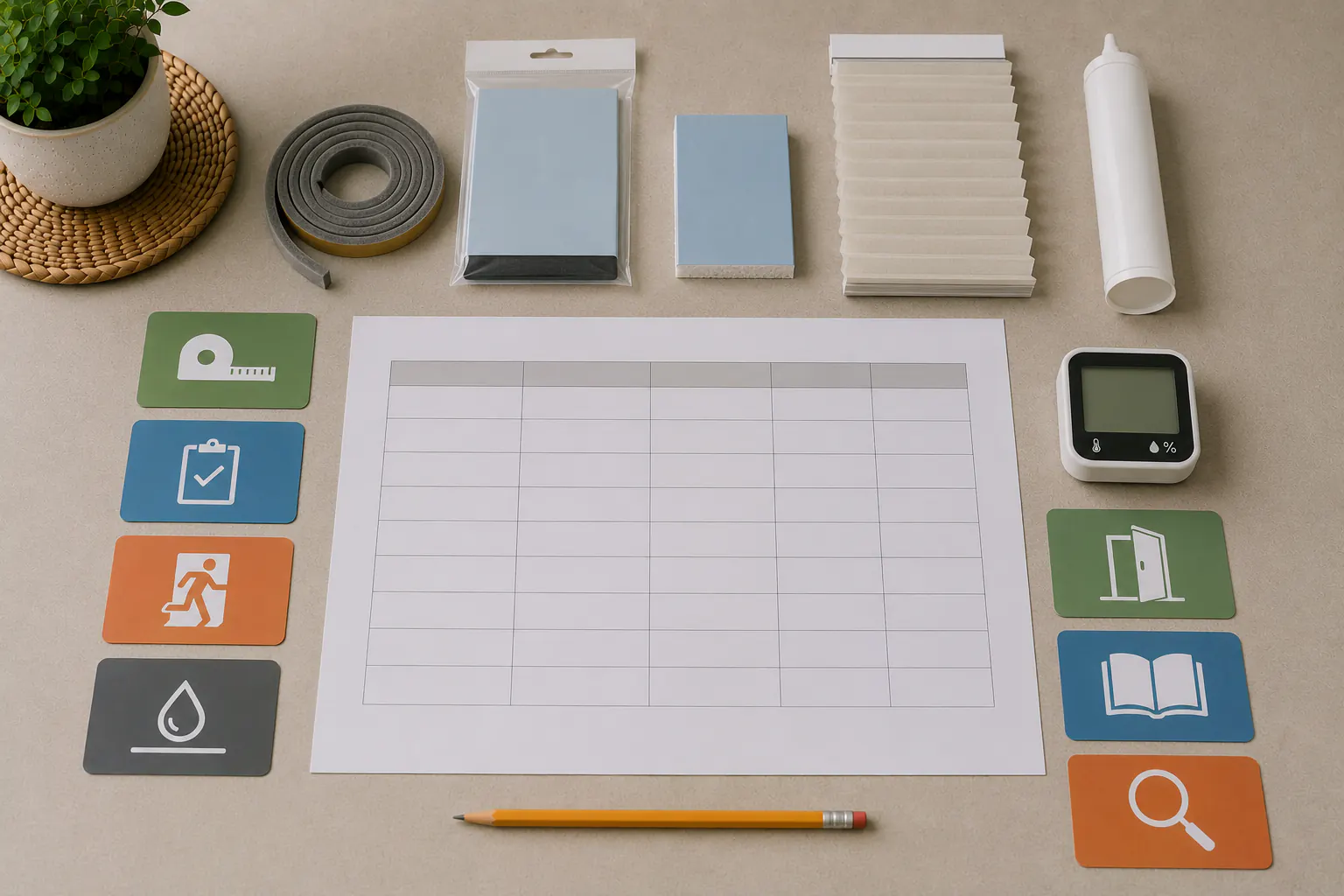
This is a research-based comparison of categories, not a tested product ranking. No exact model or universal winner is recommended.
Diagnose before comparing
Complete the room-by-room draft audit. Exclude any location with:
- active or recurring water, condensation, mold, swelling, rot, corrosion, or soft material;
- failed door or window operation, unstable glass, frame movement, or structural damage;
- electrical, combustion, HVAC, dryer, or utility involvement;
- a required exit, rated assembly, ventilation path, drainage feature, or unknown opening;
- lead, asbestos, hazardous dust, or contaminated material;
- lease, association, warranty, historic, or permit restrictions.
A shopping comparison cannot resolve those conditions. Use the responsible owner or qualified professional first.
Compare categories rather than bundles
| Category | Best-defined use | Evidence to require | Main exclusion |
|---|---|---|---|
| Removable compressible weatherstrip | Dry, intact moving door or window joint | exact gap range, surface, temperature, friction, durability, instructions | binding, failed latch, rated door, required undercut |
| Door sweep or bottom seal | Compatible ordinary door with safe clearance | door direction, floor, threshold, accessibility, attachment, drainage | trip edge, drag, fire door, ventilation path |
| Interior shrink-film system | Compatible intact fixed or non-egress opening | glazing and finish compatibility, release, temperature, installation method | escape window, condensation, damaged glass |
| Removable rigid insert | Repeated seasonal use on compatible opening | size, retention, weight, edge safety, storage, fast release | glass loading, child hazard, tool-required egress |
| Shade or insulated curtain | Adjustable solar and radiant control | dimensions, mounting, cord safety, fire and heater clearance | trapped moisture, blocked exit, glazing heat concern |
| Caulk or sealant | Authorized stationary dry joint with known movement and drainage role | chemistry, joint range, substrate, primer, cure, paint, UV, cleanup | moving joint, wet surface, weep, vent, unknown opening |
| Humidity gauge | Trend monitoring in a defined room | range, accuracy statement, calibration or check method, display, battery | source diagnosis or dry-assembly certification |
| Consumer thermal imager | Surface-temperature pattern documentation | resolution, temperature range, emissivity limits, method | claiming moisture, insulation, or electrical safety from color |
Do not buy a kit merely because every piece is individually familiar. The bundle may combine incompatible depths, adhesives, surfaces, or seasonal roles.
Require exact fit data
For weatherstripping, record:
- opening type and moving surfaces;
- gap width and variation at several safe points;
- compression range rather than uncompressed thickness alone;
- indoor or outdoor exposure;
- operating temperature and moisture exposure;
- friction, foot traffic, pets, children, and cleaning;
- surface material and finish;
- expected removal and replacement process.
DOE says weatherstripping should seal while allowing the door or window to operate freely. Reject a product that does not publish a usable gap range or makes compatibility depend on vague words such as “universal.”
For caulk, require the intended joint and substrate, movement capability, gap limits, backer requirements, cure conditions, paint compatibility, ventilation and PPE instructions, storage, and disposal. Caulk is for stationary joints; it is not a substitute for flashing, drainage, weatherstripping, or structural repair.
Score reversibility honestly
“Renter friendly” is not a technical property. Evaluate:
- whether written property permission is required;
- whether adhesive can lift paint, veneer, wallpaper, finish, or old glazing compound;
- whether fasteners, holes, scraping, solvents, or heat are needed;
- whether removal leaves residue or exposes a previously covered defect;
- whether the product can be removed instantly from an escape opening;
- who pays for damage and how the condition is documented.
Test only on an authorized, intact, dry, inconspicuous area according to instructions. Do not test on pre-1978 paint, suspect asbestos, damp material, historic finishes, or a rated assembly without the appropriate authority.
Treat exit operation as a pass or fail gate
No score can compensate for failed egress. After any permitted product, the door or window must open, close, latch, lock, unlock, and release normally for every intended user. Check mobility aids, reach, grip, darkness, and where a removable insert goes during escape.
Reject any system that:
- requires a tool, key, code, hidden release, or unusual sequence where not allowed;
- increases opening force or needs slamming;
- covers locks, handles, labels, sensors, or alarm contacts;
- creates a threshold trip edge;
- tangles, falls, shatters, or leaves a sharp panel in the route;
- blocks a bedroom window or a second way out.
Use the door weatherstripping guide and temporary window guide before purchasing those categories.
Evaluate moisture behavior
A tight-looking product can create a concealed cold surface or trap water. Require a monitoring plan:
- can the glass, sill, threshold, and frame remain visible;
- can the product be removed for inspection without damage;
- does it preserve weeps and drainage;
- what happens during condensation, wind-driven rain, or a leak;
- can the material dry before storage;
- does the adhesive tolerate the real humidity and temperature;
- what condition requires immediate removal.
Do not purchase an impermeable covering to hide an unresolved stain or odor. Use the condensation-or-leak guide and moisture-control guide.
Read insulation claims correctly
R-value describes resistance to conductive heat flow under defined conditions; it is not a whole-room comfort, air-leakage, moisture, or savings guarantee. The FTC R-value rule governs certain insulation claims and disclosures. Thin films, reflective products, curtains, inserts, and foam pieces may be marketed with values that depend on an assembly or air space.
Require the seller to state:
- whether the claim is a material R-value or total assembly value;
- tested thickness and test method;
- required air spaces, orientation, temperature, and installation;
- coverage and seams;
- exclusions for compression, moisture, gaps, and thermal bridging.
Do not add the R-values of unrelated marketing claims or assume a window accessory performs like wall or attic insulation.
Verify safety and recall evidence
Use the exact manufacturer, model, lot, and date to check current CPSC recalls. A missing recall does not prove quality or suitability. For products making fire, smoke, chemical, child-safety, or certification claims, verify the exact mark, standard, scope, and model through the issuing body rather than relying on a marketplace image.
Reject:
- fabricated certification logos;
- unlabeled chemicals or repackaged sealants;
- missing safety data and installation instructions;
- vague “fireproof,” “non-toxic,” or “mold-proof” claims;
- products requiring prohibited use around heat, glass, wiring, or combustion;
- reviews that confuse ease of installation with measured performance.
Keep purchase records and packaging until fit, operation, finish compatibility, and seasonal behavior are confirmed.
Separate renter and owner kits
Renter planning kit
A renter’s useful baseline is documentation, a humidity gauge, removable paper labels, approved cleaning materials for intact surfaces, and property-authorized removable seals or coverings. It includes the maintenance contact and written permission, not a drill, spray foam, or permanent caulk.
Homeowner maintenance kit
A homeowner may add substrate-compatible removable weatherstrip and an approved stationary-joint sealant only where the assembly, drainage, ventilation, combustion, code, and warranty roles are understood. Whole-house sealing, insulation, attics, crawlspaces, roofs, exterior heights, and concealed cavities still require appropriate assessment.
Emergency seasonal kit
Pre-fit and label only products already proven compatible. A storm warning or outage is not the time to drill panels, discover an adhesive damages paint, cover an exit, or cure caulk in unsuitable weather.
What a useful product comparison should show
Look for evidence that matches your opening and intended use:
- representative substrates and documented gap sizes;
- controlled temperature, humidity, pressure, and repeatable air-leak measurement;
- door and window operating-force checks before and after;
- latch, lock, egress, accessibility, drainage, and condensation assessment;
- adhesive removal and finish-damage evaluation;
- weathering, compression recovery, abrasion, and cycle testing;
- exact model, lot, dimensions, storage, and installation records;
- recall and claim verification;
- qualified review for building, fire, accessibility, moisture, and combustion boundaries.
An easy installation video or a star rating cannot supply those missing details. Keep the property and safety decision separate from a seller’s product claims.
Build the purchase record
For an item you decide to use, keep its instructions and any required permission. Add other details when useful:
- opening and location;
- owner permission;
- exact product, model, lot, and dimensions;
- compatibility and claim evidence;
- installation and removal instructions;
- inspection date and replacement trigger;
- before and after operation photos;
- moisture, finish, and egress check.
The weatherproofing hub keeps the product behind the building decision. Recheck operation, moisture and removability after permitted work; buying a kit does not establish that those conditions are resolved.
Sources reviewed
- U.S. Department of Energy: Weatherstripping; Caulking; Energy Saver, 2022, Windows; Insulation and Air-Sealing Products and Services
- Federal Trade Commission: R-Value Rule
- U.S. Consumer Product Safety Commission: Recalls
Original sources reviewed July 14, 2026. DOE’s accessible 2022 Energy Saver windows section was checked October 8, 2026 after the older window-coverings page became unavailable. Current product instructions, exact claims and recalls, property authority, local code, and qualified building, fire, accessibility, HVAC, combustion, insulation, and environmental professionals control actual selection and use.