
Choose one window before choosing a film or curtain. Check whether anyone needs it for escape or ventilation, whether it opens normally, and whether the frame is dry and intact. If its role or condition is uncertain, ask the property manager or qualified window professional before covering it.
Temporary insulation may reduce a draft or manage sunlight. It cannot make a dangerously hot or cold home safe, repair failed glazing or flashing, or replace an evacuation and backup-power plan. Match any permitted measure to the season, glazing instructions and property rules.
A winter film that covers an operable sash may be unacceptable on a bedroom escape window. A heavy curtain that helps on a cold night can trap condensation against glass. A dark summer covering placed against sunlit glass can add heat or stress an assembly if the window manufacturer prohibits it. Begin with the opening, not the product.
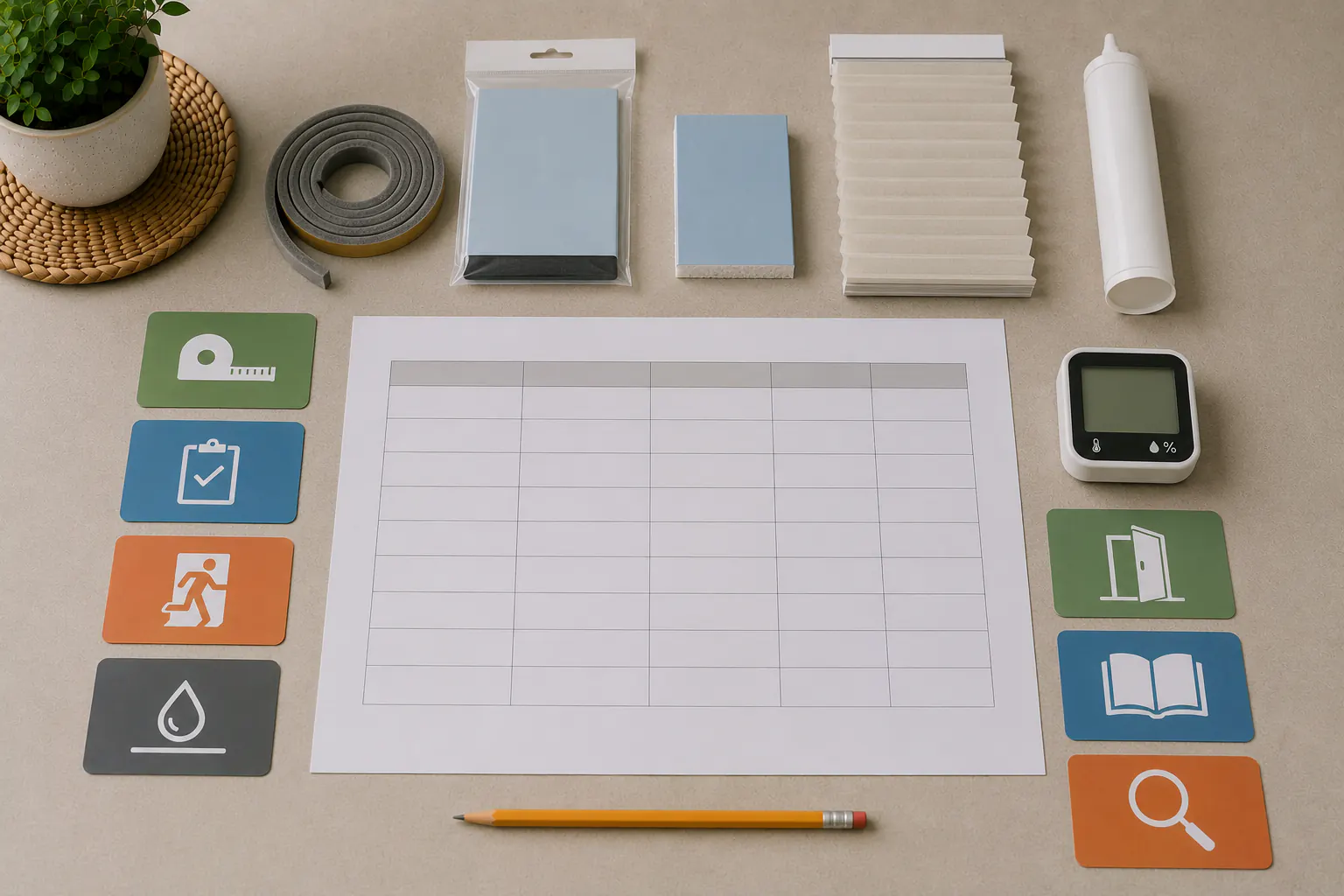
Exclude unsafe windows first
Do not add film, an insert, a curtain, shade, panel, foam, or tape when:
- the window is a required or planned emergency escape or rescue opening and the measure delays operation;
- glass is cracked, loose, bowed, hot, damaged, or unstable;
- the sash falls, binds, is painted shut, will not lock, or has failed balances or hardware;
- water enters around the frame, sill, wall, air conditioner, or glazing;
- trim is swollen, soft, delaminated, stained, moldy, or structurally loose;
- the opening contains a window air conditioner, exhaust, intake, combustion provision, alarm device, or required ventilation path;
- access requires leaning outside, a ladder, roof, fire escape, or unstable furniture;
- the product would disturb old paint, glazing compound, unknown sealant, asbestos-containing material, or a historic assembly;
- the lease, condominium, warranty, or building rule does not permit it.
Report operation, glass, water, and frame defects before covering them. A temporary layer can hide change and complicate inspection.
Identify what the window must still do
USFA recommends including doors and windows in the household fire escape plan and keeping them unblocked. Mark every window as one or more of the following:
- primary or secondary emergency escape opening;
- rescue or firefighter-signaling location;
- normal ventilation opening;
- fixed glazing with no operating role;
- daylight source important for safe movement during an outage;
- child fall-prevention or security-controlled opening;
- location for a window-mounted cooling or ventilation appliance.
Do not assume another window is an equivalent exit. Height, opening size, exterior landing, security hardware, mobility, and building plan all matter. Current local fire and building authority controls the actual requirement.
Define the seasonal objective
Different products solve different parts of the problem.
| Objective | Category to evaluate | Main limitation |
|---|---|---|
| Reduce a perimeter draft | Repair or replace authorized weatherstripping; removable interior film system | Does not fix water entry or failed operation |
| Slow winter heat loss | Interior film, fitted removable insert, insulated shade, cellular shade, or curtain | Can obstruct egress or trap condensation |
| Reduce direct summer sun | Exterior shading where professionally safe, reflective system approved for the glazing, shade, blind, or curtain | Interior layers may already be inside the heat path |
| Preserve night ventilation | Operable insect screen and removable covering arrangement | Outdoor air must be cooler and safe to bring inside |
| Improve smoke-event control | Better-fitting opening plus approved filtration and cooling plan | Tightening alone does not clean air and can increase heat risk |
| Protect during an outage | Passive shade or insulation that needs no power | Does not replace safe heating, cooling, or relocation |
DOE’s 2022 Energy Saver guide separates cold-weather and warm-weather window measures. Orientation, season, climate, operation, fit, and user behavior affect the result. A single label such as “thermal” does not prove a specific room outcome.
Record the baseline
Use the draft-audit checklist before installation. A short note can start with the window, the problem and its escape role. Add useful details as available:
- window location and sun orientation;
- escape, ventilation, and rescue role;
- normal opening, closing, locking, and support;
- indoor temperature and relative humidity;
- outdoor temperature, sun, wind, rain, and air quality;
- draft location without flame, smoke, or depressurization;
- condensation timing and location;
- stains, swelling, peeling, odor, or previous repairs;
- current shade, curtain, blind, screen, film, insert, or air conditioner;
- property permission and product compatibility.
If useful, photograph the sill and perimeter from the same safe indoor position. You do not need a full weather log or a new gauge to report a defect or decide not to cover the window.
Compare reversible categories
Interior shrink film
Film can create a still air space and reduce some leakage when installed on an intact dry interior frame. It can also cover an operable sash, attach to fragile finishes, wrinkle, puncture, and hide condensation. Use only a complete product system on a compatible surface and never over an escape window unless current authority and the product arrangement preserve immediate operation.
Do not improvise with construction plastic, packaging film, or high-adhesion tape. Do not heat film near glass, curtains, sensors, cords, or finishes unless the exact instructions authorize the tool, distance, and surface. A resident unable to remove the film instantly should not depend on that window for escape.
Fitted removable inserts
Interior inserts can improve fit without adhering across the whole frame. Verify retention, weight, sharp edges, storage, child access, and how quickly the insert releases. An insert that needs a tool, two hands, unusual reach, or a place to set it down can delay escape.
Do not wedge rigid foam, board, or acrylic into a sash in a way that loads glass, blocks locks, traps water, or prevents signaling and rescue.
Shades and insulated curtains
Shades and curtains can reduce radiant discomfort and manage sunlight while remaining seasonally adjustable. They must stay clear of portable heaters, baseboard heaters, radiators, cooking equipment, candles, cords, and exits. Secure cords and chains according to current child-safety requirements and exact product instructions.
Leave enough airflow to monitor and dry condensation where needed. Open the covering regularly to inspect the glass, sill, frame, and wall. Do not let fabric rest on a wet surface or conceal mold.
Reflective and solar-control products
Summer benefit depends on where solar energy is intercepted. Exterior shading can be effective but may require height, wind-rated attachment, facade permission, and professional installation. Interior reflective products must be compatible with the exact glazing unit; some windows have manufacturer restrictions related to heat buildup or seal stress.
Never use foil, emergency blankets, cardboard, or unknown reflective material pressed against glass as a universal heat-wave fix. It can create glare, condensation, finish damage, poor visibility, and uncertain thermal behavior.
Install without sacrificing operation
For any permitted reversible system:
- Keep the window dry, intact, and normally operable before work.
- Read the complete instructions, glazing limitations, temperature range, and surface requirements.
- Protect the planned escape route and keep another approved exit available.
- Test adhesive or contact material on an authorized inconspicuous area.
- Keep locks, releases, sensors, weep paths, drainage, hardware, and warning labels visible.
- Install in a way that can be removed without a tool when the opening serves escape.
- Recheck opening, closing, locking, and release immediately.
- Record the installation date and seasonal removal plan.
Do not seal around a window air conditioner or vent with an unknown material that can enter the appliance, block condensate drainage, contact electricity, or interfere with manufacturer clearances.
Manage winter moisture
Condensation forms when moist air reaches a sufficiently cold surface. DOE recommends coordinating moisture control, air sealing, insulation, and ventilation for the climate and construction. A covering can warm the room-facing surface, but it can also create a hidden cold pocket where moisture accumulates.
During cold weather:
- inspect behind curtains, shades, film edges, and inserts regularly;
- record indoor relative humidity and outdoor conditions;
- use kitchen and bathroom exhaust as intended and maintain required ventilation;
- dry small clean-water condensation promptly without mixing cleaners;
- stop if water collects, finishes swell, odor appears, or growth is visible;
- investigate recurring moisture before adding another layer.
Use the condensation-or-leak guide rather than assuming all window water is indoor humidity.
Manage summer heat
Shading is preventive, not a treatment for heat illness. Close effective sun-facing coverings before direct sun reaches the glass when the product and room plan allow. Reopen or reconfigure them only when outdoor air is cooler and air quality is acceptable, and when security and fall protection remain safe.
Track actual indoor temperature. The extreme-heat plan sets medical warning signs, fan limitations, cooling-center decisions, outage contingencies, and relocation thresholds. Remove or open a covering if it traps heat, blocks the only safe ventilation path, or makes the room harder to monitor.
During wildfire smoke, outdoor-air decisions depend on current air quality and heat. The wildfire-smoke hub coordinates filtration, cooling, power, and evacuation. A sealed window does not remove particles already indoors.
Test the seasonal exit plan
After installation, every resident who may use the opening should verify normal operation under safe ordinary conditions. Confirm that the product:
- releases immediately without a tool or hidden step;
- does not cover a lock, alarm contact, label, or handle;
- does not fall, shatter, tangle, or create sharp debris when removed;
- leaves a safe place for the panel, insert, or covering during escape;
- does not reduce required opening or accessible reach;
- can be managed during darkness and a power outage.
If the test is not reliable, remove the product. Do not treat a written instruction stored elsewhere as a substitute for usable egress.
Inspect and retire the measure
Check after major temperature swings, wind-driven rain, high humidity, and several weeks of use. Remove the system for adhesive failure, trapped water, mold, odor, glazing stress, finish damage, blocked operation, child hazard, or changing property instructions.
Store reusable inserts dry, labeled by location, and protected from warping and sharp-edge damage. Discard or recycle material according to local rules and the manufacturer. Do not donate a damaged or recalled accessory.
The weatherproofing hub keeps moisture, ventilation, combustion and escape checks ahead of comfort measures. Some permitted products may be removable and suitable for renter energy efficiency improvements; that depends on the exact product, finish and property permission. During a cold emergency, a covering cannot make an unheated home safe indefinitely. The extreme cold and emergency heating hub covers the people-first plan and departure decisions.
Sources reviewed
- U.S. Department of Energy: Energy Saver, 2022, Windows; Update or Replace Windows; Detecting Air Leaks; Moisture Control
- U.S. Fire Administration: Home Fire Escape Plans
- Centers for Disease Control and Prevention: Heat and Health
Original sources reviewed July 14, 2026. DOE’s accessible 2022 Energy Saver windows section was checked October 8, 2026 after the older window-coverings page became unavailable. Current product and window instructions, property authority, fire and building requirements, outdoor conditions, and qualified window, building, HVAC, and health professionals control actual decisions.