
Most energy-efficiency advice quietly assumes you own the building: add attic insulation, seal the rim joist, replace the windows. As a renter, you cannot do those things — and you should not have to. But a large share of household energy waste comes from behavior, standby loads, and small reversible measures that are entirely within your control and travel with you to the next apartment.
Start with permitted changes to nonessential device use and a written report of building problems. Even removable products can damage finishes, interfere with exits, or need approval. Check the lease, building rules, surface compatibility, and instructions before installing anything.
Start by understanding your bill
Even in a rental, the DIY home energy audit checklist is worth an hour. You are looking for the same things — drafts, wasteful devices, heating and cooling habits — but you will act on the subset you can change. Pull your last several bills to see whether heating, cooling, or year-round loads drive your cost. That tells you where to focus.
DOE’s do-it-yourself assessment method applies to renters as much as owners; you simply route structural findings to your landlord instead of fixing them yourself. (Source: U.S. Department of Energy, Do-It-Yourself Home Energy Assessments.)
The renter’s high-value list
1. Cut standby power (biggest free win)
Standby loads are 5% to 10% of residential energy use and cost nothing to reduce. (Source: U.S. Department of Energy, 3 Easy Tips for Reducing Your Standby Power Loads.) This is the single best renter measure because it needs no permission and no permanent change.
Put entertainment and office clusters on power strips you switch off, use smart plugs on lamps and non-critical devices, and unplug the occasional-use appliances. The full method is in the phantom loads and standby power guide. When you move, the strips and plugs come with you.
2. Reversible draft sealing
You can address air leaks without permanent alterations:
- Removable weatherstripping and door sweeps on doors, applied so they peel off cleanly at move-out. Keep the safe door weatherstripping method in mind — a sealed door must still open freely for exit.
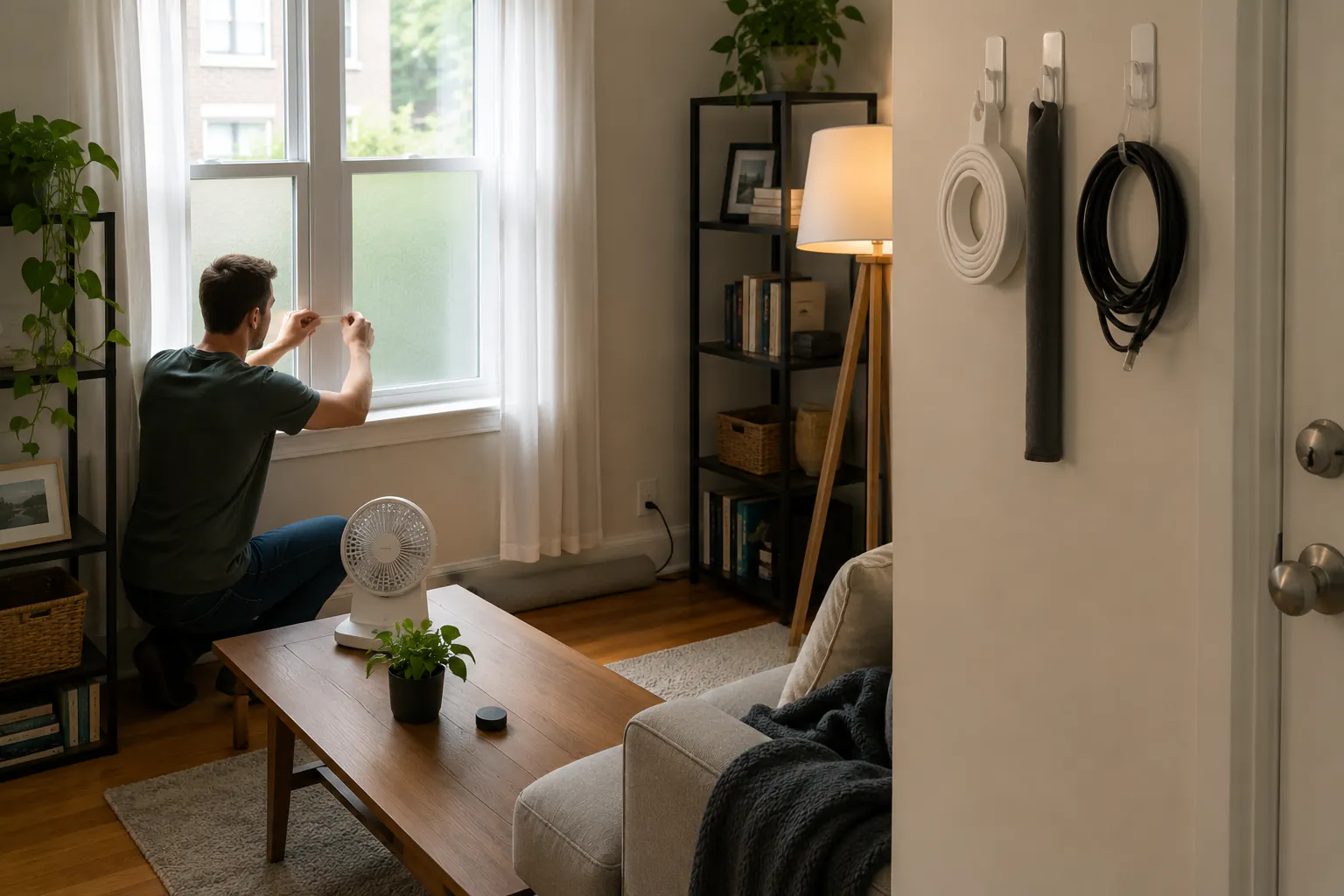
- Temporary window insulation. Interior film kits, removable rope caulk, and heavy curtains cut drafts and can be taken down. See temporary window insulation.
- Draft blockers at door bases and a portable seal on a window air conditioner in the off-season.
Reducing drafts can save 5% to 30% per year, and the renter-friendly subset captures a meaningful part of that. (Source: U.S. Department of Energy, Detecting Air Leaks.) A pre-assembled kit can simplify the job; the weatherproofing kits guide compares options.
3. Behavior beats hardware
The cheapest efficiency is free:
- Follow the household’s safe temperature and equipment plan for thermostat settings. Do not use external timers, smart plugs, or power strips with portable space heaters.
- Manage the sun: close curtains against summer heat, open them for winter solar gain.
- Use ceiling or portable fans to feel cooler without lowering the AC setpoint, and turn them off when you leave the room — fans cool people, not rooms.
- Wash in cold water and run full loads.
4. Lighting and small devices
Swap high-use bulbs for LEDs — you can take them with you or leave the originals in a drawer to reinstall at move-out. When you buy appliances or electronics, choose ENERGY STAR–certified models that also draw less in standby. (Source: ENERGY STAR, product information.)
5. Your appliances, measured
If you own your refrigerator, microwave, or window AC, measure them with a plug-in watt meter. A cheap old second fridge or a power-hungry window unit may cost more than it is worth, and the meter tells you whether replacing your own appliance pays back before your lease ends.
Apartment-specific opportunities
Renting an apartment adds constraints but also a few advantages worth using:
- Shared walls reduce your exposure. Interior units lose less heat than a detached house because neighbors on either side buffer temperature. Your highest-value sealing targets are the surfaces that face outside — exterior windows, the entry door, and any wall or window facing an unheated hallway or the outdoors.
- Window air conditioners are often the biggest single load. If you supply your own window unit, its efficiency and seal matter more than almost anything else in summer. Insulate the gaps around it, remove or cover it in the off-season, and measure it so you know its true cost.
- Electric baseboard or plug-in heat is expensive. If your unit heats with electric resistance, the efficiency math changes: every degree costs more. Prioritize draft sealing and zoned heating of only the rooms you occupy.
- Controllable lighting and plug loads travel. LEDs, smart plugs, and power strips are the measures you keep when you move, so they pay back across multiple leases rather than one.
Ask about incentives before you buy
Before purchasing efficiency hardware, check what someone else will pay for. Many utilities offer free or subsidized home energy assessments, discounted LEDs, smart-thermostat rebates, and sometimes free weatherization kits — and these are frequently available to renters, not just owners. Your utility’s website or a call to customer service is the fastest way to find out. Some state and local programs also help with efficiency for income-qualified renters. Taking a free assessment first means you spend your own money only on the measures that actually apply to your unit.
What belongs to the landlord
Draw a clear line. These are not renter DIY projects — report them in writing:
- Failing or single-pane windows that leak badly
- Heating or cooling systems that do not work or run constantly
- Insulation deficiencies in the building envelope
- Any electrical hazard — warm outlets, scorched plugs, tripping breakers
You are responsible for how you use the space; the landlord is responsible for the building’s systems and safety. A written request creates a record and is the right escalation path, not a screwdriver.
Efficiency doubles as outage readiness
Renters often have fewer backup options — no room for a large generator, limited balcony access, shared walls. That makes efficiency even more valuable during an outage, because a small apartment power station has a tight budget of watt-hours. Every standby load you already switch off and every draft you already seal means that limited backup lasts longer. When the power drops, apply how to reduce your electricity load during an outage — for a renter running on a small battery, that discipline is the difference between a comfortable night and a dead pack by morning.
Leave no value behind at move-out
Keep any approved original parts and follow the product’s removal instructions at move-out. Removable does not guarantee a mark-free finish or deposit protection. Check what belongs to the property, what you may take, and whether removal needs management or qualified help.
Return to the home energy efficiency hub for the complete picture, and treat these reversible measures as both a lower bill now and a longer runtime when you need it.
Sources reviewed
- U.S. Department of Energy, Energy Saver: Do-It-Yourself Home Energy Assessments; Detecting Air Leaks; standby-power guidance
- ENERGY STAR: product information
Sources reviewed July 14, 2026.