
Find your HVAC manual or installation invoice and save the service contact. Your first question is simple: “What surge protection, if any, serves this equipment, and who checks it?” Ask your HVAC contractor and a licensed electrician before buying a device. You do not need to map the wiring yourself.
Ready.gov recommends unplugging appliances, equipment, and electronics where safely possible during an outage and using surge-protection devices. That is a sound preparedness direction, but a central air conditioner, heat pump, furnace control, boiler, mini-split, or shared-building system cannot be treated like a phone charger. (Source: Ready.gov, Power Outage Hazard Information Sheet.)
Use this guide to prepare that conversation, not to open a panel or install a device. If equipment already shows an abnormal condition, deal with that through the utility, building contact or qualified service first; a shopping list is not a repair plan.
It is one branch of the HVAC and climate-control hub. Equipment selection, normal maintenance, post-outage restart, and backup power remain separate decisions.
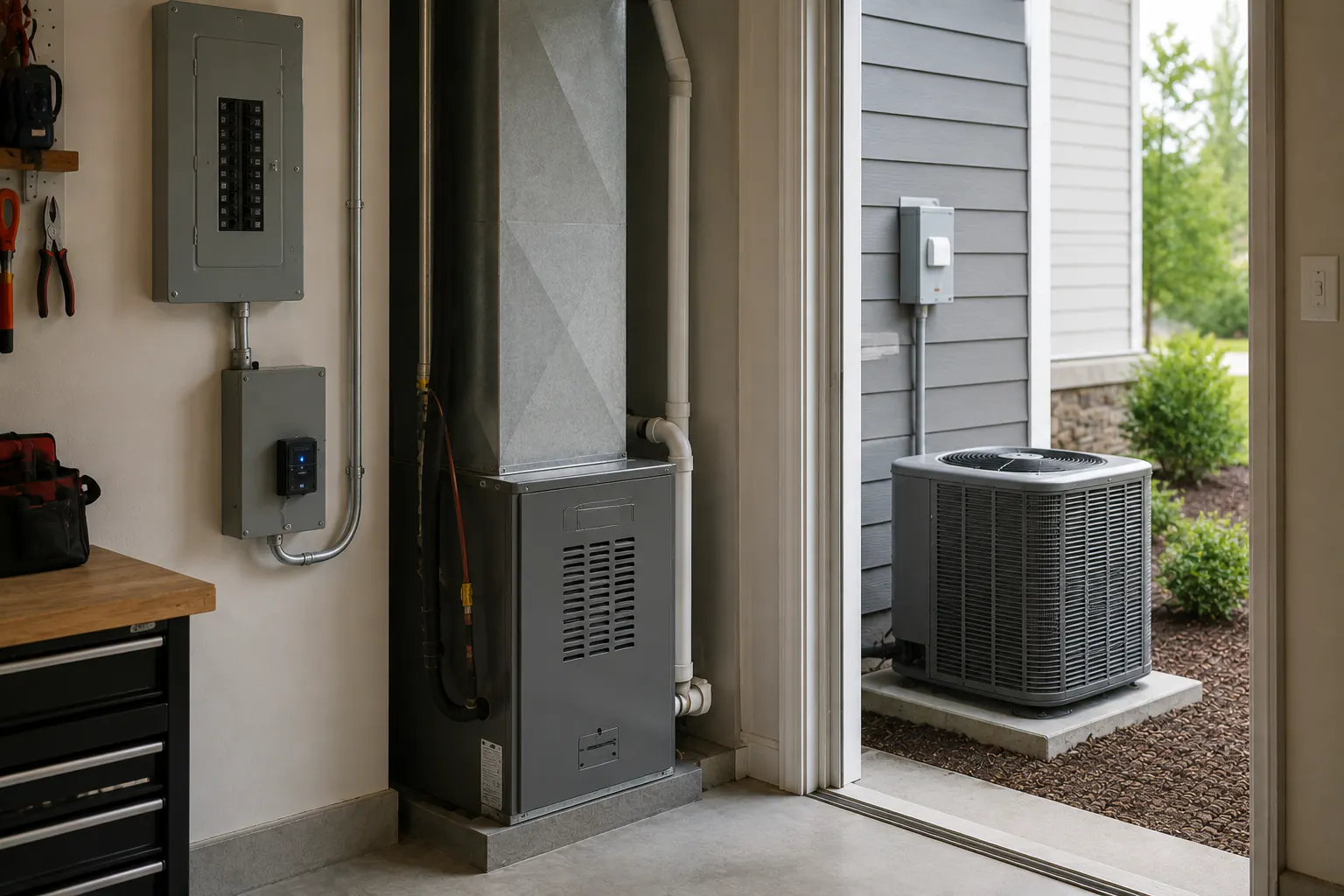
Understand what a surge is and is not
A surge is a brief voltage increase. Surges can arrive from outside the home or result from switching loads within the electrical system. NIST explains that protection can exist at plug-in equipment, the service entrance, or near the utility meter, with different responsibilities and limitations. (Source: National Institute of Standards and Technology, Surges Happen!.)
Surge protection does not guarantee protection from:
- every lightning event or direct strike;
- long-duration overvoltage or undervoltage;
- lost neutral, damaged service, flooding, fire, or bad wiring;
- outage, brownout, frequency, waveform, or generator problems;
- incorrect equipment installation or refrigerant charge;
- a device that has reached end of life or lost protective function;
- communication, coaxial, antenna, or data paths left outside the protection plan.
Do not use “surge” as a diagnosis for every post-outage HVAC fault. A qualified technician and electrician must determine what failed.
Start with the records you already have
Write down the equipment model, service contact and any existing protection listed in your manual or invoice. Leave unknowns blank. Ask the installer to explain the rest; missing records should not delay a fault report or a request for help.
These details may be useful when the contractor prepares a proposal. Use existing documents or information safely visible from an ordinary position, without opening or approaching unsafe equipment:
- indoor and outdoor HVAC equipment;
- thermostat, zone controls, condensate pump, humidifier, dehumidifier, and accessories;
- hardwired versus plug-connected components;
- service voltage and dedicated-circuit requirements from the equipment documents;
- panel, subpanel, disconnect, generator, transfer, solar, battery, and load-control relationships;
- communication, internet, and low-voltage control dependencies;
- existing surge-protective devices and who installed them;
- any status indicator or maintenance instruction;
- warranty or manufacturer requirements.
Do not infer wiring from a breaker label. Do not remove a cover, trace conductors, touch a disconnect, or operate a protection device merely to complete the map.
Ask about layered protection
NIST’s consumer guide describes service-entrance and point-of-use approaches as layers rather than substitutes. Ask the licensed electrician how protection at the service, distribution panel, and equipment interacts in this specific installation.
Start with three questions: what equipment receives protection, what remains unprotected, and who handles a fault or replacement. When you have a proposal, use these questions to understand its details:
- What surge environments is each proposed device designed to address?
- Where will the device be connected, and what code and manufacturer rules apply?
- How do conductor length, grounding, bonding, panel condition, and installation affect performance?
- Does the HVAC manufacturer require, permit, or restrict a particular protective approach?
- What protects thermostat, communication, condensate, and accessory circuits?
- What does not receive protection under the proposal?
- How is device status checked without opening equipment?
- What event or indicator requires inspection or replacement?
- How do generator, transfer, solar, battery, and utility configurations change the plan?
- Who documents and warrants the installation?
A device label alone does not answer those system questions.
An ordinary plug does not make a power strip suitable
Some room equipment or controls may use an ordinary plug, but that does not make every power strip or point-of-use surge protector suitable. Check the exact appliance instructions, current draw, plug, receptacle, circuit, grounding, and any prohibition on intermediary devices.
The U.S. Fire Administration advises plugging major appliances directly into a wall outlet and never using an extension cord with a major appliance. It also advises against overloaded power strips and damaged cords. (Source: U.S. Fire Administration, Appliance and Electrical Fire Safety.)
Do not:
- place a window or portable air conditioner on an extension cord or generic power strip;
- use an adapter to defeat the grounding connection;
- hide a cord or protector under furniture, carpet, or insulation;
- connect a hardwired system through a plug-in device;
- use a device whose rating, status, or listing is uncertain;
- daisy-chain protectors, UPS units, power strips, or cords;
- treat a lit indicator as proof that the outlet or grounding is safe.
Use the extension-cord outage guide and overloaded-circuit warning guide for household electrical boundaries.
Include grounding and service condition
Surge-protective devices work as part of an electrical system. Ask the electrician to evaluate service equipment, grounding and bonding, panel condition, available spaces, overcurrent protection, conductor routing, and local code before recommending a device.
Stop and seek utility or electrical help for:
- flickering across multiple circuits;
- unusually bright and dim lights;
- burning odor, heat, buzzing, arcing, or discoloration;
- loose or damaged service, meter, panel, receptacle, or disconnect;
- repeated trips;
- water or flood exposure;
- a fallen line, tree impact, lightning damage, or structural event.
Surge protection cannot repair an unsafe service. Do not approach damaged equipment, standing water or a fallen line to investigate, photograph it or switch power off. An active emergency takes priority over arranging routine service; follow the emergency instructions for the situation rather than collecting these records first.
Plan for lightning and severe weather
No household action makes it safe to touch equipment during lightning, flooding, or an active electrical event. Before forecast severe weather:
- confirm official alerts and outage contacts;
- save HVAC manuals and service numbers offline;
- use only manufacturer-approved normal shutdown instructions when there is time and no hazard;
- set a heat, cold, smoke, medical, pet, and relocation plan that assumes HVAC may be unavailable;
- arrange any permitted exterior clearing in advance, within the exact equipment instructions and property permission; leave uncertain access or work to the responsible professional;
- protect records and document the pre-event condition.
Do not go outside to operate a disconnect during lightning or flood conditions. Do not climb to inspect equipment. Move people to safety and follow their care plans before gathering notes or photographs; unfinished preparation must not delay leaving.
Document status and end of life
A protective device can fail, disconnect its load, or lose protective capability. NIST notes that status indications vary and must be interpreted through the device instructions. Ask the installer to provide:
- exact manufacturer and model;
- installation location and protected equipment;
- installation date, permit, and responsible contractor;
- status-indicator meaning;
- inspection and replacement criteria;
- action after lightning, utility event, or device fault;
- warranty and claim documentation requirements;
- safe method for confirming status.
Do not reset or replace a hardwired device yourself. Do not continue operating HVAC when the device, disconnect, panel, or equipment shows an abnormal condition.
Coordinate outage restart
Surge protection is only one part of restoration. Use the HVAC restart checklist to confirm the required utility, building and qualified-service authorization, retrieve the manual, and use only documented normal controls. A stop condition already visible from a safe position is a reason to seek help, not an invitation to approach or inspect the equipment.
Ask in advance whether the HVAC system:
- has an intentional restart delay;
- retains or loses thermostat settings;
- requires inspection after a major event;
- can restart automatically;
- interacts with generator or load management;
- has surge protection that may disconnect power after failure;
- needs a qualified restart after flooding, fire, lightning, or extended outage.
Never bypass a delay, protector, fault, or disconnect to restore comfort faster.
Renter and multifamily plan
Renters usually cannot alter the service, panel, hardwired HVAC, or common equipment. Ask management:
- what protection serves the building and in-unit system;
- which plug-in equipment belongs to the tenant;
- how to report a failed receptacle, protector, thermostat, or HVAC system;
- whether window or portable cooling equipment is permitted and on what circuit;
- what the building restart process is after an outage;
- where residents should go if indoor temperature becomes unsafe.
Keep a short record of requests, without sending a full medical history in a maintenance report. Confirm that a relocation destination is available and suitable, including any needed assistance or transport. Care and departure come before documenting a dispute. Local law and the lease control responsibility; this guide does not set a universal landlord deadline.
Compare what each proposal includes
For each proposal, record protected equipment, device location, applicable ratings and standards, installation method, grounding evaluation, communication paths, generator/solar interaction, status method, replacement plan, warranty, permit, labor, and exclusions.
Do not choose on the largest printed number alone. Ask the qualified installer to explain why the proposal fits your equipment and building, which limits remain, and how the work meets the applicable utility, manufacturer and code requirements. Keep that explanation with your manual and service contact so the next fault or replacement has a clear owner.
Sources reviewed
ReadyLience reviewed current outage and electrical-fire guidance from Ready.gov and the U.S. Fire Administration, current CPSC extension-cord information, ENERGY STAR HVAC installation guidance, and NIST residential surge guidance on July 14, 2026. The NIST consumer publication explains enduring principles but dates from 2001; current code, standards, equipment instructions, utility practice, and qualified design control every installation.