
Pick the room where cooling would help most: often a bedroom overnight or a living room during the hottest hours. Start with its floor dimensions and, if you rent, the property manager’s installation rules. Those two details are more useful than choosing the largest BTU number on a box.
If dangerous heat is already affecting someone, arrange help or a suitable cooling location first. Shopping and sizing can wait; an unverified new unit is not an emergency care plan.
Oversizing is not resilience. ENERGY STAR warns that a unit that is too large may cool the room before removing enough humidity, leaving the space cool but damp. Undersizing can mean continuous operation without reaching a useful condition. (Source: ENERGY STAR, Room Air Conditioners.)
This guide builds a requirements sheet. It does not rank products or authorize installation.
Use the HVAC and climate-control hub when the project extends beyond one room into central equipment, mini-splits, maintenance, smoke filtration, or outage recovery.
Define one cooling zone
Room AC sizing starts with the actual area being cooled, not the whole apartment unless air can reliably move through that layout. Pick the occupied zone:
- one bedroom used overnight;
- a living room used by the household during the hottest hours;
- a home office with significant equipment heat;
- a room selected for a medically vulnerable occupant under a clinician plan.
Measure the floor area in feet. For a rectangle, multiply length by width. Break irregular rooms into simple rectangles and triangles, then add them. Record ceiling height because many published sizing tables assume an eight-foot ceiling.
Do not count a hallway, kitchen, open stair, or adjacent room as cooled merely because the door is open. Airflow, solar gain, occupancy, and layout can make a nominally connected area behave like several zones.
Use the capacity table as a starting point
ENERGY STAR publishes a room-area-to-capacity table for window room air conditioners, beginning at 5,000 BTU per hour for 100 to 150 square feet and increasing with area. It also instructs consumers to adjust for conditions such as high ceilings, sun, shade, occupancy, and kitchen heat. (Source: ENERGY STAR, Room Air Conditioners.)
Record the baseline capacity from the current official table, then list every reason the room differs:
| Condition | Planning question |
|---|---|
| High ceiling | Does the manufacturer or qualified seller provide an adjustment for room volume? |
| Strong afternoon sun | Can exterior shade or another room reduce the load first? |
| Deep shade | Does the official method call for a lower adjustment? |
| More than two regular occupants | Does the current ENERGY STAR method add capacity per additional person? |
| Kitchen or heat-producing equipment | Can the source be reduced, or does the official method require more capacity? |
| Open plan or doorway | Is one room unit still an appropriate strategy? |
| Poor envelope | Would air sealing or shading solve part of the load before equipment purchase? |
Do not invent a correction factor. Use the current official sizing method and the product’s rated cooling capacity, then seek qualified sizing when the room is unusual.
Compare window, through-wall, and portable constraints
These categories are not interchangeable.
Window room air conditioner
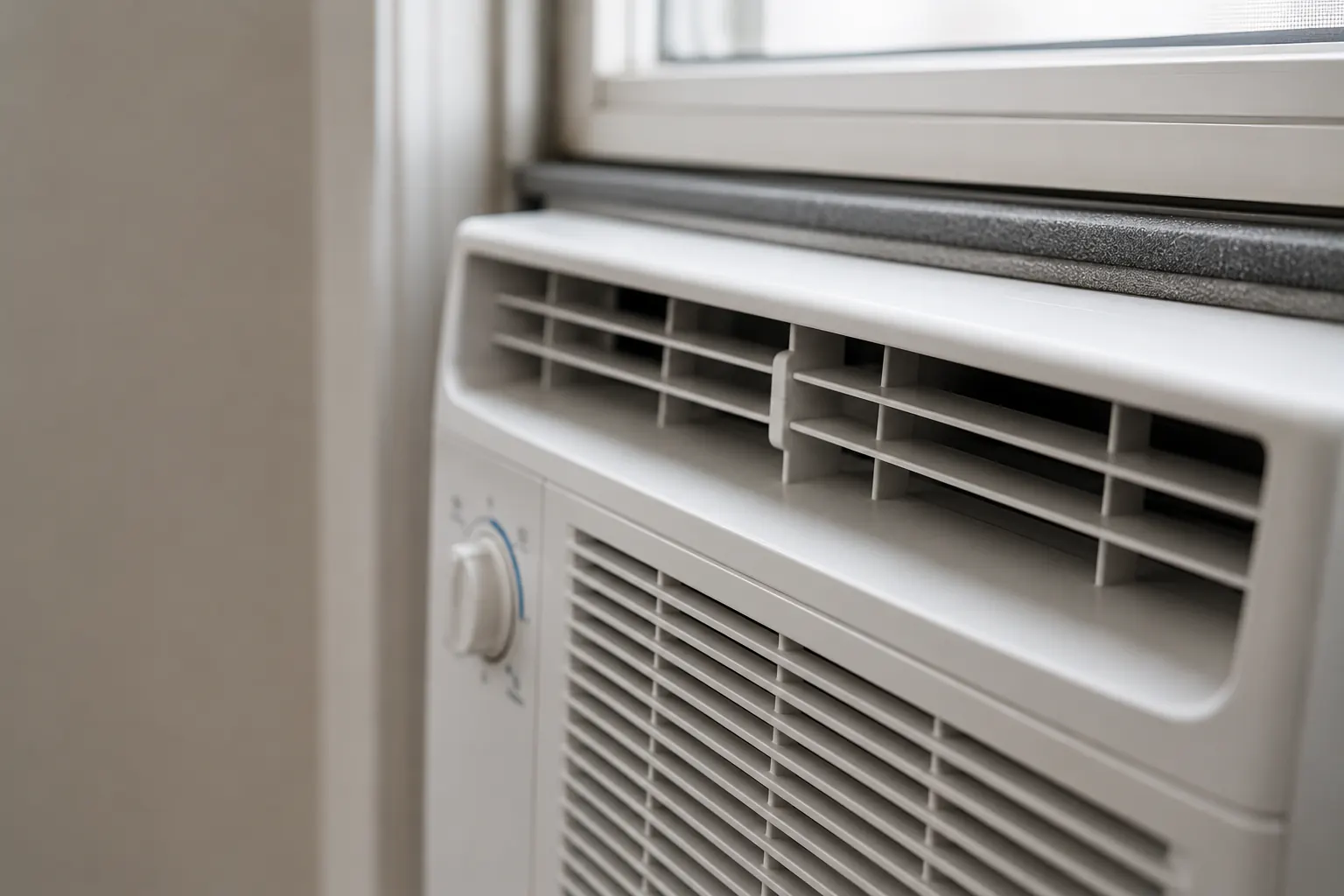
A window unit rejects heat outdoors directly and is covered by ENERGY STAR room-air-conditioner sizing resources. The window, sash, support, drainage, egress, exterior rules, storm exposure, and landlord permission all matter. A unit must not create a fall hazard or block the only required escape opening.
Through-wall room air conditioner
A through-wall unit needs the correct sleeve and a wall opening designed for the equipment. Do not place a window unit into a wall unless the manufacturer explicitly approves that configuration. Structural, weatherproofing, drainage, electrical, and permit questions belong with the property authority and qualified installer.
Portable air conditioner
A portable unit remains indoors and rejects heat through a hose. Its real job includes managing hose routing, window insert, condensate, floor space, noise, and heat leakage. Do not compare a portable unit’s marketing capacity with a window unit without using the applicable DOE rating and test context. Keep the exhaust path exactly as the manufacturer specifies; never vent into an attic, crawlspace, shared corridor, or another occupied room.
DOE’s home-cooling resources distinguish room and portable approaches, but a category label alone does not predict comfort in a particular room. (Source: U.S. Department of Energy, Energy Saver 101: Home Cooling.)
Audit the electrical path before purchase
Use the product’s manual or published nameplate information for voltage, current, plug, receptacle, circuit, and any dedicated-circuit condition. Do not lift or move an installed unit to read a hidden label. Have the property authority or licensed electrician confirm the existing supply. A receptacle that physically accepts a plug does not prove the circuit, wiring, grounding, protection, or shared load is suitable.
Do not:
- use an extension cord, adapter, travel converter, modified plug, or improvised power strip;
- force a grounded plug into an incompatible receptacle;
- share a circuit merely because other devices appear small;
- alter a receptacle, breaker, panel, or wiring;
- connect a major cooling load to a portable battery or generator based only on running watts.
The U.S. Fire Administration advises plugging major appliances directly into a wall outlet and never using an extension cord with a major appliance. (Source: U.S. Fire Administration, Appliance and Electrical Fire Safety.)
Use the overloaded-circuit warning guide for heat, odor, discoloration, loose plugs, dimming, buzzing, or repeated trips. Those are stop conditions, not reasons to try another outlet.
Include humidity and drainage
Cooling is also moisture removal. ENERGY STAR notes that an oversized unit can cycle off before dehumidifying effectively. Its room AC guidance says the unit should be level as directed so drainage works correctly. (Source: ENERGY STAR, Room Air Conditioners.)
Before purchase, identify:
- how condensate is handled in the selected operating mode;
- whether a container, drain, pump, or automatic evaporation is involved;
- what full-pan or drain fault indication looks like;
- whether drainage could reach flooring, a wall cavity, a facade, another unit, or a walkway;
- who is responsible for installation and water damage under the lease.
Do not drill, tilt, modify, or add a drain contrary to the manual. Stop use and seek the appropriate service help for leaking water, damaged housing, ice, mold-like growth, or unknown residue. Do not approach wet or hazardous electrical equipment to unplug it or take a picture; protecting people comes before troubleshooting.
Check whether it fits daily life
Capacity does not tell you whether people can live with the unit. Compare:
- sound at the speed you expect to use overnight;
- light from the display and whether it can be controlled normally;
- control accessibility for a person with limited reach or vision;
- filter access without lifting the unit or entering a hazard;
- clear walking and exit paths;
- window security and weather closure when the unit is not in use;
- weight, seasonal storage, and safe removal responsibility;
- replacement filters and service availability.
Do not claim a decibel specification represents your bedroom unless the test conditions and operating mode match.
Plan the outage role realistically
A room air conditioner can be a substantial backup-power load. Use the exact equipment’s documented running and startup requirements rather than assuming another appliance or medical device uses less. Compressor startup and cycling complicate battery and inverter planning. Use the backup power for cooling guide and home load worksheet, but treat existing measured and nameplate data as inputs rather than authorization to connect. Do not interrupt essential equipment or provoke a startup test to fill the worksheet.
If the power is out during dangerous heat, follow the extreme-heat outage plan. Set a relocation trigger and identify cooling locations before depending on a runtime estimate. Ready.gov advises finding an air-conditioned place when home cooling is unavailable and recognizing heat illness rather than relying on a fan as the primary cooling device. (Source: Ready.gov, Extreme Heat.)
Build the comparison sheet
Use these fields to compare candidates. Mark an unknown as a question for the manufacturer, property manager, installer, or electrician, not a number to guess:
- selected room and usable area;
- ceiling height and official capacity adjustment;
- unit category and installation location;
- permitted window or wall configuration;
- voltage, current, plug, circuit, and electrician confirmation if needed;
- current official efficiency metric and certification status;
- condensate method;
- filter type and replacement access;
- sound data and test condition;
- weight and support method;
- egress, security, weather, and landlord constraints;
- warranty, service, parts, and current recall check;
- expected outage role and a separate relocation plan.
Your next step can be small: write down the room dimensions and ask who can approve the installation and electrical supply. Keep your separate cooling destination and transport plan confirmed while those questions are being resolved.
Sources reviewed
ReadyLience reviewed current room-air-conditioner, home-cooling, electrical-fire, and extreme-heat guidance from ENERGY STAR, the U.S. Department of Energy, the U.S. Fire Administration, and Ready.gov on July 14, 2026. Current product instructions, property permission, local code, window and structural conditions, electrical evaluation, recalls, and public-health guidance control the real installation and use.