
The return of electricity is a transition, not a certificate that the household is back to normal. Food may still need a decision, devices may restart in an unexpected state, and storm, water, heat, access, or communication problems may remain. A short reset prevents the next outage from starting with depleted batteries, missing information, and an unrecorded failure.
If power is still out, begin with What to Do When the Power Goes Out. Return here only once immediate hazards and the stay-or-leave decision are settled.
The Backup Power Systems hub owns the broader power plan; this page only coordinates the household recovery around it.
This checklist coordinates the home. It does not authorize electrical work. For equipment stop conditions and staged load restoration, use how to restart household loads safely.
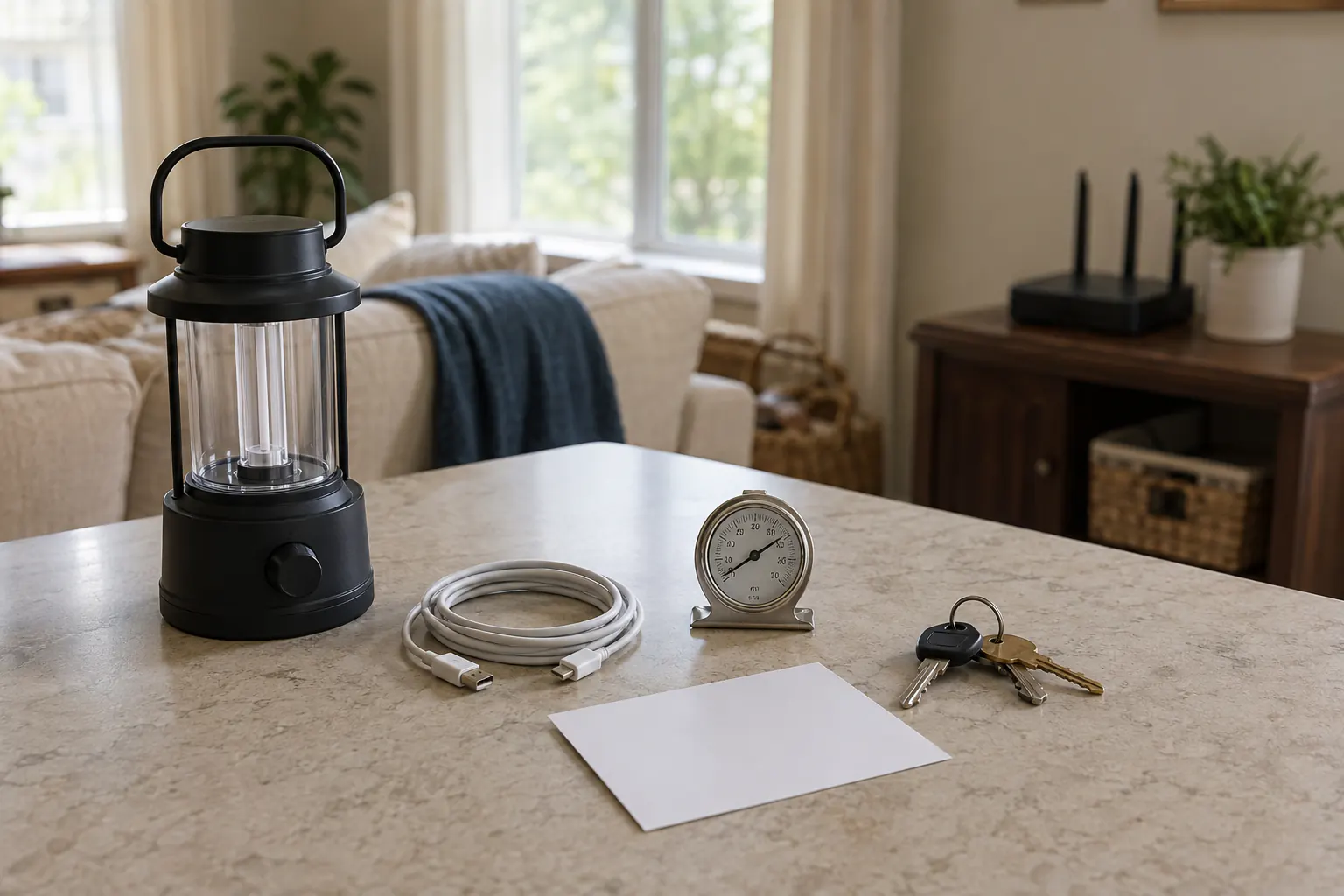
Start with hazards, not convenience
Before reconnecting or charging everything, look and listen from a safe position. Stop and call for help for fire, smoke, gas odor, a carbon-monoxide alarm, active arcing, shock, floodwater near equipment, damaged service equipment, or a building that may be unsafe. Do not enter a wet basement, utility room, mechanical room, garage, or other area with water and electrical or fuel equipment.
If lights are unusually bright or dim, equipment cycles repeatedly, or several rooms behave abnormally, reduce ordinary loads only through safe normal controls and contact the utility or property authority. Power returning does not make a wet cord, damaged outlet, recalled appliance, or improvised connection safe.
Run the household reset in an order
| Order | Check | Why it comes now |
|---|---|---|
| 1 | People, building, alarms, and immediate hazards | No convenience task outranks an unsafe condition |
| 2 | Food temperatures and recorded outage time | Food decisions are time-sensitive and evidence-led |
| 3 | Care, communication, and access | People may still need support or a reachable contact route |
| 4 | Essential devices and ordinary household loads | Restoration should be controlled, not simultaneous |
| 5 | Recharge and restock the readiness layer | The next interruption should not begin empty |
| 6 | Record damage, losses, and one failed assumption | Recovery information is easiest to lose once routine returns |
The 4-, 12-, and 24-hour continuity route explains why each system has a different decision horizon.
Decide food from records, not relief
Record the outage start and restoration time, refrigerator and freezer temperatures if available, door openings, cooler condition, and any flood or contamination exposure. Then evaluate food item by item using the power-outage food-safety guide. Never taste food to decide whether it is safe.
FoodSafety.gov gives a general planning window of about four hours for an unopened refrigerator, and 24 or 48 hours for a half-full or full freezer with the door closed. Those windows do not override a warmer measured temperature, flood exposure, a product instruction, or the item-specific chart. Photograph spoilage or damage before cleanup when an insurer, assistance program, landlord, or property record may need it.
Clean appliances only after food decisions and after the surrounding electrical area is dry and safe. The electrical restart guide owns the point where an appliance, outlet, panel, cord, or building system should remain isolated.
Rebuild communication and care reserves
Charge the devices that are part of the household plan, but do not leave every battery on indefinitely once normal service is stable. Check that the primary phone, a backup light, radio, and agreed contact method work as expected. Update the family communication plan if a contact, meeting point, building access method, school procedure, or support person changed during the event.
For individually required medical equipment, refrigerated medication, powered mobility, or other care needs, follow the care plan and product instructions. The correct reset may be to contact a clinician, pharmacist, provider, or manufacturer rather than simply recharge a battery. A general household list does not replace that direction.
Restore ordinary loads deliberately
Walk through the home and check normal controls before turning on appliances. Confirm that heat-producing devices are off, chargers are undamaged, clocks and alarms are correct, and automatic equipment has not restarted unexpectedly. Then restore ordinary loads in a paced order. Do not reset breakers, open panels, bypass protection, connect a generator, or investigate shared equipment unless the responsible procedure explicitly applies and conditions are safe.
Use safe household load restoration for the full electrical boundary. That guide deliberately stops at wet, damaged, hardwired, fuel-fired, medical, HVAC, solar, battery, pump, or other specialized systems that need a responsible owner.
If a portable battery or station was used, recharge it according to its manual, inspect its ports and cables, and record how much energy was actually consumed. Compare the observation with the original runtime calculation. The result is not a product test, but it can replace a vague assumption with a household-specific note.
Capture the recovery record while it is fresh
Take photos only where useful and safe. A household inventory should show what was lost, damaged, or needs replacement without broadcasting private records or valuable information. The home inventory and insurance recovery hub helps separate household documentation from a claim, legal, or coverage promise.
Record five facts:
- outage start and restoration estimate versus actual time;
- the first thing that was missing, inaccessible, or dead;
- food, water, access, work, care, or communication decision that created friction;
- equipment that behaved unexpectedly or needs professional review;
- one modest change to make before the next interruption.
Avoid turning every outage into a major shopping project. Replace consumed items, repair actual failure points, and remove clutter that did not serve a clear function.
Restock by the failure, not by the aisle
Before ordering or buying anything, write the specific gap in plain language: “the stair light was upstairs,” “the phone cable did not reach the charging location,” “the freezer temperature was unknown,” or “nobody knew the building after-hours number.” Then choose the smallest correction that resolves that gap. It may be a better location, a printed card, a tested cable, an appliance thermometer, a scheduled battery check, or a conversation with management rather than a new device.
Rotate stored food into ordinary meals where it remains suitable, refill water only in appropriate containers under the existing household plan, and recharge the batteries actually used. Mark an item for replacement only after inspecting it and checking its product instructions. A larger pile of equipment does not correct a plan that nobody can find or operate. The purpose of restocking is to make the next first hour calmer, not to make the outage look like a shopping failure.
Close the loop within a week
Once conditions are normal, review the household plan with the people who used it. Did everyone find the first light? Did the contact plan work without internet? Was the battery reserve protected? Did food decisions rely on records instead of guesses? Could a renter or visitor use exits and access safely?
If the answer is no, choose one correction and schedule a small test. A calm review is how preparedness becomes ordinary household maintenance rather than a collection of equipment waiting for a dramatic event.
Keep the note with the household plan and return to it at the next seasonal check.
Sources reviewed
- Ready.gov power-outage hazard information sheet
- CDC returning-home safety guidance
- FoodSafety.gov food safety during a power outage guidance
Sources reviewed August 3, 2026. Current local instructions, utilities, building management, product manuals, and qualified professionals control the actual recovery.