
Check the current evacuation instruction first. If leaving is required, backup power is not a reason to stay. Before storm conditions arrive, identify the household’s protected care, communication, food, water, and temperature needs and the point at which its plan requires outside help or relocation.
Build the outage plan before the storm. If an evacuation order applies, leave; backup power is not a reason to remain in a surge zone or unsafe structure.
Use the full hurricane plan first
Confirm the evacuation zone, expected hazards, destination, route, and stop-work time in the hurricane preparedness hub. Then use this guide to prioritize the systems that matter if the household is authorized to remain or returns to an extended outage.
The existing power outage preparedness guide covers the general response. Hurricane-specific planning adds flood exposure, longer isolation, cooling, water-system dependencies, debris, and a more complex restoration phase.
Define essential loads by consequence
List every device with running watts, startup surge, hours or duty cycle, and consequence if unavailable.
Critical continuity
Prescribed medical devices, medication refrigeration under an individualized plan, certain mobility equipment, and building systems whose loss creates immediate danger. Confirm approved batteries, adapters, settings, alarm behavior, and relocation thresholds with the care team, device manufacturer, pharmacist, and qualified installer.
Do not use a consumer runtime estimate as the only medical continuity plan.
Essential household loads
Communication, selected lighting, refrigeration, an efficient fan within safe indoor-temperature limits, a sump or drainage pump where applicable, a private-well pump, and limited cooling. These loads can have very different surge and energy requirements.
Deferrable loads
Entertainment, laundry, resistance heating, most electric cooking, whole-home convenience lighting, and other high-demand uses. Removing one large appliance can preserve many hours of communication and task lighting.
Use the backup power guide and power station runtime calculator with measured device data.
Build a three-layer power plan
Layer 1: low-power essentials
Standardize phone cables, charged power banks, a battery radio, headlamps, flashlights, and a room thermometer. Keep paper contacts and instructions because a charged phone does not guarantee network service.
Assign one communication device as the reserve. Use low-power mode, reduce screen use, and send scheduled status messages rather than maintaining continuous calls.
Layer 2: portable battery supply
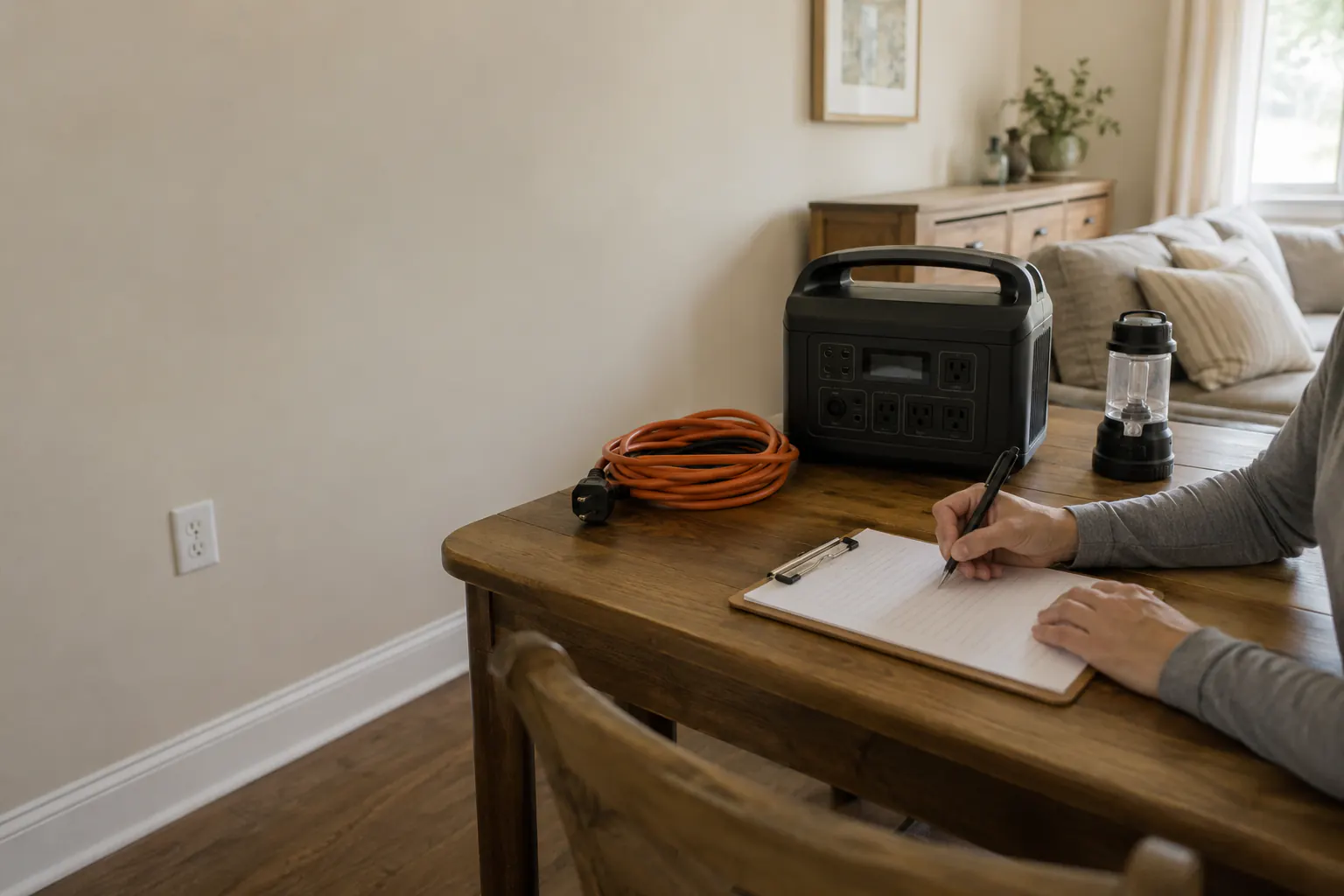
A portable power station can operate indoors if the manufacturer permits and the unit is dry, undamaged, correctly ventilated, and kept within its temperature limits. It stores finite energy; document how it will be recharged.
Check stored watt-hours, usable energy, continuous inverter output, startup surge, port limits, waveform, charging input, and cable ratings separately. Test refrigerators, pumps, fans, and communications before the season.
Do not place a battery in floodwater, direct rain, extreme heat, an exit path, or a closed unventilated container. Stop using a battery that is damaged, recalled, swollen, wet, leaking, unusually hot, or producing odor or smoke.
Layer 3: generator or installed system
A generator can support larger loads but introduces carbon monoxide, fuel, fire, weather, noise, connection, and maintenance hazards. Design placement and wiring before choosing wattage.
Never run a portable generator indoors, in a basement, garage, porch, carport, shed, or near doors, windows, and vents. Follow the generator manufacturer and current CPSC guidance for outdoor distance and weather operation. Keep working battery-backed CO alarms.
Never backfeed through a receptacle or use a double-male cord. Transfer equipment and household wiring require a qualified electrician, permits, and equipment listed for the installation. Read generator carbon monoxide safety before the storm.
Plan fuel without creating another emergency
Use approved containers, legal quantities, and local fire-code storage. Keep fuel out of living areas and away from ignition, heat, drains, flood exposure, and children. Rotate it according to product and equipment requirements.
Calculate runtime under the intended load, not the marketing maximum. Include cool-down before refueling, oil and maintenance intervals, secure transport, and a realistic resupply route. Never refuel hot or running equipment.
If roads are closed, stored fuel is the entire generator horizon. Preserve it for defined loads and keep a non-generator fallback.
Prepare for heat and humidity
An outage after a hurricane can expose people to dangerous heat. Shading, reduced indoor heat, one occupied zone, and early relocation reduce cooling demand.
CDC advises using indoor electric fans only when indoor temperatures are below 90°F; above 90°F, fan use can increase body temperature. A powered fan is not proof of safe cooling. Use the extreme heat outage plan and backup power for cooling guide.
Set a destination and departure trigger for heat, especially for older adults, children, pregnancy, chronic illness, disability, medication concerns, and households without accessible transport.
Account for water and wastewater systems
Municipal water may lose pressure or receive a boil-water or do-not-use advisory. A private well pump will not run without a compatible power system, and flooding can contaminate wells or cisterns. A septic system may depend on pumps, controls, or safe soil conditions.
Store drinking water before the storm using the emergency water storage guide. Follow the water authority and public-health instructions after the storm. Boiling kills germs but does not remove every chemical or toxin.
Do not energize a flooded well, pump, controller, or treatment device. Obtain system-specific inspection and disinfection guidance from the health department, qualified contractor, or other responsible authority.
Reduce wastewater use if the utility or septic professional instructs it. Never enter a septic tank, sewer, flooded crawlspace, or confined utility area.
Protect food and medication
Put thermometers in the refrigerator and freezer. Keep doors closed and record the outage start. Use the power outage food safety guide for time, temperature, ice-crystal, and discard decisions.
Discard food touched by flood or storm water under authoritative guidance. Cans and packages can be contaminated even when the contents look normal. Never taste food to test safety.
Temperature-sensitive medication needs pharmacist, manufacturer, or care-team instructions. Do not place it directly on ice or freeze it unless its approved storage instructions permit that. Record the temperature excursion and obtain replacement advice.
The first 15 minutes after power fails
- Account for everyone and check for injury, heat, and medical-device concerns.
- Confirm whether the outage is local, building-wide, or regional.
- Check official alerts without going outside into unsafe conditions.
- Switch to battery lighting and preserve phone energy.
- Keep refrigerator and freezer doors closed.
- Begin the indoor temperature, outage-time, and device-runtime log.
- Inspect from a safe position for water near electrical equipment, smoke, gas odor, arcing, or structural damage.
- Do not start a generator until the outdoor location and conditions meet the preplanned safe setup.
Call 911 for fire, CO alarm with symptoms or danger, medical emergency, entrapment, or another immediate life threat. Leave a building with gas odor or a sounding CO alarm and contact emergency services from outside.
Floodwater changes the electrical rules
Do not touch a panel, switch, receptacle, cord, appliance, battery, generator, or tool while standing in water. Never turn power on or off yourself in a flooded area. Stay away from downed lines and anything touching them.
Water can remain inside equipment after surfaces look dry. Flooded wiring, service equipment, HVAC, appliances, solar equipment, batteries, transfer systems, and generators require evaluation by the utility, manufacturer, and qualified professionals as applicable.
Do not assume utility restoration makes the building safe to energize. The returning home guide begins with structural, utility, flood, and CO stop rules.
Communication when networks fail
Use two alert paths, such as a phone plus battery radio. Set check-in times with the out-of-area contact so family does not continuously call.
Text a compact status:
- location and people accounted for;
- current shelter or destination;
- power, water, and medical status;
- next intended movement;
- next check-in time.
Do not publicly post an empty home, exact fuel storage, generator location, medication, or travel route. Use the family communication plan for missed-contact escalation.
Set relocation triggers
Leave or seek official help before the household loses the ability to move. Triggers can include:
- an evacuation or post-storm movement instruction;
- structural damage, rising water, fire, gas odor, or unsafe access;
- loss of critical medical continuity;
- dangerous indoor heat or symptoms;
- insufficient safe water or sanitation;
- CO alarm or inability to operate combustion equipment safely;
- battery or fuel reserve reaching the planned departure threshold;
- destination access expected to close.
Owning more equipment does not remove these triggers.
When utility power returns
Check official restoration information and inspect for obvious hazards without touching damaged equipment. If the home flooded or service equipment is damaged, keep power off and wait for qualified clearance.
For an undamaged system under utility and manufacturer guidance:
- Disconnect or shut down portable generation according to the approved procedure.
- Restore loads deliberately rather than starting every appliance at once.
- Watch for arcing, burning odor, abnormal heat, repeated breaker trips, or equipment faults.
- Confirm refrigeration and cooling actually restart.
- Continue CO monitoring and food, water, medication, and indoor-temperature controls.
- Recharge batteries on a dry, stable, manufacturer-approved setup.
Record energy used, failed loads, fuel consumption, recharge time, and decisions. Those measurements should drive future purchases, not an advertised capacity alone.
Sources reviewed
- Ready.gov: Hurricane Hazard Information Sheet
- CDC: Preparing for Hurricanes or Other Tropical Storms
- CDC: Safety Guidelines After a Hurricane or Other Tropical Storm
- CPSC: Carbon Monoxide Information Center
Sources reviewed July 14, 2026.
Coleman’s model 2000033983 information and the exact Amazon 1000-lumen variant were checked October 12, 2026 for ordinary area lighting only. No storm or product test was performed; official departure instructions and the established power plan remain controlling.